Expert on Israel-U.S. relations, world Jewry and The Middle East.
The Long October
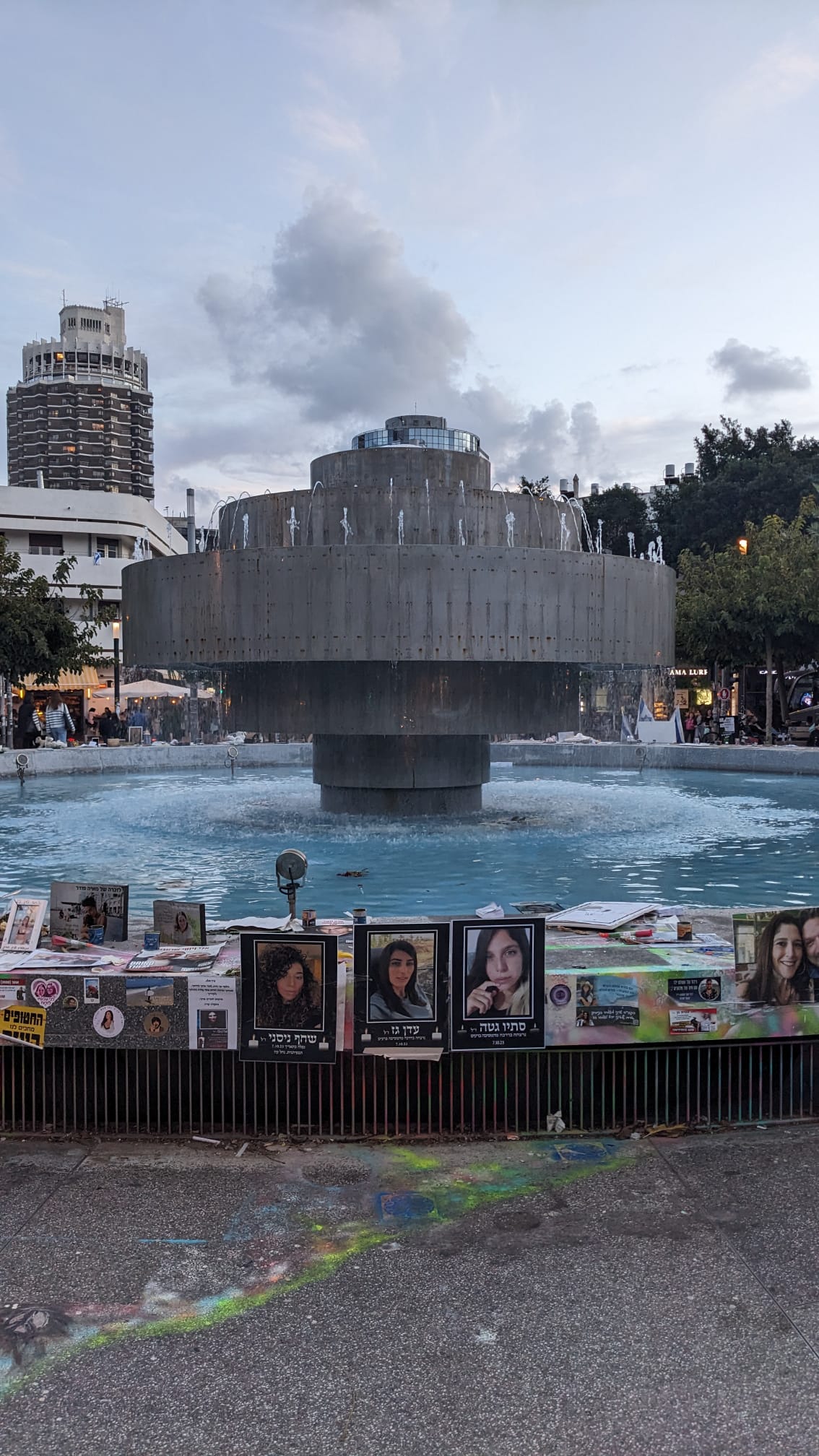
The fountain in Dizengoff Square is adorned with posters and stickers commemorating fallen IDF soldiers.
CAMBRIDGE, Mass, October 7th, 2025 – Yesterday, I couldn’t fall asleep. As I lay in bed, I returned to that night when our world flipped upside down. Then, like now, I was in Boston. 11:29 PM here was the infamous 6:29 AM in Israel. I remembered the frantic messages to friends, the flood of horrifying images that are still burned into my memory, and, for the first time in my life, feeling real existential fear.
This past year, I’ve lived, as Israelis say, “on the line”, spending a month in Israel and a month in the US. People in the US keep asking me, “What’s the situation in Israel?” What they really want to know is: “How do you continue living normal lives with what’s happening in Gaza? How hasn’t time come to a halt?”
But for many Israelis, time has come to a standstill. For the families of hostages who wake up daily to a horror movie of uncertainty, for the bereaved who wake each day to an empty chair, for the growing number of PTSD-stricken soldiers who relive unimaginable events during ordinary moments. But even amid the horror, I’ve heard countless grieving families say: “We didn’t fall apart.” We are exhausted, broken, and shattered, but we didn’t fall apart.
That’s what I tell people about Israel. We’re in a war (one that should have ended long ago), facing terrible losses. A democratic nation (yes, still!) fighting a murderous terrorist organization that has no right to exist. It’s a drawn-out, multi-front war: one brutal initial attack, thousands of missiles interrupting daily life, safe rooms becoming must-haves for every apartment, businesses collapsing or surviving despite endless reserve duty, a collapsed tourism economy, fallen soldiers memorialized in every bus stop and café, hostage posters on every wall.
And still—we haven’t fallen apart.
Tel Aviv is still Tel Aviv. Jerusalem, despite everything, is still Jerusalem. People live. They go to reserve duty, bury friends, curse the government, and still go jogging on the boardwalk and drink beers with friends. Not because they don’t care about the children of Gaza. Not because they have no heart. But because they are human, and humans know how to live, to grieve, to adapt, and to live again.
We are living. In a kind of “Long October,” like in that Counting Crows song, we “laugh a little slower, talk a little lower”. But even in this Long October, “there’s reason to believe, maybe this year will be better than the last”.
I’ve decided to return to the US once more for a new position, to launch a program about Israel in the belly of the beast, at Harvard. Apart from a few admirable Jewish community events, October 7 passed here like any other day. The summer is still fading into fall, the sun was shining, the lawns were green, and people went to class. Life goes on. I walk to work in a buttoned shirt, listening to the live broadcast of Israel’s national memorial service. My new headphones block out Boston’s peace and amplify the stark contrast with Israel’s reality. I feel like a secret agent, appearing to be just another academic, but actually living a double life. My loyalty lies across the ocean. My emotions are stirred by Hebrew speeches from thousands of miles away. And the tears don’t stop.
Why am I here? Maybe for the same reason, we are all where we are. A dear friend once told me, during one of those many times I was unsure where I should be or what I should do: “Where you are, that’s where your mission is.” I’m here because I love Israel, unconditionally. My family, my friends, the people, the idea. I’m here, not there, because life circumstances mean I can fulfill a mission here that I couldn’t elsewhere. I’m here because, as my beloved sister wrote, I fear having hope, but I fear losing it even more. I believe we deserve to live in peace in our homeland. I believe Jews and Israelis deserve to live in safety and thrive anywhere in the world. And I will do whatever I can to ensure both goals are realized.
Back to the memorial. Much has been said about the rift between Israel and Diaspora Jewry. The government and its policies alienate world Jewry. That’s partly true. But just as we criticize how social media polarizes global politics, the same applies to the Israel-Diaspora bond. Unlike decades ago, when the relationship was facilitated mostly through established institutions, Diaspora Jews today experience Israel primarily through Instagram and Twitter, where polarization festers. But those who visit Israel see the difference between cruel algorithms and real life. That’s why an increasing number of young people are moving to Tel Aviv. Because truth and real-life experiences are more powerful than digital hate, which often consists of bots arguing with other bots.
Yes, our current government is the worst in our history. It bears responsibility for the catastrophe. But Israel itself remains. Those who watched the national memorial saw the Israeli people, a nation capable of creating such a powerful, sincere, artistically moving event during a grinding war. These are a people worth fighting to connect with. That’s the message I carry with me here. Because while the government chases money, power, and war, the people long for life and love. And that’s what we will always fight for.
Related Topics
Related Posts