


Writing on Jewish life, relationships, trauma, and resilience
The Meeting Neither Trump Nor Netanyahu Can Afford to Lose
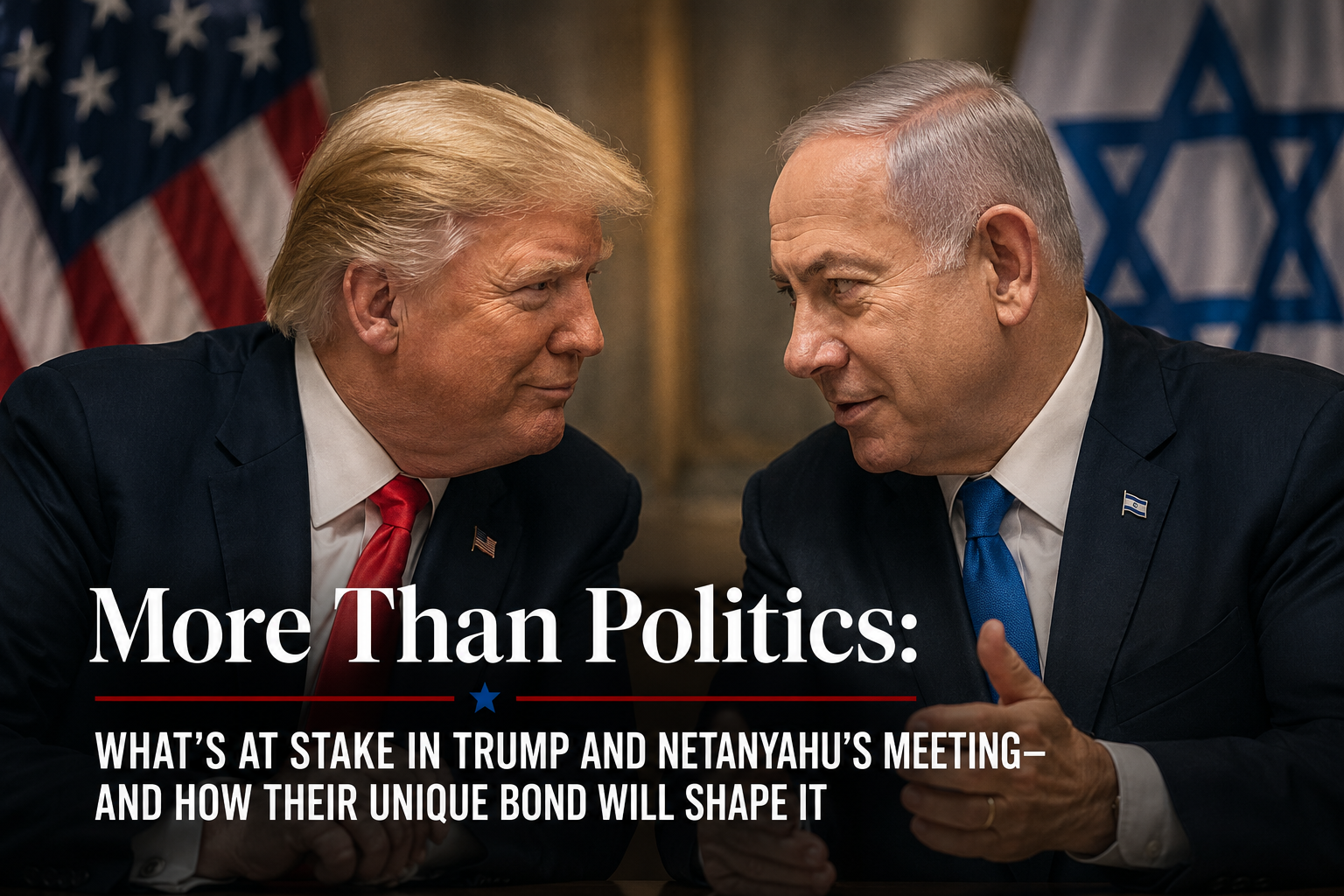
Illustrative. AI image created by the author.
Before Benjamin Netanyahu says a word at the White House tomorrow, Donald Trump will already know the argument. He will know the warnings about Iran, the appeal to Israel’s survival and, almost certainly, the suggestion that only Trump has the strength to finish what others could not.
Netanyahu knows Trump’s argument, too. He knows the president wants the fighting ended, the Strait of Hormuz reopened and an agreement carrying one unmistakable signature: Donald J. Trump’s. He also knows Trump does not want to look as though the prime minister of Israel is setting American policy.
That is what makes tomorrow’s expected meeting so dangerous—and so compelling. Each man needs the other. Each also needs the cameras outside the room to believe he does not.
Netanyahu is approaching an Israeli election while trailing in the polls. He needs to return home with proof that, despite recent tensions, he remains the Israeli leader best able to influence Trump. Trump is heading toward the American midterms after an unpopular war that many Americans believe Israel drew the United States into. He needs to demonstrate that he—not Netanyahu, not Tehran and not events—is in command.
Both men need the meeting. Neither can afford to look as though he needs it more.
The policy disagreement is serious. Trump appears interested in an agreement that ends the fighting and restores movement through the Strait of Hormuz. Netanyahu fears that such an agreement could preserve the Iranian regime, leave its nuclear ambitions unresolved and require Israel to confront the same threat again after a temporary pause. For Netanyahu, the test of any agreement will not be whether it ends this round of fighting, but whether it prevents Iran from using the pause to rebuild the capabilities that made the fighting necessary. The report describes sharp divergence: Washington is searching for an exit while Jerusalem may still see renewed military action as the safer course.
But policy will not be the only language spoken in that room. So will loyalty. So willy grievance. So will history.
Netanyahu is not another foreign leader arriving with a briefing book and a carefully rehearsed appeal. Few people currently advising Trump possess a longer or more consequential political history with him than Netanyahu. Before Trump entered politics, he publicly endorsed Netanyahu’s reelection in 2013, telling Israelis that they already had a great prime minister.
During Trump’s first presidency, the two men built a shared political legacy around recognition of Jerusalem as Israel’s capital, the relocation of the American Embassy, recognition of Israeli sovereignty over the Golan Heights, withdrawal from the Iran nuclear agreement and the Abraham Accords. These were not ceremonial favors. They reshaped American policy and became achievements both leaders claimed as part of their historic record.
Their history also includes rupture. Trump was angered when Netanyahu congratulated Joe Biden after the 2020 election. The estrangement lasted for years before the two men met again at Mar‑a‑Lago in July 2024. Their reconciliation did not erase the grievance. It demonstrated something more important: neither man could easily discard the other.
That is not an ordinary diplomatic relationship. It is an accumulation of shared victories, perceived betrayals, political debts and restored access. Cabinet secretaries arrive with memoranda. Netanyahu arrives with memory.
He knows which arguments appeal to Trump’s sense of strength, loyalty and historic destiny. He understands that Trump does not merely want a successful outcome. He wants an outcome that carries his name in letters large enough to be visible from space.
Netanyahu is therefore unlikely to present his case as a request for another favor for Israel. He will frame it as an opportunity for Trump to protect—or complete—the legacy they created together. A tougher agreement with Iran can be presented as the deal only Trump could secure. Continued pressure can be described as unfinished business. Israeli security can be tied to American strength. Preventing Iran from recovering can be cast not as Netanyahu’s demand, but as Trump’s chance to achieve a victory no previous president could deliver.
Trump, however, knows Netanyahu, too. He knows the Israeli prime minister can turn a handshake into a campaign asset, an ambiguous assurance into a political commitment and a presidential compliment into evidence that no other Israeli leader could manage the relationship with Washington as effectively. Trump will want Netanyahu’s appreciation. He will not want to appear managed by him.
That tension may shape every photograph, every adjective and every sentence delivered after the meeting.
I have spent decades teaching that the argument happening today is rarely only about today. Couples may argue about dishes when they are really arguing about respect. Presidents may argue about Iran while also arguing about loyalty, credit and control. The scale is obviously different. Human nature has not received the memo.
Trump has recently moved between praising Netanyahu and publicly belittling him, reportedly calling him “crazy” and “a very difficult guy.” Netanyahu has largely maintained diplomatic silence, even as his allies have attacked Trump’s policies and advisers. Yet their private dealings remain so opaque that observers cannot always tell whether the two men are fighting or quietly coordinating.
That uncertainty is not incidental. It is the product of history. Long relationships develop shorthand. People who have survived earlier collisions can sometimes speak more bluntly because they know where the exits are—and where the hidden doors back into the room can be found.
Their history could therefore help. Trump may be able to tell Netanyahu directly that America will not continue an open‑ended conflict. Netanyahu may be able to tell Trump that an agreement failing to address Israel’s core security concerns will not endure. Years of accumulated experience could allow them to move beyond diplomatic theater and identify what each actually requires.
But history can also make disagreement more dangerous. Expectations are higher. Old grievances are easier to reactivate. A dispute over strategy can quickly become a test of gratitude. A disagreement over timing can become a struggle for control. Once policy becomes personal, compromise begins to look like surrender.
The most important outcome tomorrow may not be a dramatic announcement. It may be whether Trump and Netanyahu can establish boundaries around their disagreement.
What must Iran do?
What happens if it refuses?
What role will Israel have in negotiations affecting its security?
And under what circumstances would military action resume?
The language after the meeting may reveal as much as any formal statement. Does Trump speak about what “we” decided—or what “I” instructed? Does Netanyahu endorse an American agreement—or merely praise Trump’s leadership? Is Israel described as a partner in the next phase, or as a country expected to remain on the sidelines? Small words can expose large fractures.
Tomorrow is not diplomatic speed dating. These men know one another’s ambitions, vulnerabilities and tells. They have celebrated together, fought bitterly and repeatedly rediscovered their usefulness to one another. The decisive question is not whether Trump and Netanyahu disagree. They have disagreed before.
It is whether two men who know each other so well can keep a dispute over policy from becoming a verdict on loyalty. The future of the Iran conflict may depend on whether their history enters the room as a map—or as a weapon.
About the Author
Seth Eisenberg is President and CEO of PAIRS Foundation and has spent his career at the intersection of Jewish life and relationship education. He has worked extensively throughout the Jewish community and with individuals, couples, and families to strengthen the emotional skills that sustain connection across difference and adversity. He writes about emotional literacy, trauma, resilience, parenting, and what it means to raise the next generation grounded in worth rather than wound — and, at times, about how those same dynamics of trust, broken agreements, and accountability play out between nations.
Related Topics
Related Posts


Seth Eisenberg