
The Making of ‘Cohen al-Jolani’
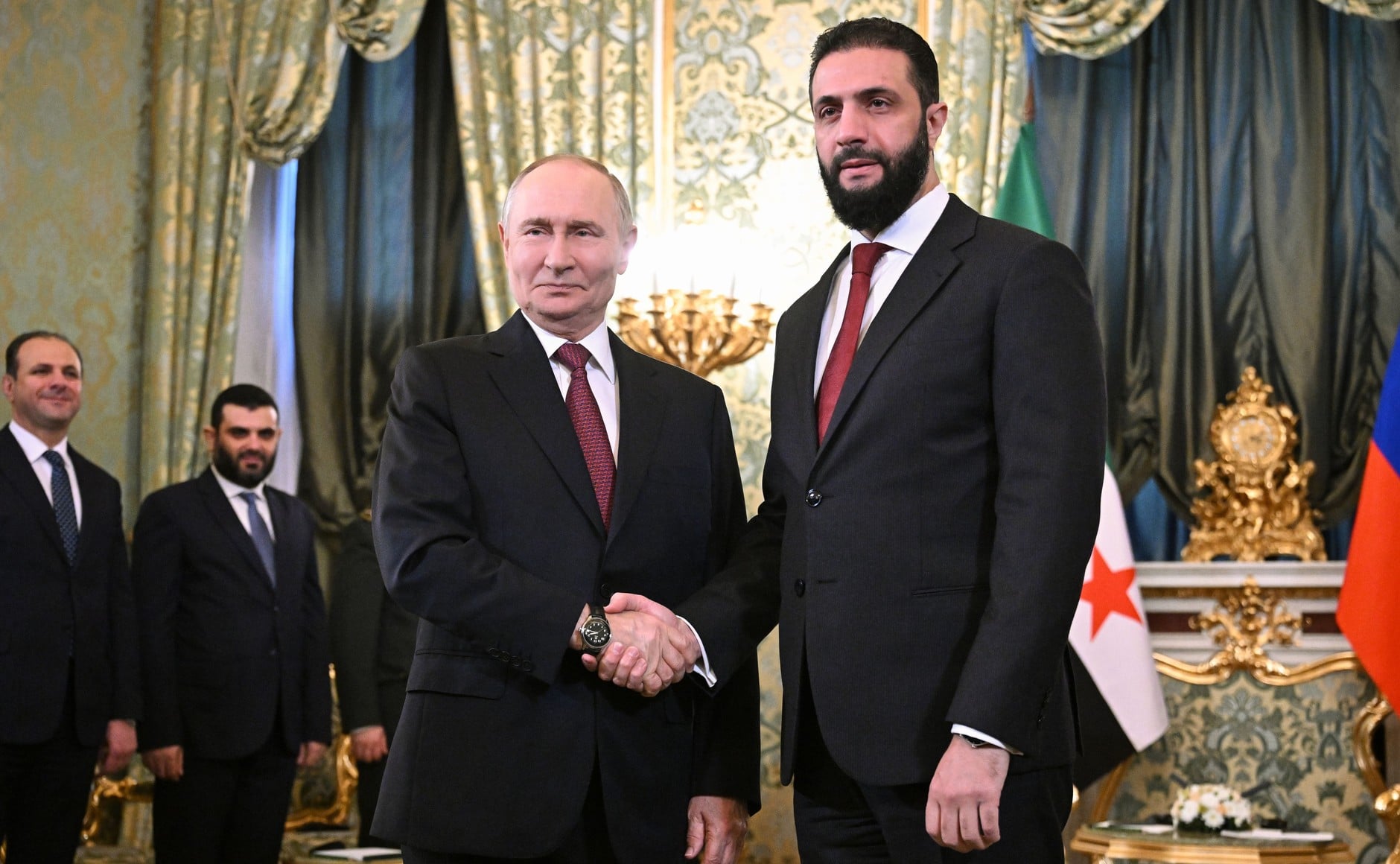
Russian President Vladimir Putin meets Ahmed al-Sharaa (Abu Mohammed al-Jolani), October 15, 2025. Photo: Kremlin.ru (CC BY 4.0)
How Antisemitism Became an All-Purpose Political Explanation
On a winter morning in December 2024, an Arabic-language news account affiliated with Russian information networks posted a photograph of Abu Mohammed al-Jolani, the leader of Hayat Tahrir al-Sham (HTS). The image itself was unremarkable: Jolani stood overlooking a hazy cityscape, dressed in an olive tactical shirt. But the post included a second image—an extreme digital zoom into the stitching on the back of his shirt. The caption claimed that “Middle Eastern activists” had uncovered “Hebrew writing” on Jolani’s clothing, proof that he was wearing Israeli military gear.
The letters in question were not Hebrew. They formed the logo of EmersonGear, a Chinese manufacturer of tactical apparel. But the claim spread rapidly anyway. Within hours, thousands of users across X (formerly Twitter), Telegram, and other platforms were sharing the image as evidence that Jolani was not who he claimed to be. The stitching became a symbol. The accusation acquired momentum.
By nightfall, the rumor had hardened into a narrative: Jolani’s shirt was Israeli surplus; the stitching was Mossad branding; the outfit had been “issued” to him by handlers. No documentation was offered. None was required. The insinuation did the work on its own.
This episode was not an isolated case of online misinformation. It was part of a larger and increasingly durable storyline that circulated throughout 2024 and 2025 across Syrian, Lebanese, Iraqi, and pan-Arab digital spaces: that Abu Mohammed al-Jolani was not a Syrian Islamist leader at all, but a Jewish agent whose “real name” was something like “Yonatan Zvi-David” or “Masad Mooli Yonatan David.” The details shifted. The structure did not. Jolani was “Cohen al-Jolani.”
The accusation did not function as biographical speculation. It functioned as a political explanation.
Over the course of this investigation, more than 300 Arabic-language posts, images, and videos were reviewed across X, Telegram channels, and public social feeds, archived between January 2024 and November 2025. What emerges from this material is not merely a rumor campaign against one Syrian figure, but a revealing case study in how antisemitism operates today in Arabic political discourse: not as episodic rage provoked by events, but as a ready-made interpretive framework, activated whenever political reality becomes difficult to explain.
From Rumor to Ideological Scaffolding
A parallel strand of the “Cohen al-Jolani” narrative developed in Egypt, where conspiratorial commentary elevated the claim into a sweeping historical thesis. In December 2024, Egyptian columnist Safwat Omran published an article alleging that Jolani was the latest product of a long-running Israeli infiltration program. Drawing a direct comparison to the famous 1965 exposure of Israeli spy Eli Cohen—known in Arab political mythology as Kamel Amin Thaabet—Omran argued that while Israel failed to rule Damascus through Cohen in the 1960s, it had succeeded in 2024 through Jolani.
The article alleged that Jolani’s “real name” was “Mossad Muli Yonatan David,” that he was groomed under an Israeli intelligence project called “Ulysses,” and that he studied Islamic jurisprudence at a fictitious “Tel Aviv Islamic University.” None of these claims withstands even minimal scrutiny. Yet their function was not documentary accuracy. They provided ideological scaffolding: a totalizing explanation for political instability, religious authority, and power shifts, all attributed to a familiar external agent.
In this framing, Jolani’s actions no longer needed to be debated. His governance, ideology, or military decisions were irrelevant. Jewishness itself supplied the motive.
Visual Proof Without Evidence
Online, the narrative spread through visual shortcuts rather than argument. AI-generated portraits depicted Jolani with half his face wrapped in an Israeli flag. Doctored images showed him shaking hands with Benjamin Netanyahu. A fabricated screenshot mimicking Israel’s Ynet news site claimed that Mossad had “admitted” Jolani’s role as an operative named Yonatan Zvi-David. The English was broken, the layout inconsistent, the story nonsensical—but the image circulated widely.
Even when fact-checking accounts debunked these claims, the corrections reached a fraction of the audience. In replies, users dismissed debunking efforts as part of the cover-up. What mattered was not credibility but coherence: the claims fit an existing structure of suspicion.
The narrative’s success also lay in its cross-ideological appeal. Pro-Assad accounts used it to delegitimize Jolani as an Israeli creation. Anti-HTS activists deployed it to frame him as a betrayer of the revolution. Islamist critics used it to explain his discipline and longevity. Secular nationalists suggested he had been “trained since childhood” by foreign intelligence. These groups agree on little else. Yet they converged around the same explanation because they share a linguistic reflex: when a political actor defies expectations, Jewishness becomes shorthand for hidden control.
“Cohen” as a Political Adjective
In this discourse, “Cohen” no longer functions as a Jewish surname. It has become an adjective meaning infiltrator, saboteur, or foreign agent. The phrase “Cohen al-Jolani” operates grammatically like a lineage or tribal affiliation, binding identity to motive. The frequent claim that Jolani is “Jewish by origin” is not genealogical. It is accusatory.
This usage is not new. As early as October 2016, the Syrian opposition account @ibnqasuoon mocked Jolani during intra-jihadist disputes using the hashtag #كوهين_الجولاني. At the time, it was sarcastic. But its significance lies in what it reveals: long before AI-generated images or foreign amplification, “Cohen” was already functioning as a linguistic weapon within Syrian rebel discourse.
Over time, accounts like @ibnqasuoon—with tens of thousands of followers and high posting frequency—helped normalize the epithet. Their content blended anti-HTS rhetoric with antisemitic tropes, portraying Jolani’s survival and authority as inherently foreign. The repetition mattered. Language habituates suspicion.
Amplification, Not Invention
Foreign actors recognized this vulnerability. Russia-linked accounts did not invent the “Cohen al-Jolani” narrative. They amplified it. The seam-of-the-shirt post exemplified a familiar tactic in Russian information operations: introduce minimal cues—“Hebrew writing,” suggestive zooms, vague intelligence references—and let local audiences fill in the rest. The audience did not need persuasion. It needed activation.
Western conspiracy networks also played a role. The verified X account @Palsvig, operated by Danish political figure Mads Palsvig, repeatedly amplified the narrative for English-language audiences, framing Jolani as “another Eli Cohen.” The account’s broader content ecosystem—replete with antisemitic conspiracies about global Jewish control—made the transition seamless. Arabic-language insinuations and Western far-right narratives reinforced one another.
Why It Matters
The danger of this discourse extends beyond misrepresenting a single Syrian actor. When Jewishness is treated as a marker of political deception, real Jewish communities—already marginal and vulnerable in much of the region—absorb the aggression. Posts about Jolani routinely slide into generalizations: “This is how Jews infiltrate nations.” The target may be Jolani. The effect is collective.
The narrative also corrodes political reasoning. Serious critiques of HTS—its abuses, governance, ideology—are displaced by spectacle. Opposition becomes performative rather than substantive. Agency is stripped from local actors and reassigned to imagined Jewish hands.
Most importantly, the accusation becomes unfalsifiable. Every action confirms the theory. Diplomacy proves coordination. Repression proves orders from handlers. Rhetorical shifts prove coaching. Nothing can disprove it.
The seam on Jolani’s shirt offers a fitting metaphor. It meant nothing. Yet once framed as Hebrew, it ignited a cascade of certainty. Users zoomed in not to discover truth, but to confirm what the narrative had already supplied.
The figure at the center of this accusation will eventually change. The story will adapt. But the structure—the reflex to explain political complexity through antisemitic suspicion—remains intact. As long as that structure persists, the seam will always be enough.
Related Topics
Related Posts