
Israel Paralympian Silver Medalist, Adaptive Sport Thought Leader
The man who changed paralympic sports
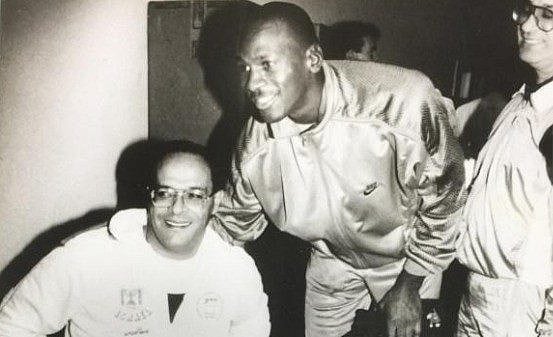
Two GOATs who changed their sports (From Baruch Hagai's personal collection)
There are some athletes who are great at their sport. They may even be the greatest.
Nobody plays basketball better than LeBron James, right? He is just great at basketball. You may debate him being the greatest but you know he is great. He is fast, he can shoot, he can dunk, he is physically enormous, and he can hold a basketball in the palm of his hand like it was a tennis ball. He is fun to watch.
Pete Sampras was like that in tennis. Pistol Pete, they called him. For 286 weeks in a row, he was world number 1, and he won Wimbledon seven times. Other players dreaded his forehand and when he served well, he had the best serve on the tour. A great player. Maybe the greatest, or the GOAT as my 12 year old son would say.
In football (or soccer), Leo Messi is definitely one of the greatest. Except for only a few, no one can dribble like Messi, and no one handles the ball and sees the game like him. He can pass the ball between three defenders and leave his striker in front of the goalie, one on one. He has definitely given us some of the best football moments in history.
While those great athletes (among them I can also add others like David Coulthard in Formula 1, one of the greatest drivers of all time, Carl Lewis in Track, who ran faster than people imagined possible at the time, and Ian Thorpe, the Australian swimming sensation of the first decade of the 21st century) have given us moments of awe, amazement and joy, and while they were GREAT at their sport, their focus was on personal excellence and achievement and perfecting their mastery.
This is the point where you stone me and argue that I don’t know what I am talking about, (after all, aren’t discussions and arguments about sports part of the fun?), so I am just gonna say it. Some athletes are great, like the ones I mentioned above. But only a few actually CHANGE the way their sport is played.
They may not be the greatest, though sometimes they are, but they change something fundamental about their sport – it could be the way Roger Federer turned tennis into an art. It could be the way Usain Bolt turned running into a party. It could be Michael Shumacher in Formula 1, who was the first driver who was actually an athlete and made physical conditioning an important part of the game. It could be Serena Williams, whose athleticism and power have redefined women’s tennis, pushing the limits of what female players can achieve on the court. Of course, how can you go through a list of athletes who changed their sports without mentioning Michael Jordan, who didn’t play better than the others, he just didn’t play the same game.
I know this list is debatable and it is obviously not complete, go ahead and argue down here in the comment section. But really, it isn’t important, Because I am here to tell you about the man who wasn’t just the greatest but also changed not one, but two different Paralympic sports, and he happens to be an Israeli, and he happens to be our own: The GOAT of both wheelchair basketball and wheelchair table tennis, the Jewish boy from Tripoli, Libya, who was one of 13 brothers and sisters, who was left paralyzed by polio and won a staggering 22 Paralympic medals, 17 of which are in the right color:
Baruch Hagai.
Baruch changed the game of wheelchair table tennis forever when in his first match of the 1968 Paralympic games held in Tel Aviv (yes, Israel hosted the Paralympics in 1968) he just smiled at his opponent before hitting his first serve and released his wheelchair brakes. Until then, players in wheelchairs played with locked brakes for stability. Baruch released his brakes and started gliding back and forth, pushing with one arm and hitting with the other, moving sideways, turning and saving balls from long lines and hitting top spins from under the table. He cruised to gold in 1968, and then again in 1972 and again in 1976. He wasn’t just a good player. He was a spectacle. People’s jaws dropped when he played — he was fast, dynamic and most of all, mobile.
He unlocked the wheelchair brakes. Simple and genius.
Baruch also changed wheelchair basketball. Until his era, wheelchair basketball was a very static game, players passed, sometimes dribbled once or twice and then made an attempt to shoot. Baruch danced. He dribbled with both hands, pushed his wheelchair like it was flying a few inches above ground, shot with his right hand and then with his left, invented the one on one, the stop and spin to shake off a defender, the scoop shot and the reverse lay up. He introduced showtime to wheelchair basketball, 20 years before Magic Johnson.
For his incredible achievements on and off the court, Baruch received the highest Israeli honor in 2001 – the Israel Prize. As the head coach at the Israel ParaSport Center for the past three decades, he has educated generations of young athletes with disabilities, and he is still my own personal role model and mentor.
Greatness is not solely defined by records or medals. True greatness lies in the ability to challenge the status quo, to inspire others, and to ignite change, just like Baruch did.
—
This blog post is dedicated in Baruch’s honor at this time of his current struggle with health issues. He should have a refuah shlema.
Related Topics
Related Posts