The Mask of Tolerance
A Latin American Jewish woman in Amsterdam reflects on how calls for “peace” after October 7 exposed the limits of Dutch tolerance.
I remember the morning I found out about the so-called peace deal Trump had announced. I had opened Instagram before my first coffee, and the first story I saw was a repost from a girl I knew from my Jewish community back in Panama. It was Trump’s post about the “first phase” of a peace agreement between Israel and Hamas.
I thought, I’ll believe it when I see it. Because that phrase, peace in the Middle East, has been repeated for decades until it has almost lost meaning.
People keep saying the war didn’t start on October 7, 2023. They’re right. It began long before Israel’s founding, during years of failed proposals for coexistence that Jewish leaders accepted and others turned down. But this is not about history. This is about what October 7 left on me.
The Betrayal
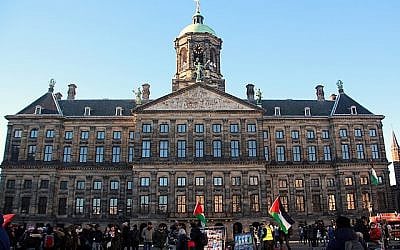
I am a Latin American Jew who has been living in the Netherlands, a country that calls itself tolerant and progressive. Yet days after Israel agreed to a ceasefire and signaled a willingness to move toward peace, around 250,000 people marched through Amsterdam in what they proudly called the “Red Line” protest.
They said they were marching for peace. But peace had already been agreed upon. So what exactly were they marching for?
Were they reading the news? Were they following the negotiations? Or were they simply following a crowd that made them feel righteous? Because 250,000 people in the streets chanting slogans that divide rather than unite is not peace. That is performance.
What October 7 Left Me
What October 7 left me was betrayal.
Friends, colleagues, and even clients I once laughed with started posting “From the river to the sea.” People who had never cared to read a single line of history now felt qualified to shout “genocide” on their stories.
When I tried to engage with them gently, asking if they knew the context, most admitted they didn’t know enough to discuss it. But somehow, they knew enough to accuse an entire nation of evil.
As Israeli writer Hen Mazzig said, people have freedom of speech, but Jews no longer have freedom from the violence those words provoke.
The Silence that Followed
Since October 7, antisemitic incidents in the Netherlands have surged. According to the European Union Agency for Fundamental Rights (FRA), 96 percent of Jewish respondents across Europe said they had encountered antisemitism in the past year, and many reported avoiding visible expressions of their identity.
Dutch Jewish organizations have reported a 400 percent increase in antisemitic incidents since late 2023. Synagogues have been threatened. Jewish schools and centers have needed extra police protection. Many people whisper instead of wearing a Magen David in public.
And while this happens, something horrifying is unfolding in Gaza, and now the world is quiet.
The hostages have been returned. There are no longer Israeli civilians trapped underground. Yet Hamas continues to rule Gaza through fear, now turning its weapons on its own people. Palestinians who speak out or try to access humanitarian aid are being executed in the streets. The same group that once claimed to fight for Palestinian liberation is now murdering Palestinians, and the same “human rights” activists who filled European streets are suddenly silent.
Because this part of the story doesn’t fit their slogans.
Meanwhile, in the West
Across the Atlantic, in New York City, home to the largest Jewish community outside Israel, the recent election of Zohran Mamdani has triggered unease among Jewish organizations. A politician known for his openly anti-Israel positions, his victory feels symbolic of something larger: how quickly antisemitism has become normalized under the language of “justice.” When hate hides behind progressive slogans, it spreads quietly until it doesn’t.
And here in the Netherlands, last week’s elections brought the centrist left D66 party back into power, narrowly defeating the far right. Many celebrated it as a win for moderation. But for Jews like me, the feeling is more complicated. Whether the far right gains ground or the center left returns to power, our safety still feels fragile.
The far right was never truly a solution either, since its rise only deepened divisions and made any concessions in government impossible. Now that D66 leads again, it is unclear whether this will bring stability or more polarization. For Jews, uncertainty itself feels dangerous.
This isn’t about politics. It’s about survival and about whether my son will grow up in a country where his Jewish identity is seen as a threat or as something that belongs here.
Erasure and Emotional Wreckage
Even culture hasn’t escaped this climate. A few months ago, Amsterdam published a children’s book celebrating its “many faces,” the many cultures of Mokum, a word rooted in Hebrew. Yet Jews were missing from its pages. And now, the city’s Concertgebouw has cancelled its annual Chanukah concert, refusing to host Israeli cantor Shai Abramson because of his background.
When our history can be erased from a book and our music silenced in a concert hall, it becomes clear that Jewish visibility in the Netherlands is welcome only when it stays quiet.
I have felt unsafe, anxious, and heartbroken. I unfollowed people I once trusted. I changed my social media feed to protect my sanity. I sought out old Jewish and Israeli employers, not for jobs but for peace of mind, for spaces where I don’t have to justify my right to exist.
Because suddenly, I felt I had to defend something that should have been obvious: that my people too deserve safety and compassion.
And yet, in the middle of all the noise, a few people reached out. Friends who didn’t know much about the conflict but cared enough to ask if I was okay. Those simple gestures of kindness reminded me that humanity still exists.
What the Netherlands Needs to Face
Dutch society needs to face its reflection in the mirror.
You cannot claim to stand for peace while chanting slogans that glorify hate. You cannot call yourself tolerant while Jewish children walk to school in fear. You cannot march for human rights and ignore when Jews are targeted. You cannot claim to stand for peace while staying silent as Hamas murders its own people.
The Netherlands has always loved to see itself as a beacon of freedom. But freedom is not selective. Freedom also means protecting those you do not understand.
What October 7 left me is clarity.
I will keep showing up. I will keep being kind in a world that was not kind to me. But I will no longer trust as easily. And I will not stay silent to make others comfortable.
Because the mask of tolerance has fallen, and beneath it lies something far uglier: indifference.
And indifference, history has taught us, is never neutral.