Ecohasid meets Rambam
The Menorah, Part 1: On being a small light
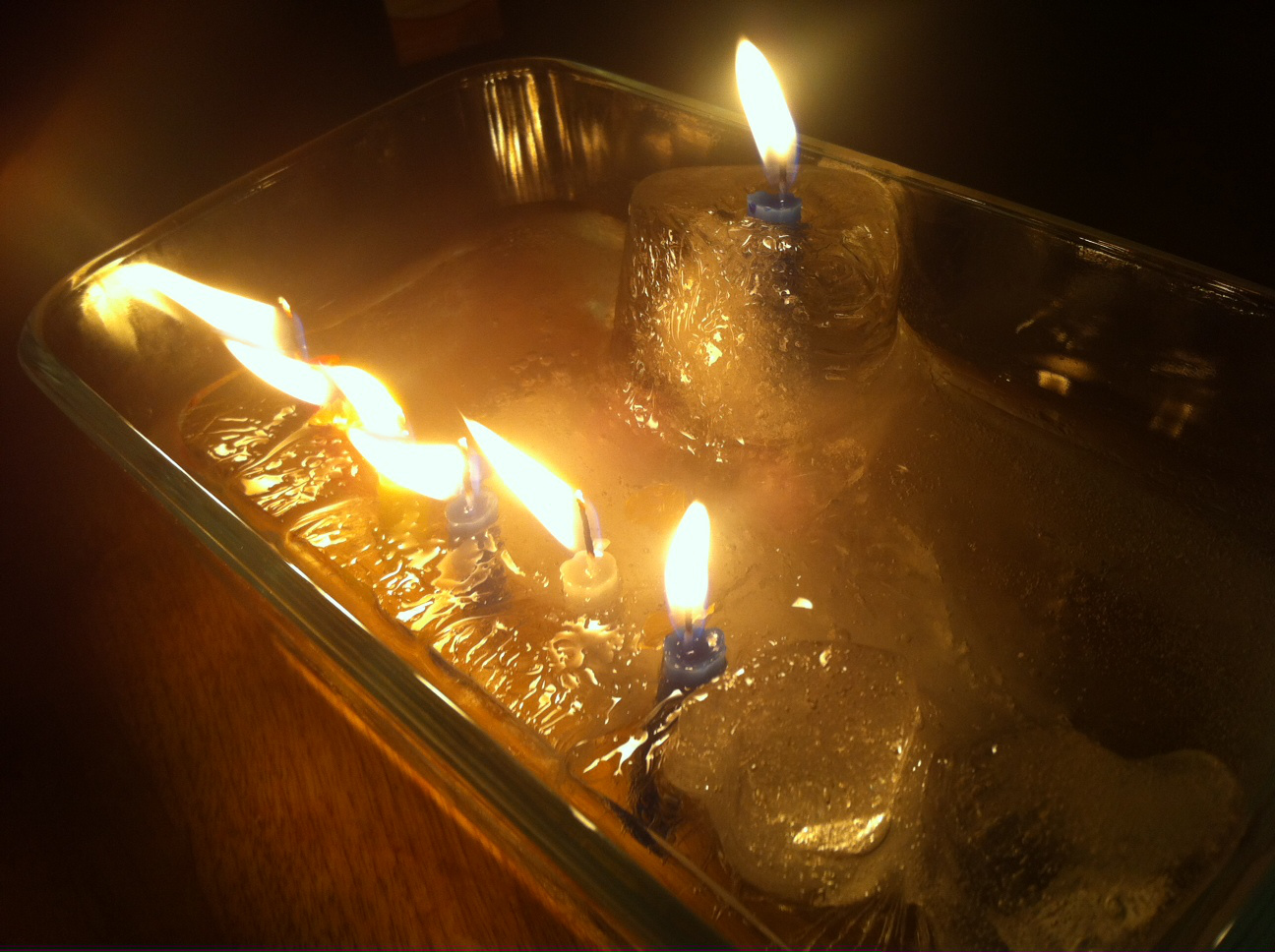
Ice menorah, lit outside, 2017. (David Seidenberg)
Lighting the menorah – an ideal ritual for our time*
(Part 1 was written specifically for the time of COVID but include valuable info and midrashim for now too.)
WE HAVE JUST A HANDFUL of Jewish rituals designed to be done outdoors, which makes them all especially good for COVID-pandemic times. One of course is Sukkot, where we live outdoors in our makeshift booths that are necessarily open to the sky and that can be easily opened to the breeze. The sukkah is a ritual space that can be used day or night. The other two rituals, though, are mainly for the nighttime. One is Kiddush Levanah, when we stand before the moon/levanah, give her a blessing, and jump and dance towards her. The other ritual is perhaps the one most familiar to every type of Jew, but it is not familiar as an outdoor ritual. That is lighting the menorah or Chanukiyah, as it is called in modern Hebrew, as we will be doing for eight days.
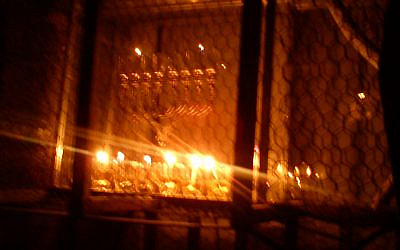
It’s true that most of us chutz la’aretz (outside of Israel) light our menorahs inside the house by a street-facing window, but that’s only second best according to the Talmud. The ideal is to light outside one’s front door, where space turns from private to public, where people will not just see the menorah but readily interact with it. That’s why in Israel, it’s common to see glass boxes mounted to one side of the door to the street where one can place an oil lamp menorah that can burn without getting blown out by a breeze.
Lighting a menorah in a pandemikc time, no matter whether you do it outside your front door or in your window, is also one of the rituals that work just as well now, when most people are confined to a single household or pod, as it did before the pandemic. I know for myself, it’s the only ritual I ever did over facetime before COVID, mostly to include far-flung grandparents. You can’t exactly share a matzah over phone or video, though many of us did our best to simulate doing just last Passover. But you can easily share the light of a candle or lamp over video, and blessings sung can be heard around the world with just a phone.
The flames must be separate, like us as we socially distance
THE HALAKHAH (Jewish law) teaches that the flames of a menorah need to be separated from each other by at least a fingerbreadth, and that it’s best to set them up more or less in a straight line. Another way to describe this in an image is that the Chanukah candles are socially distanced!
The Talmudic reason for this is that the menorah light shouldn’t be like a m’durah, a campfire or bonfire, and that one should be able to count the flames to tell at a glance how many candles or wicks are lit. Since we light one more candle each day, that means anyone can tell what day of Chanukah it is by looking at your lit menorah. In a time when one day blends into another, knowing the number of the day is a comfort. If the wicks were in a circle, then the flames would overlap from multiple angles and visually blend together, like our days have done. Another distinction is that a m’durah is generally used for heat, whereas a ner, a lamp or candle, is used primarily or only for its light – for discernment. (More on this in Part 2!)
There is an alternative, almost opposite fantasy of what Chanukah means that contradicts this halakhah. One hears it in the song Ba’nu Choshekh: “We come to chase away the darkness, in our hand light and fire, each one of us a tiny light, but we all make a mighty light!” But according to Jewish practice, the lights are davka not supposed to be joined together to make one mighty light.
In fact, there is a quiet comfort and confidence in not rushing to join together, in not chasing darkness away, not whipping up conflagrations, but instead dwelling in what is, in planting seeds of light, person-by-person, wick-by-wick. Chanukah is a time to honor that reality. This year, when we have no choice but to keep our lights separate from each other during COVID, we might as well find the virtue in doing so.
And so we light in these crushing times
LIGHTING A MENORAH outside your front door is the fullest expression of what it means to “publicize the miracle”, to be pirsum ha-nes, as one says in Yeshivish. For all of us not used to lighting outside, you can try this with an unused aquarium. Outside, you can invite the neighbors. An ice menorah is also a special treat outside, where it won’t melt too fast.
Even though this year we can’t join together, we can easily witness in person each other’s lights, even take a tour past people’s windows filled with candlelight. The light of our Chanukiyahs, which will glorifyingly multiply eight times, and which, according to our tradition, is holy, casts the halo around what stays pure within us in the face of trauma. That means the light we each carry and sustain in ourselves, as we trudge through this year and through the holy, dark time of solstice, also stays pure.
A midrash says that Israel is like an olive tree: to get the pure oil that gives light, the olives need to be crushed. For so many of us, this is a crushing time, and whether we extract the light from this time is up to us. When we witness each other’s light, whether through a window or together on a front stoop or over video, we are also witnessing each other’s resilience, empowerment, resistance. To do so, the menorah reminds us, can be miracle enough.
* This article was written during COVID lockdown, but has lots of Torah that still works now after COVID. Part 2 and Part 3, however, are specifically revised to be about the current time, and not about COVID.
Get alternative lyrics to Ba’nu Choshekh that honor darkness here. Download the service for Kiddush Levanah here. Read Part 2 and Part 3. Find more Chanukah resources from Rabbi Seidenberg’s website, neohasid.org, here.
Related Topics
Related Posts