Ecohasid meets Rambam
The Menorah, Part 2: The Miracle of Light from Olives*
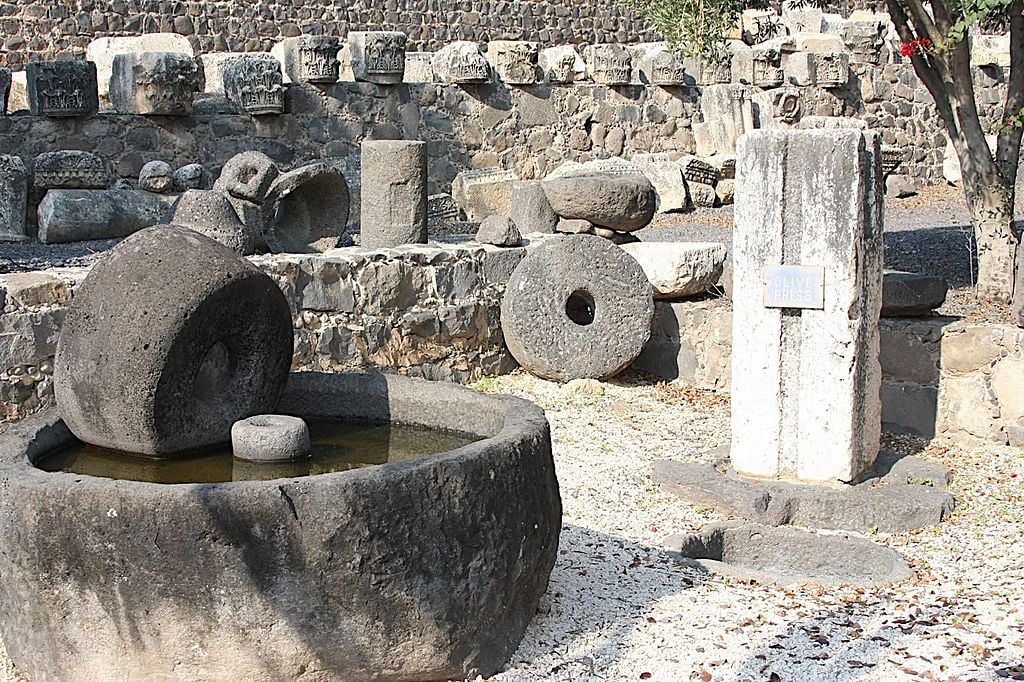
ancient olive oil press, Capernaum, Galilee, wikimedia (public domain)
The biblical and ecological meanings of the menorah inform everything spiritually and politically powerful about Chanukah. A little bit of knowledge about seasons and harvests can enrich everyone’s Chanukah.
The olive tree and the Temple’s menorah
THE TRADITIONAL SHAPE of the menorah, with all its flames in a line standing separate from each other, is part of Jewish law. In Part 1, I explored the rabbinic reason for this shape: the flames of the menorah should be in a line, so they can all be seen separately at one glance.** The alignment of the candles in the Chanukiyah also imitates the flat tree shape of the seven-branched menorah that stood in the Temple.
That would be reason enough for its shape, since we are commemorating the rededication of the Temple. But why does the Torah insist that the Temple menorah have seven branches in one line, “three branches of the menorah on the one side and three branches… on the other side” (Exodus 25:32)?
One reason the Torah gives is that the lamps need to cast their light toward the altar: “and (the priest) will lift her (the menorah’s) lamps and shine light outward from her face” (Exodus 25:37). By setting the flames in a long line, the shape of the menorah guaranteed that the light it cast wouldn’t create sharp shadows in the direction it was facing (kind of like setting up O-ring lighting for zoom).
Harvesting light
THE TORAH ALSO TEACHES that the menorah represents a tree, with its branches sculpted like almond flowers with sepals, and the menorah was literally lit by a tree, since the fuel had to be very pure olive oil. The almond flower is the first tree blossoming in the spring, a symbol of renewal and awakening. And olive oil is simply (and magnificently) a staple of the land of Israel, and the oil to use if you want to get the best light.
A few years ago, I learned some new things about how olive oil gets made in Israel and Palestine. The trees may be finished growing their olives by Sukkot, but the olives are not harvested until after the first rain falls on them – typically after the end of Sukkot. They are harvested over a month’s time. After harvesting, they are crushed in an olive press to make oil, and then the oil might sit for a few weeks til any sediment settles out. (That’s why it could take eight days to get new olive oil.)
Since Chanukah falls exactly two full moons plus ten days after the end of Sukkot, we celebrate lighting the menorah or Chanukiyah right around when the first oil pressed from the new harvest would come to market or get used in Temple rituals.
The rabbinic story about Chanukah tells us that the miracle of the holiday was that the olive oil lasted eight days. But during the Maccabean revolt, the work of harvesting the olives, along with Sukkot and the other harvests, became difficult or impossible because of the war. Because of that, it was an even bigger a miracle to find any oil at all. And the biggest miracle is the olive tree itself.
The darkest night and the miracle
I NEVER GET TIRED of pointing out that the darkest night of the year is not actually the winter solstice, but rather the fifth night of Chanukah, the moonless night before or nearest to the winter solstice. In fact an aggadah or story in the Talmud teaches that the first human beings were terrified when the days became shorter and shorter, and responded to the lengthening days after solstice by creating a festival of lights that was the basis for our Chanukah (Talmud Avodah Zarah 8a, sec.7). That’s what Chanukah is really about, no matter what version of history, rabbinic or Maccabean, that one pays attention to.
That irrefutable and immutable miracle is also one embedded in Nature, rather than history. That’s the miracle of the olive harvest itself, and the wonder of a world where a beautiful tree grows fruit from the sun’s light that we can harvest to give us oil, so that we can create our own light.
Along with that miracle is a miracle specific to the ecology of the land of Israel and the Mediterranean: the oil from the new harvest is ready just in time for us to ignite it to create light in the greater Temple of the world in its darkest season, when we need it most. These natural miracles would be enough reason to celebrate Chanukah as a festival, even without the miracles described in the Book of the Maccabees of fire falling from heaven (see Part 3), or the opposite of fire dropping from heaven, the rabbinic miracle of the “oil that burned quite slowly” (as Jon Stewart phrased it in a duet with Stephen Colbert at 2:27).
(For the Maccabees, Chanukah was about fire, not about light. Part 3 is all about this difference between the Maccabees Chanukah and the rabbis’ Chanukah.)
Finding the holy in the darkest year
SO OUR MENORAH, our Chanukiyah, is not a m’durah, not an attempt to overcome the dark with a blazing fire (not like the song Banu Choshekh — see Part 1), but a bridge of light composed of individual flames that look like seeds of light. This bridge helps us across that darkest night of the sun’s cycle in the Northern hemisphere, without fighting or denying or disrespecting the dark.
As we pass through this dark time, remember that holy darkness that holds peace, and can bring freedom, that makes our small lights shine brighter. Each olive its own little package of light, each person their own source of illumination.
Chag urim sameach!
* Originally “The Menorah in COVID, Part 2” — updated for post-COVID-crisis times. That version included some of the material in Part 3 as well, about the Maccabees vs. the Rabbis.
** The separation of the candles was a symbol overfull with resonance in the time of social distancing during the pandemic, which was the inspiration for this three-part article about the menorah.
With thanks to Sue Salinger, Shaul Judelman, Sarah Notis, Riqi Kosovske, and other friends who helped me explore these ideas. Read Part 1 here. Find more Chanukah resources, including a Chanukah version of the Ana Bekhoach prayer, on Rabbi Seidenberg’s website neohasid.org here.
Related Topics
Related Posts