The views expressed herein are solely mine.
The Middle East Is Europe’s Security Frontline
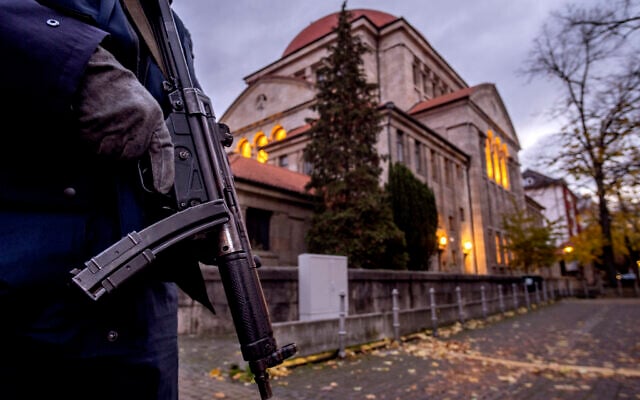
Illustrative: A German police officer stands guard in front of the synagogue in Frankfurt, Germany, November 8, 2023. (AP Photo/Michael Probst, File)
Today, any credible assessment of European security must begin with the recognition that the continent’s threat landscape is now directly shaped by Middle Eastern conflict dynamics.
Since the 2015 Paris attacks—which killed 130 people and exposed a Europe-wide intelligence blind spot—more than 340 jihadist attacks or foiled plots have been recorded across the European Union.
In fact, Europol documents show that over 40% of these cases involved operatives who traveled through Syria, Iraq, Lebanon, Gaza, or Turkey, or who maintained active links with organizations headquartered there. Thus, Europe is no longer insulated from Middle Eastern turmoil; it has become one of its downstream theaters.
Simultaneously, the operational footprint of Hamas, Hezbollah, and Iran’s Islamic Revolutionary Guard Corps (IRGC) reaches well beyond the region.
The IRGC’s Quds Force directed assassination plots in Denmark (2018), Germany (2022), and the United Kingdom (multiple disrupted cases in 2023).
At the same time, Hezbollah maintains active money-laundering networks in France and Germany, while Hamas operatives have plotted attacks from Turkey with logistical support running into Europe.
Tellingly, Israeli SIGINT was pivotal in exposing a Hezbollah bomb-making facility in Cyprus in 2021 and warning Germany of Iranian assassination teams targeting dissidents on European soil in 2023. These are not theoretical risks—they are ongoing transnational operations.
Accordingly, Iran’s proxy expansion has become a central driver of Europe’s evolving threat matrix.
With over 100,000+ terrorists spread across Hezbollah (around 50,000), Iraqi Shiite militias (15,000–20,000), Hamas and PIJ factions (40,000+), and the increasingly aggressive Houthis movement, Tehran now directs the largest non-state military network on Earth.
Following Hamas’s attack on Israel on October 7, 2023, European intelligence agencies elevated their internal threat levels after tracing ideological and logistical echo effects inside diasporic networks in Belgium, France, and the Netherlands.
In 2022 and 2023 alone, European security services disrupted dozens of Iranian-linked plots, including plans targeting journalists, Jewish institutions, and political figures. Europe is not adjacent to this conflict; it is within operational range.
Consequently, Europe’s legacy counterterrorism doctrines remain dangerously outdated.
Frameworks conceived after the 2004 Madrid and 2005 London attacks—when networks were smaller, less technologically sophisticated, and geographically confined—cannot address threats that now flow through encrypted communications, cryptocurrency financing, drone proliferation, proxy warfare, and migration routes exploited by extremist operatives.
Ergo, the Afghan Taliban’s return to power in August 2021, the Islamic State’s resurgence in the Sahel (with over 6,000 fighters active in Mali, Niger, Burkina Faso), and Houthi Red Sea attacks disrupting 12% of global trade have cascading second-order effects on European radicalization patterns, maritime security, and energy markets. Gaza, Beirut, Sanaa, Tehran, and Brussels now form a single operational continuum.
In effect, Europe’s security resilience increasingly hinges on intelligence fusion with key Middle Eastern actors—particularly Israel. Israeli cyber units provided crucial data used in 2022 to disrupt ISIS-inspired attack plans in Austria and Germany. Jordan and Egypt supply HUMINT derived from decades of counterinsurgency experience; the UAE and Bahrain contribute cyber and financial intelligence acquired after the Abraham Accords; and Saudi Arabia’s reporting on Iranian maritime activity is used within NATO’s maritime situational awareness cycle.
Without these channels, the probability of a mass-casualty attack on European soil rises exponentially. This is not diplomatic rhetoric—it is a measurable operational dependency.
Fundamentally, Europe’s policymakers must acknowledge that the Middle East constitutes the continent’s primary security frontier, not a distant geopolitical abstraction. Treating Middle Eastern instability as an external issue has already produced catastrophic outcomes—from Paris 2015 to Brussels 2016 and Vienna 2020.
In parallel, continued denial of the structural interdependence between the regions does not constitute strategic prudence; it represents a profound analytical failure.
Therefore, European governance must be recalibrated toward a model that reflects the integrated, continuous, and inseparable security continuum linking Middle Eastern conflict ecosystems to the European homeland.
Related Topics