The views expressed herein are solely mine.
The Middle East’s Next War Will Be Over Water
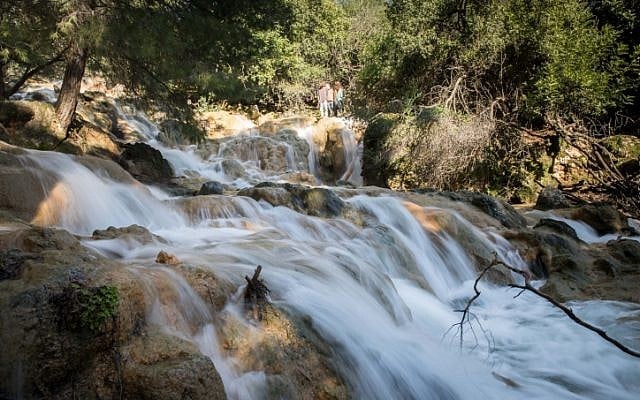
The Farod waterfalls flow after heavy rains in the Lower Galilee on January 19, 2019. (Hadas Parush/Flash90)
The Middle East is not running out of slogans. It is running out of water. And while pundits remain hypnotized by manifestos, missiles, and terrorist groups the region’s real balance of power is being rewritten quietly, mechanically, and without drama—behind concrete dams, desiccated riverbeds, and rationed taps. This is not an environmental story. It is a story about power, coercion, and survival.
Modern Middle Eastern geopolitics still pretends that ideology drives history. In reality, infrastructure does. Control the flow of water, and you control agriculture, electricity, urban stability, and, ultimately, regime legitimacy. That truth is now impossible to ignore—except, apparently, by the international media class.
Consider Turkey, a NATO member rarely framed as a coercive regional power. Through its vast dam network on the Tigris and Euphrates, Ankara has achieved something armies failed to do for centuries: structural dominance over downstream states. Iraq and Syria do not merely negotiate with Turkey anymore. They wait on it. Every reduced flow tightens agricultural collapse, fuels internal displacement, and hollows out state capacity. This is leverage that does not need threats. Gravity does the work.
The results are already visible. Southern Iraq’s rivers are turning saline, farmers are abandoning land their families worked for generations, and urban centers absorb wave after wave of internal refugees with no jobs and no patience. These are not humanitarian footnotes; they are the raw ingredients of unrest. States do not collapse when they lose arguments. They collapse when they cannot provide water.
Syria’s civil war did not begin with slogans alone. Years of drought preceded the uprising, gutting rural livelihoods and pushing desperate populations into cities already under strain. The lesson was absorbed quietly across the region: climate stress plus infrastructure failure equals political vulnerability. Terrorist groups understand this better than diplomats. Control water, and you do not need to win hearts and minds—you wait.
That said, Iran now stands as the clearest proof that water scarcity is no longer a future risk but a present accelerant of internal instability. From Isfahan to Khuzestan, rivers have vanished, aquifers have collapsed, and water protests have erupted in regions once considered politically manageable. Farmers blocking highways and chanting against the state are not reacting to ideology; they are reacting to thirst. Tehran’s response has not been reform but repression, turning water scarcity into another instrument of domestic control. A dictatorship that once derived legitimacy from revolutionary mythology now struggles to provide the most basic element of survival—and no amount of censorship can refill a dry riverbed.
Against this backdrop, the Nile Basin exposes how water scarcity escalates from internal crisis to interstate confrontation. The standoff between Egypt and Ethiopia over the Grand Ethiopian Renaissance Dam is not a development dispute; it is an existential contest over hydrological sovereignty.
Egypt, almost entirely dependent on the Nile, views upstream control as a direct threat to national survival. Ethiopia, asserting its right to development, has discovered that dams confer strategic leverage no treaty can fully restrain. This is the same logic playing out elsewhere in the Middle East: whoever controls the headwaters dictates the political weather downstream.
Against this backdrop, Israel’s strategic posture looks radically different. Its desalination plants and water recycling systems are not green luxuries; they are pillars of sovereignty. This way, Jerusalem can absorb climate shocks that would fracture its neighbors. This is why water cooperation has quietly underpinned normalization talks far more than the press admits. Energy can be shipped. Water cannot. Whoever solves it becomes indispensable.
Yet, Western commentary remains stuck in yesterday’s map. It obsesses over borders drawn in ink while ignoring pipelines carved in stone. It debates ceasefires while aquifers collapse. It moralizes endlessly about conflict without grappling with the material conditions that make conflict inevitable.
And here is the uncomfortable reality: future Middle Eastern wars may not begin with rockets. They will begin with shortages. They will not be announced by generals but by engineers. And they will not be resolved by summits but by whoever controls the valves.
Regrettably, silence around this issue is not accidental. Water politics expose state failure, long-term planning deficits, and the limits of ideology. They offer no villains easy to hashtag and no solutions that fit into election cycles. They demand a reckoning with the fact that climate and infrastructure now shape power more decisively than speeches or sanctions.
At present, the Middle East is entering an age where sovereignty will be measured not by flags or fighters, but by reservoirs and reliability. Those who ignore this will continue to be surprised by the instability they claim came out of nowhere. Those who understand it are already building the future—quietly, methodically, and without asking permission.
History is moving through pipes and dams. The question is who is paying attention.
Related Topics