London based entrepreneur, cybersecurity analyst doing a PhD in AI
The Miracle Drug.
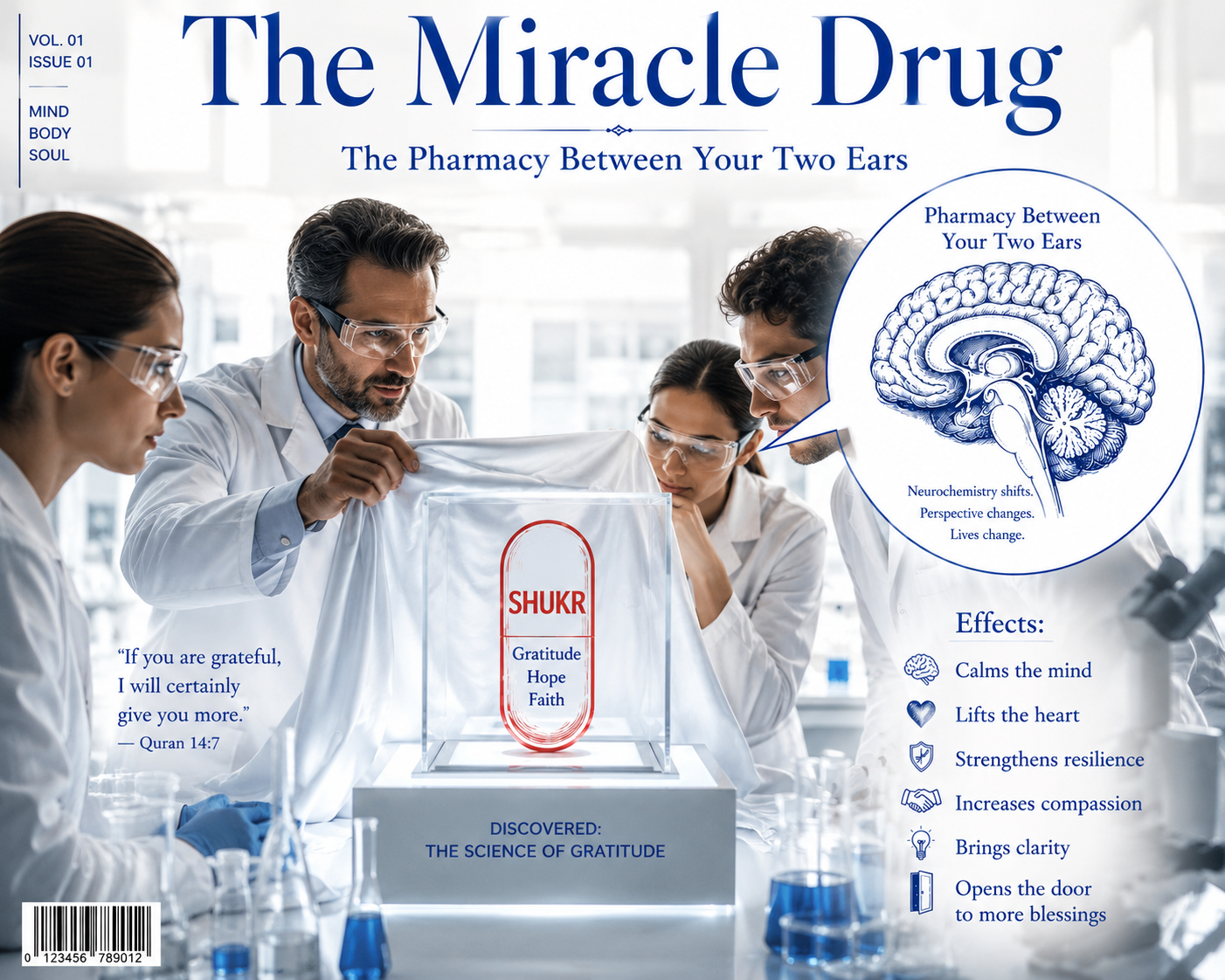
You have a pharmacy between your two ears. And a miracle drug you can manufacture within your own biology everyday.
The human brain contains systems regulating stress, motivation, reward, attention, pain and emotion. What we repeatedly notice, expect and think about can influence how we experience life.
The interesting question is therefore:
What are you repeatedly asking your brain to notice?
The problems?
Or the blessings too?
The brain notices danger
The human mind is exceptionally good at detecting what is wrong.
That makes evolutionary sense.
A threatening sound deserves immediate attention. A dangerous face matters. Pain teaches avoidance. Something going wrong can demand more attention than ten things going right.
But there is a problem.
If we continually feed the mind danger, outrage, comparison and catastrophe, the exceptional can begin to feel normal.
The same can happen to societies.
Like for every human being, genuine issues exist in every society
These things must never be hidden beneath artificial positivity.
But something else is simultaneously true.
Someone recovered today.
Someone fed a hungry person.
Someone held their newborn child.
Someone was forgiven.
Someone received good news.
You woke up.
Your heart continued beating.
Perhaps the problem is not that blessings disappeared.
We stopped noticing them.
The Qur’anic equation
The Qur’an gives an extraordinary principle:
“If you are grateful, I will certainly give you more.”
— Qur’an 14:7
This is first a theological statement, not a neuroscience experiment. Allah promises increase for shukr—gratitude.
But psychologically, gratitude does something fascinating.
It redirects attention.
Instead of continuously asking:
What am I missing?
you begin asking:
What have I already been given?
The house you once desperately wanted eventually becomes simply “the house.”
The job you prayed for becomes Monday morning.
The healthy body becomes invisible until something hurts.
The person you once feared losing becomes familiar.
Human beings adapt to blessings remarkably quickly.
Gratitude makes the familiar visible again.
Gratitude reaches the brain
Neuroscience gives us reason to take this seriously without exaggerating it.
In a randomized study by Kini and colleagues, participants undergoing psychotherapy completed a gratitude-writing intervention. When researchers later examined their brains using fMRI during a gratitude task, the gratitude group showed differences in neural responses associated with gratitude, including in the medial prefrontal cortex. Remarkably, effects were observed three months later. (ScienceDirect)
Deliberately practising gratitude can be associated with measurable changes in how the brain responds during gratitude-related processing.
The pharmacy metaphor therefore becomes useful:
what we repeatedly practise can influence the mind through which we experience the world.
Seligman asked another question
Psychology historically concentrated, understandably, on what goes wrong.
Depression.
Trauma.
Anxiety.
Disorder.
Martin Seligman and the positive-psychology movement asked an additional question:
What helps human beings flourish?
In a famous randomized study, Seligman and colleagues tested several positive-psychology exercises.
One was extraordinarily simple.
Every evening, write down three things that went well and why.
Some of the interventions produced lasting increases in happiness and reductions in depressive symptoms, although the effects varied across exercises and time. (PubMed)
Think about how simple the intervention is.
Nothing in the outside world necessarily changes.
You simply ask your mind a different question:
What went right today?
Perhaps you had enough food.
Someone called you.
Your child laughed.
You completed something difficult.
You walked outside.
Someone showed you kindness.
The blessing already existed.
Attention found it.
Gratitude needs hope
But gratitude alone can become passive.
That is where hope enters.
Psychologist C. R. Snyder developed one of psychology’s most influential models of hope.
For Snyder, hope contains two crucial components:
Agency: I can move toward the goal.
Pathways: I can find a route—or another route—to reach it.
Hope is therefore not:
“Everything will somehow be fine.”
It is:
There is somewhere worth going, and I can search for a way forward.
Research based on Snyder’s model has associated greater hope with better psychological adjustment and outcomes across areas including education, health and coping. (Taylor & Francis Online)
A recent meta-analysis also found that both agency and pathways thinking were negatively associated with depression and anxiety. (Springer)
So we obtain a remarkably useful sequence:
Gratitude: I recognise what I have.
Hope: I can imagine something better.
Agency: I can move toward it.
Pathways: I can find a way.
But gratitude is not blindness
This distinction matters.
Positive psychology must never become:
Ignore injustice.
Ignore illness.
Ignore poverty.
Ignore war.
Smile.
That is not gratitude.
The Qur’an does not ask human beings to pretend suffering does not exist. It repeatedly confronts oppression, grief, injustice and wrongdoing.
A psychologically healthy person—and a healthy society—must therefore hold two truths simultaneously:
Something is wrong today.
And:
Something is still worth being grateful for today.
Lose the first and we become complacent.
Lose the second and we risk despair.
A doctor can acknowledge disease while hoping for recovery.
A society can confront injustice while recognising what remains good.
A grieving person can mourn what was lost while thanking Allah for what remains.
Gratitude does not deny the wound.
It refuses to let the wound become the whole body.
Few are grateful
The Qur’an makes another remarkable observation:
“Work gratefully, O family of David! Only a few of My servants are truly grateful.”
— Qur’an 34:13
Notice the verb.
Work.
Gratitude is not merely something you feel.
It becomes something you practise.
Perhaps that is why the Qur’an says truly grateful servants are few. (Quranic Arabic Corpus)
Gratitude requires resistance to psychological adaptation.
You deliberately notice again what familiarity taught you to ignore.
The prescription
So try something tonight.
Count three blessings.
Actually count them.
One large.
One small.
One you normally overlook.
Then ask:
What could be better tomorrow?
That is hope.
Then:
What can I do about it?
That is agency.
Then:
What other route could I try if this one fails?
That is pathways thinking.
Now we have something more powerful than blind optimism:
Grateful for what remains.
Honest about what is wrong.
Hopeful about what could change.
Working toward something better.
The miracle drug is therefore not pretending everything is wonderful.
It is learning to see the whole picture.
Modern psychology calls parts of this gratitude, hope, agency and pathways thinking.
The Qur’an gives the central practice a much older name:
Shukr.
Count what remains.
Thank the One who gave it.
Recognise what is broken.
Work to repair it.
And maintain enough hope to believe that tomorrow can still be better than today.
For Muslims, this practice is already woven into life five times a day—perhaps we have simply stopped noticing it. Every ṣalāh begins with Al-Fātiḥah: “Al-ḥamdu lillāhi Rabbil-ʿālamīn” — “All praise and thanks are for Allah, Lord of all worlds” (Qur’an 1:2); and among Allah’s Names is Ash-Shakūr (ٱلشَّكُور) — The Most Appreciative, The Rewarder of Gratitude (Ash-Shakūr — 99 Names of Allah). Gratitude was never meant to be an occasional exercise; it was built into the rhythm of the day.
Related Topics
Related Posts