The Missing Piece: Why Air Power Alone Will Not Free Iran
This post follows my earlier piece, Stop Treating Iran as a Rational Actor, and should be read alongside it.
We are more than five weeks into a war whose stated goal, at least from Washington, includes regime change. The bombs are falling. Iran’s leadership has been decapitated. A new supreme leader has been installed. And the IRGC is still shooting.
This should surprise no one who took seriously the argument in my earlier piece. You cannot bomb a theological architecture into submission. The IRGC is a fundamentalist institution, in the precise academic sense of that word. Its internal logic frames catastrophic chaos as confirmation of the mission, not as defeat. The Mahdist indoctrination that accounts for more than half of all IRGC training exists precisely to make the organization resistant to the kind of external pressure currently being applied. The system does not produce moderates. That is its design.
But there is a dimension I left unaddressed, and the current commentary is almost entirely ignoring it.
The Iranian population cannot act. And they know exactly why.
Not because they lack the desire. The January massacres, potentially 30,000 dead in 48 hours, the bloodiest government repression in the history of the Islamic Republic, tell us unambiguously that millions of Iranians are willing to risk their lives against this regime. Tehran became a ghost town not out of loyalty to the new Khamenei, but out of rational fear of a machine-gunning security force that has proven, repeatedly, that it will kill without hesitation.
What is missing is the answer to a question every Iranian considering action must ask: if I go out into the street today, what comes after?
Right now the answer is: the IRGC kills me, and nothing comes to fill the vacuum.
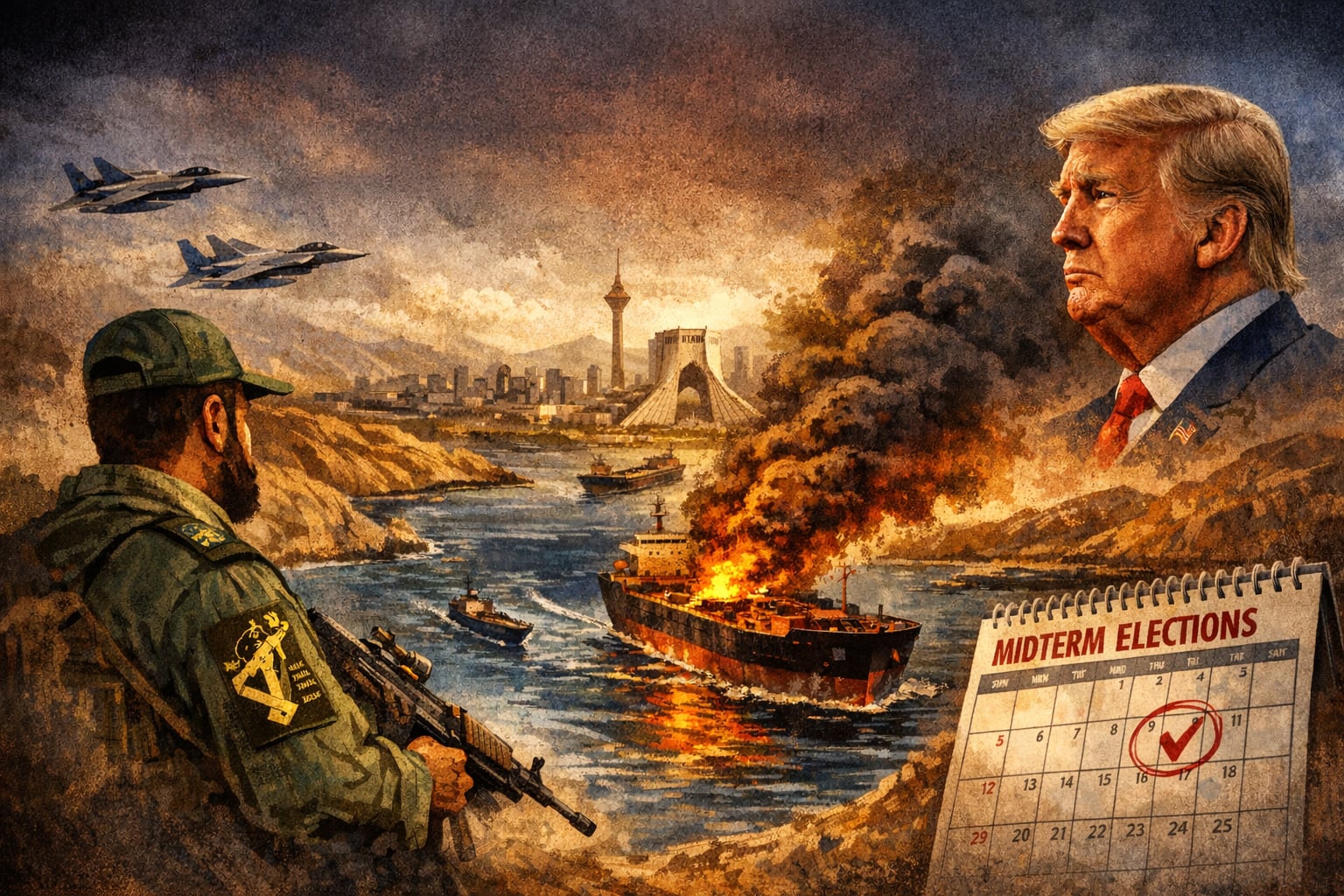
This is not passivity or indifference. Ordinary Iranians are reading this situation with considerable clarity. They can see that the IRGC still controls the Strait of Hormuz, the single most consequential choke point in the war. By holding it, the regime is not merely defending itself; it is actively strangling the political timeline of the operation. Iranian leadership understands, with some sophistication, that Trump faces midterm elections and that domestic American pressure, rising fuel costs, and a restless Congress all work in their favor the longer they survive. They do not need to win. They need to outlast the political will on the other side. And that is a plausible strategy.
Ordinary Iranians can see this too. As long as the IRGC has a credible path to survival, rising up offers the worst of all possible outcomes: the certainty of being shot today, combined with the likelihood that the regime endures anyway and exacts its revenge tomorrow. After January, when the regime demonstrated it would massacre tens of thousands in 48 hours without meaningful international consequence, the threshold for a second attempt is not lower. It is dramatically higher. The people who took to the streets in January paid for it in blood, and the regime is still standing. That memory is recent and visceral.
This is the coordination problem that air power alone cannot solve. Uprisings against intact security forces are not simply suicide missions. They are collective action problems. People take existential risks only when they believe that enough others will act simultaneously, that the regime’s capacity to kill them has been sufficiently degraded, and that something viable will replace what falls. Without a credible ground presence, or at minimum a credible threat of one, none of those three conditions can be met from 30,000 feet.
Consider what a credible ground threat would actually accomplish, even without a single soldier crossing the Iranian border. It would signal to IRGC regional commanders that their physical survival is no longer guaranteed by institutional loyalty, introducing a defection incentive that aerial bombardment alone cannot create. It would tell ordinary Iranians that external protection is possible at the moment of action, shifting the calculation that currently makes street protest a death sentence. It would force the IRGC’s coercive apparatus to disperse and defend territory, degrading its capacity to concentrate force against civilian populations. And critically, it would undermine the IRGC’s core current strategy, which is simply to hold Hormuz and wait out Trump’s political clock.
None of this requires an occupation. Iran is a country of 90 million people with complex ethnic and political geography, and no serious person is arguing for that. What is required is the kind of credible commitment, the realistic prospect of ground forces, that historically has been the difference between uprisings that cascade and those that are simply massacred.
The historical record is instructive. Romania’s 1989 revolution succeeded not because Ceaușescu ran out of bombs, but because soldiers refused to fire. That moment was made possible by the visible collapse of Soviet backing that had previously guaranteed the regime’s survival. The specific guarantor changed; the principle holds. IRGC rank-and-file soldiers below the ideologically hardened core are not true believers to a man. They are people with families being bombed, economic futures destroyed, and commanders being killed. What keeps them shooting is the calculation that the alternative to compliance is worse than compliance. A credible ground threat changes that calculation.
Trump’s stated model, “rise up, we’ll support you from the air,” is not a strategy. It is an invitation to a massacre with American moral endorsement. The Venezuelan comparison he has reportedly favored actually illustrates the problem: Maduro was removed because he was physically seized, not because his population was told to revolt while his security forces remained intact and armed. No amount of air power replicates that mechanism.
This brings us to the voices in the West who are loudest in opposing any ground dimension to this war. Their arguments are made in good faith, and some of the cautions are legitimate. But the functional consequence of their position deserves to be named directly. By ruling out the one instrument that could change the IRGC’s survival calculus, they are ensuring the condition that keeps ordinary Iranians home. They are not protecting Iranians from a dangerous war. They are protecting the IRGC from the one threat that might actually end it. The regime could not design a more favorable Western consensus if it tried.
There is a deeper problem too, one that connects directly to the theological framework in my earlier piece. The IRGC’s world-conqueror orientation, the constitutional mandate to extend “the sovereignty of God’s law throughout the world,” is not moderated by suffering. It may be intensified by it. An IRGC that interprets bombardment as the prophesied chaos preceding the Mahdi’s return is moving, within its own framework, toward vindication rather than toward negotiation. Air power destroys hardware. It does not dissolve the loyalty calculations of hundreds of thousands of security personnel, and it does not address the eschatological conviction that makes those personnel willing to fight through devastation.
The conclusion is not a comfortable one. The war’s stated objectives and its chosen instruments are potentially misaligned in a fundamental way. Air power can degrade Iran’s military capacity significantly. What it cannot produce is the internal political transformation that would actually end the threat, because that transformation requires Iranians to act, and Iranians will not act while they can see the IRGC holding Hormuz, reading the American political calendar, and maintaining a credible path to outlasting this war.
The question is not whether the Iranian people want freedom. January answered that, in blood. The question is whether the war’s architects have a plan that gives that desire a realistic chance, or whether they are, once again, asking a traumatized and surveilled population to take a lethal gamble with no credible guarantee of protection and every reason to believe the regime will still be there when the shooting stops.