English Literature Professor and Zionist
The MLA Sinks Itself
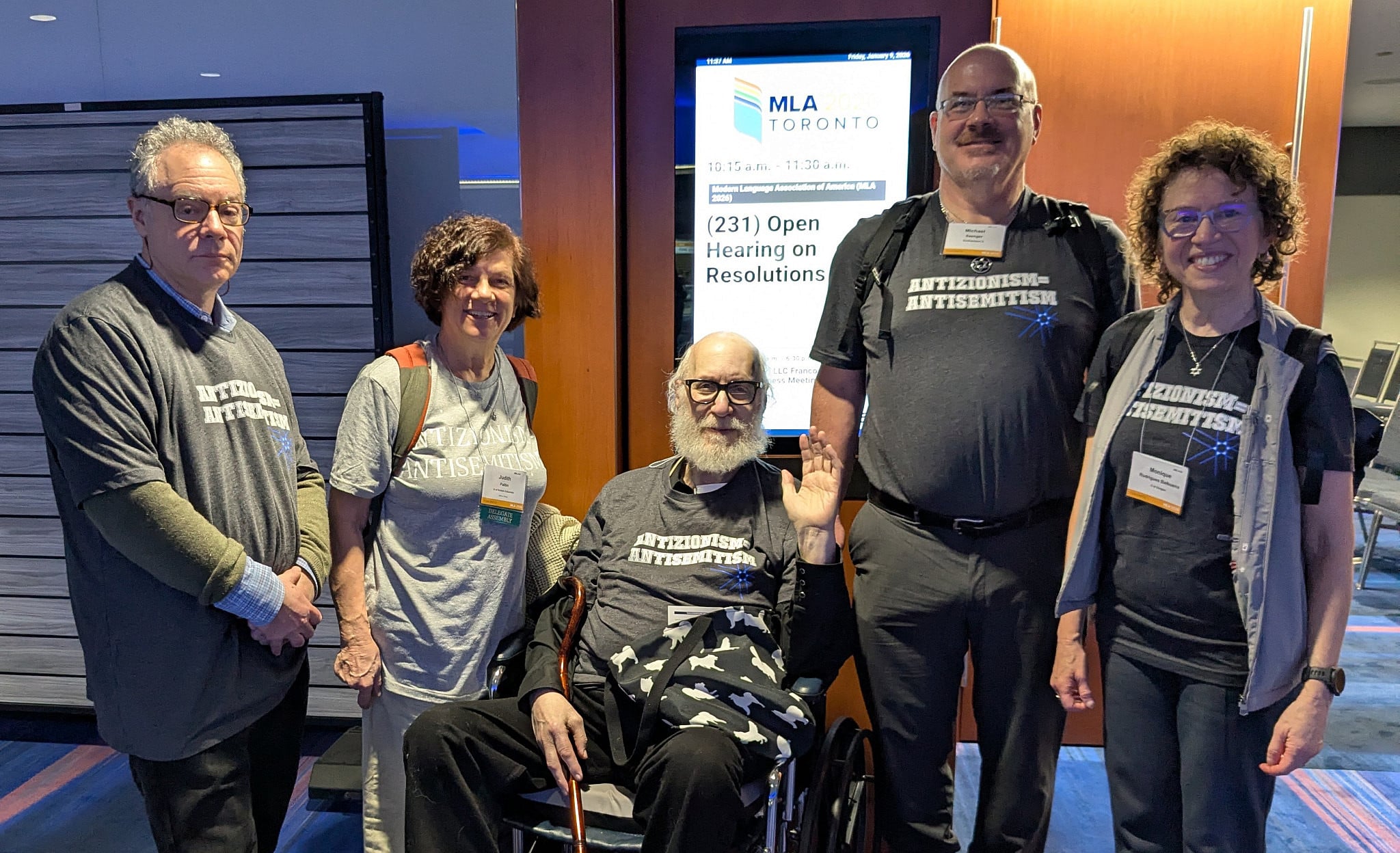
Jonathan Skolnik (University of Massachusetts, Judith Paltin (University of British Columbia), Cary Nelson (University of Illinois), Michael Saenger (Southwestern University), Monique Balbuena (University of Oregon)
The Modern Language Association is the largest humanities organization in the world. It is the kind of place where one might expect to hear a discussion of the poetics of social perception. For example, in Shakespeare’s Othello, Iago tricks Cassio into embarrassing himself, and then taunts him, saying, “What, are you hurt, lieutenant?”. Cassio responds, “Ay, past all surgery,” and then explains: “Reputation, reputation, reputation! O, I have lost my reputation! I have lost the immortal part of myself, and what remains is bestial. My reputation, Iago, my reputation!” A wound to a person’s sense of honor can hurt far more than a blade ever can. No surgery can repair reputational harm.
Or one might expect to hear a discussion of how neologisms work. When any culture discovers new things, it coins new words for them. That sounds exciting, but it also has a dark side. Neologisms, and shifts in word use, have long been used to mark social exclusion. If you remember the previous century, you probably recall hearing older people say with frustration that the word “gay” used to just mean happy. People would lament that the word had fallen into other uses, and the way they talked about it indicated that they did not approve.
Those are the kinds of things that literature professors teach, and those are the kinds of things that used to be discussed at the MLA’s annual convention, which was held yesterday in Toronto.
Instead, on Saturday, the Delegate Assembly of the Modern Language Association was consumed with controversy, as it took up a resolution to malign Israel:
WHEREAS escalating attacks on academic freedom, free speech, faculty governance, and equity are irreparably damaging education in the United States;
WHEREAS these attacks weaponize allegations of antisemitism and racism to undermine struggles against those real problems, justify massive cutbacks, and silence protest against the US-sponsored Israeli genocide in Gaza;
WHEREAS untenured and adjunct faculty and international students are especially vulnerable to doxxing, firing, and deportation;
BE IT RESOLVED that the MLA condemns these attacks and their specious justifications, and urges all United States educational institutions to join in this opposition.
Genocide is, by nature, a unilateral crime. Terrible suffering happened in the Gaza War, but that suffering happened to civilians in a war zone where two fully capable armed forces were in combat. To label this a genocide is wrong, and it echoes accusations of bloodlust that have been made against Jews for thousands of years.
Universities, and learned societies, are places where everyone, including professors, have the right to make absurd and even hateful claims. Those claims need to be supported, however, and they cannot be made on behalf of the university, or the society, as a whole. Academia should be a place where people learn to think, not a place where they are told what to think.
In an ideal world, the MLA would be a place where one could point out that other absurd accusations against Israel, which include faithwashing, pinkwashing, greenwashing, scholasticide, sophicide and onticide, are made-up words. Why make up new words, as if no country has ever fought a war before? Because creating a new word creates the sense that Jews are, to quote Cary Nelson, outside the human moral community, and that ordinary words just don’t work for them. In a very similar way, this motion tries to relabel a war as genocide.
Humanities are under threat. Universities charge a lot of money, and job prospects are often bleak, both for instructors and for graduates. The convention’s cavernous rooms were often nearly empty. Compounding that problem, professors who should be guiding conversations and sharing expertise instead use scholarly societies such as the MLA to advance positions on topics they know little or nothing about, and demand that the entire society agree with them.
I, and a group of other Jewish professors came to the convention and contested this resolution, with support from the Academic Engagement Network. We engaged with our colleagues. We wore T-shirts that read “Antizionism = Antisemitism”. We handed out leaflets. We were approached by many attendees who expressed deep appreciation for our presence. We handed out shirts, and we hope to see more of them. The topic of antizionism is complicated, but it has also become in some ways very simple. The statement on the shirt may have been an oversimplification ten years ago, but now it is simply true. And the accusation of genocide is not.
But all these positions should be open to debate. We adamantly stood at the microphone to defend the academic freedom of those who disagree with us. Our opponents did not share that sentiment. Many of us spoke bravely, generously, and passionately against the growing antisemitism that this resolution is designed to advance. Once we opened the door, other professors spoke up for our cause. We lost, by a vote of 61 to 52. Considering how extreme the MLA has become, that narrow loss is a genuine accomplishment.
38 states have passed laws that block public funds from going to entities that support the Boycott, Divest, Sanctions movement, which seeks to isolate and malign Israel. Those states include big states, like California, Texas, and Florida. The resolution that passed is effectively the same as the BDS resolutions that have been advanced at this and other societies for years. The MLA is heavily dependent on public funds, particularly through libraries, which subscribe to the MLA Database. Beyond that, the MLA proudly announces on its website that it has formed a Strategic Partnership Network, which “brings together institutions with a proven commitment to the humanities to develop critical resources for responding and building a sustainable foundation for the future.” Those institutions include such prestigious names as Washington and Lee University, Southern Methodist University and Columbia University.
Libraries normally trust databases. Universities normally trust large academic societies. That’s how reputation works, which is why Cassio is so grieved that he has lost his. Reputations are connected, like ships tied together with ropes.
At the moment, the condemnation of Israel is merely the sentiment of a slight majority of a deeply divided Delegate Assembly of the MLA. It is not yet the position of the association as a whole.
In a moment of swirling radicalism, some members of the Modern Language Association want to do irreparable damage to their own organization, by weaponizing its convention to marginalize Jews and embrace antisemitism. One would hope that cooler heads prevail. If the MLA cannot stop its radicals from sinking their own ship, other institutions might want to rethink their connection to the association.
Related Topics
Related Posts