
The Moonlight of Freedom
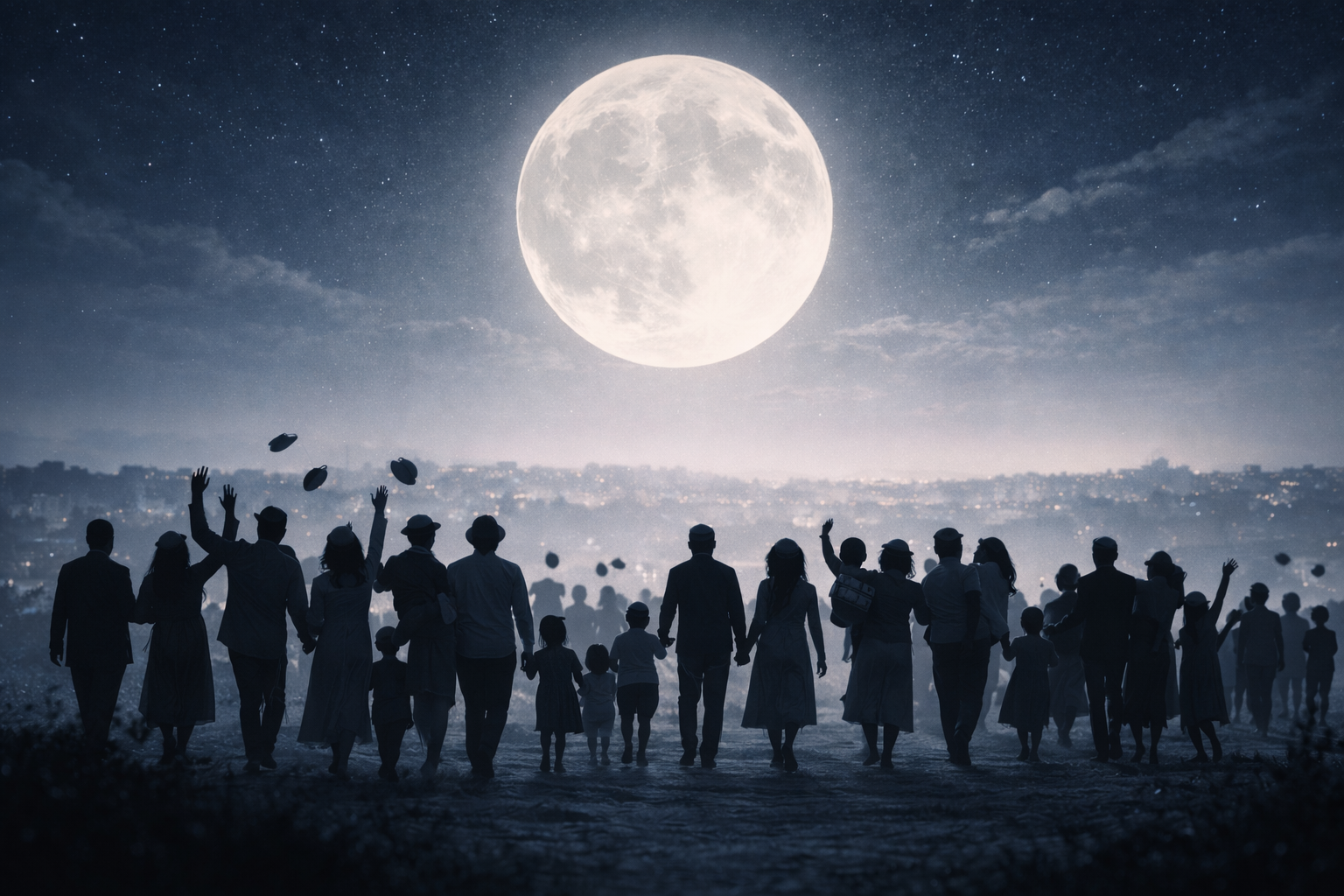
Parashat Bo brings the Exodus narrative to its decisive moment. The final three plagues descend upon Egypt—locusts, darkness, and the death of the firstborn—and with them comes the collapse of Pharaoh’s will. These are not merely punishments; they mark the unraveling of a civilization that believed itself permanent and unassailable. Egypt’s claim to mastery over power, nature, and history itself is finally shattered.
Yet before the Jewish people leave Egypt, before freedom is fully realized, the Torah pauses. At the threshold of redemption, Israel is addressed for the first time not as a collection of individuals, but as a nation.
This month shall be for you the first of the months:
החודש הזה לכם ראש חדשים
(Shemot 12:2)
This is the first mitzvah given to the Jewish people as a collective, and it is striking in its nature. It is not a commandment of belief, prayer, or ethics. It is the sanctification of time. After centuries in which every moment of their existence was dictated by Egyptian oppression—measured in bricks, quotas, and exhaustion—the Jewish people are granted authority over the calendar. Time itself is redeemed before space is ever entered.
The mitzvah of Rosh Chodesh establishes that Jewish time is not merely observed but consecrated. Through the sighting of the new moon and the declaration of the Beit Din, human testimony becomes the mechanism by which sacred time is created. Even when astronomical reality might suggest otherwise, the Torah entrusts this authority to Israel. Redemption does not begin with escape, but with covenantal partnership.
If Rosh Chodesh establishes the legal authority to sanctify time, Kiddush Levanah translates that authority into lived religious experience. The monthly blessing over the moon is recited outdoors, beneath the open sky, with no objects and no intermediaries—only time, sky, and faith.
Halachically, Kiddush Levanah may only be recited during a defined window of the month. While customs differ regarding its earliest time, all agree that it must be said before the moon’s visible decline begins, generally no later than the midpoint of the month, when the moon stands full and radiant. Jewish tradition does not bless the moon at its birth, when it is barely perceptible, nor after its waning has begun. Sanctification takes place in the moment of growth, when fullness lies just ahead.
This mitzvah has taken on a uniquely communal and embodied form. It is often recited on Motzaei Shabbat, as Shabbat departs and its sanctity still lingers. Communities step outside into the night. Psalms are recited, words of consolation are spoken, greetings of Shalom Aleichem are exchanged, and movement accompanies prayer—hearts lifted, heels raised, and bodies lightly springing three times in joy—affirming renewal and communal spirit, directed toward faith and celebration, not the celestial body itself. Renewal is not only declared; it is enacted, felt, and shared.
In kabbalistic thought, this exchange of peace is more than courtesy. The mystics taught that Shalom itself is a form of tikkun. Exile is understood as fragmentation—between heaven and earth, between people, and within the human soul. When Jews greet one another beneath the moonlit sky, they participate in the healing of that fragmentation. Each Shalom Aleichem becomes a small but meaningful act of repair, restoring relational harmony and making space for divine presence to dwell in a fractured world.
The text of Kiddush Levanah itself is central to this theology. The three lines often emphasized in practice can be presented as follows:
David, King of Israel, lives and endures.
דוד מלך ישראל חי וקיים.
Just as I dance toward you but cannot touch you, so may my enemies be unable to harm me.
כשאני רוקד אליך ואיני נוגע בך, כן יהיו אויבי בעדי.
May my enemies never overpower me, and may peace and kindness surround me.
שלא יעלו אויבי עלי, ושלום וחסד יסובבו אותי.
Beyond its words, this encounter with the moon becomes an act of remembrance—linking ritual to history, and prayer to redemption.
David, King of Israel – This line affirms that just as the moon wanes and returns, Jewish sovereignty and destiny may be eclipsed but never extinguished. It is a statement of enduring hope, connecting past, present, and future.
Just as I dance toward you… – This line is not a prayer for dominance but for distance. Evil is acknowledged yet denied intimacy. It reflects the Exodus itself, in which freedom required separation, not annihilation. Survival is sanctified as a form of faith.
May my enemies never overpower me… – This line expresses a longing for security and a life framed by kindness and peace. Kabbalistically, it reflects the ongoing restoration of harmony—Malchut in process—through daily engagement with sacred time.
This encounter with the moon is never only about the present moment; it is also rooted in historical memory. The first redemption of the Jewish people took place at night, on the night between the fourteenth and fifteenth of Nissan, under a full moon. Chazal draw our attention to this detail. The redemption began at night, and our ancestors were summoned to freedom not in the clarity of daylight, but in darkness illuminated by reflected light. As they stepped into the unknown, the moon lit their path—not the certainty of the sun, but the quiet glow guiding those who walk forward without assurance.
History bears witness to the resilience of this mitzvah. Survivor testimony recorded by Rabbi Yisrael Meir Lau, later Chief Rabbi of Israel, recounts how Jews in the concentration camps, with ritual observance nearly impossible, still found ways—sometimes whispered, sometimes only gestured—to honor the mitzvot that remained, particularly the sanctification of the moon. Even under constant surveillance and oppression, their captors could control their bodies and their days—but not the heavens, not sacred time itself.
A similar reverence is reflected in the conduct of the Chafetz Chaim, who once waited through a bitterly cold, snow-covered night for the moon to emerge so that he could recite Kiddush Levanah. When a student later learned from his wife why he had stood outside for so long, the answer was simple: the opportunity to sanctify renewal could not be surrendered.
The Zohar teaches that the moon represents Malchut, the divine presence as it is revealed within the world. When the moon is diminished, the Shechinah is described as being in exile; when it is renewed, harmony is restored. Kiddush Levanah is therefore not symbolic alone—it is an act of cosmic repair. The Maharal deepens this insight by explaining that Israel is bound to the moon because Jewish existence is not defined by static perfection, but by renewal. Decline is not failure; it is the condition that makes becoming possible.
This connection helps explain why the moon, rather than the sun, becomes the defining symbol of Jewish time. While the sun embodies completion and self-sufficiency, the moon embodies process and potential. To sanctify the moon is to affirm that holiness is found not only in arrival, but in growth itself. Jewish life does not unfold as a straight line toward perfection. It is a cycle of return, renewal, and becoming.
Each time we sanctify the moon, we are invited to remember how our ancestors first walked toward freedom under the light of that very same moon—and to recognize that we are still walking their path, still carrying their cause and their dream, now moving toward the final redemption that continues to take shape around us.
Parashat Bo teaches that freedom begins when time itself is redeemed, and as long as Jews continue to lift their eyes heavenward and sanctify time beneath the open sky—redemption remains not only a memory of the past, but a promise still unfolding.
שבת שלום
שמואל