
99.6% Ashkenazi + .4% Viking = 100% Zionist
The Moral High Ground: The Hardest Place to Fight
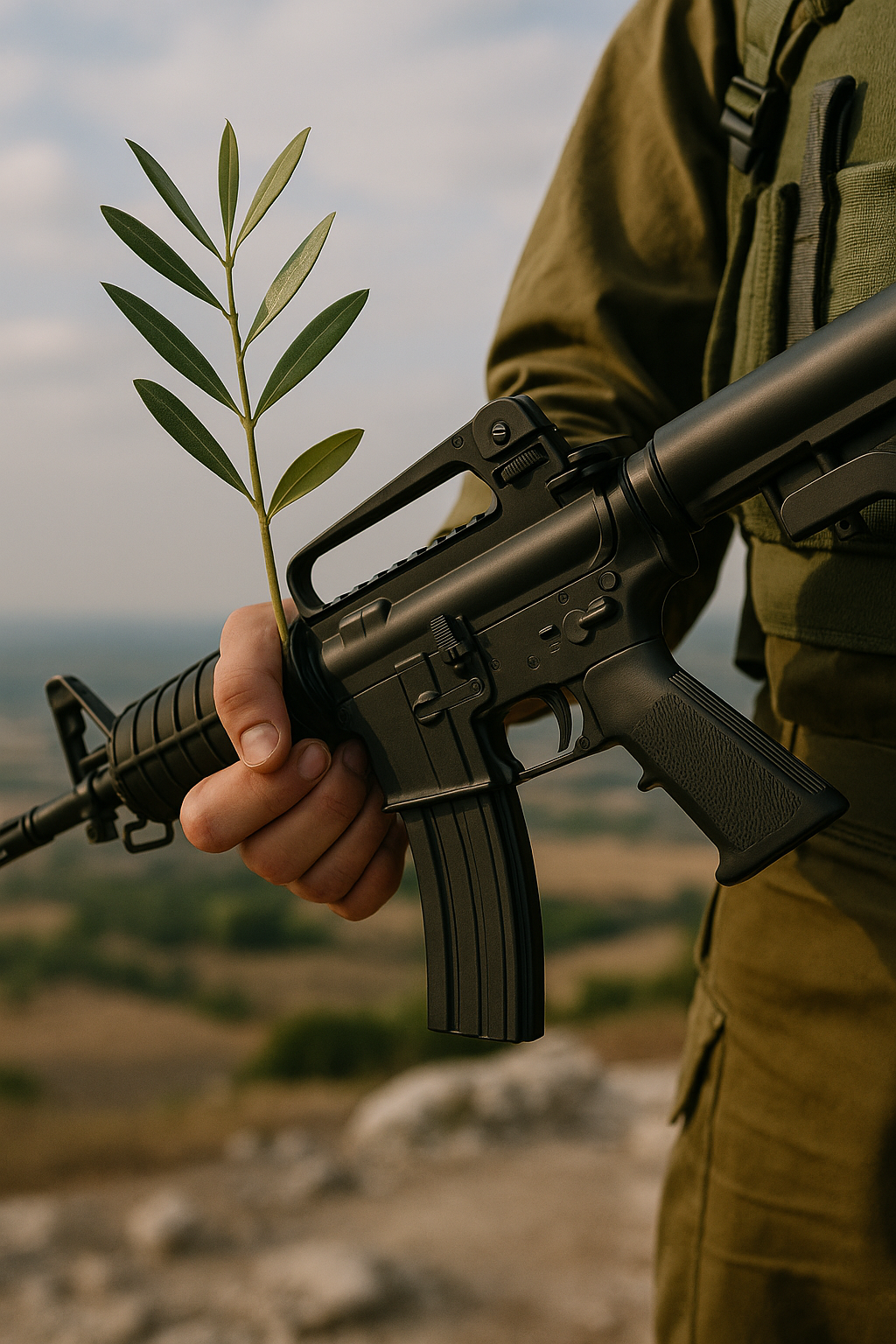
Maintaining the Moral High Ground
In the bloody, brutal world of modern urban warfare, few militaries even attempt to balance military necessity with civilian protection. Fewer still manage to do it under the glare of global scrutiny. Yet Israel’s conduct in Gaza stands as a striking — and often unacknowledged — example of what it looks like when a nation deliberately places morality above strategic expediency, even at great cost.
While critics rush to condemn, Israel has consistently deployed measures that no other military has attempted on this scale or with this consistency. In Gaza, a battlefield where the enemy operates from hospitals, schools, and apartment buildings, Israel does more than wage war — it wages it with restraint.
Before striking a target, Israel warns civilians through text messages, phone calls, recorded announcements, leaflets, radio broadcasts, and even social media. These warnings aren’t generic; they are location-specific and often personalized. In many cases, the IDF has called the occupants of a building directly, urging them to evacuate. In addition, Israel shares military maps to guide civilians away from combat zones — another extraordinary step that often means forfeiting the element of surprise.
And then there’s the roof-knock: the IDF’s use of low-yield munitions to signal an impending strike. This unique tactic — unprecedented in modern warfare — gives those inside a final, urgent chance to flee. No army is required to do this under international law, but Israel has integrated this method as standard practice, precisely because it places a premium on civilian life.
Israel’s military ethics — enshrined in the IDF’s code of “purity of arms” and “value of human life” — aren’t theoretical. They play out in real time. Combat missions are usually aborted when civilians are spotted. Unless the target is a high-value figure, such as a senior Hamas leader or one of the masterminds of the October 7th massacre, Israel weighs the strike under the international law of proportionality. This legal standard requires that the anticipated military advantage must outweigh the expected harm to civilians. Israel does not take these calculations lightly. In practice, it often means foregoing valuable opportunities to eliminate dangerous figures if the civilian cost would be too high.
Israel’s moral calculus is made all the more excruciating by the reality that Hamas openly and flagrantly violates the laws of war. International law requires combatants to wear uniforms or distinctive insignia so they can be distinguished from civilians. It forbids the use of civilian infrastructure — churches, schools, hospitals — for military operations. Hamas does the opposite. Its fighters blend into the civilian population, its rockets and weapons are hidden in mosques, clinics, and classrooms, and its command posts are buried beneath hospitals. Worse still, Hamas weaponizes these violations, daring Israel to strike and positioning cell phone cameras to record the aftermath. Civilian lives are mere pawns in their strategy. Is the world truly blind to this, or do too many simply choose to look away?
These choices don’t just limit Israel’s operational freedom. They put Israeli soldiers at greater risk. Delayed or aborted strikes can allow terrorists time to regroup or escape. Ground incursions are launched instead of airstrikes to minimize civilian harm, exposing troops to booby traps, ambushes, and sniper fire. Every additional precaution taken to spare civilians increases the hazards for those tasked with carrying out the mission.
This moral calculus is especially striking when compared to other urban battles in recent history. In Mosul and Raqqa, coalition forces faced ISIS fighters who similarly embedded themselves among civilians. Civilian-to-combatant casualty ratios in those campaigns often ranged between 3:1 and 6:1. In Grozny, Russia’s tactics reduced the city to rubble, with estimates of tens of thousands of civilian deaths. In Aleppo, Syrian and Russian forces pounded neighborhoods indiscriminately, leveling entire districts. In these cases, civilian casualties weren’t collateral — they were the defining feature of the campaigns.
Consider the recent IDF strike on a beachfront café in Gaza, where a number of senior Hamas naval commanders were killed. According to an Associated Press report quoting Hamas officials, Israel simultaneously targeted civilians waiting for food — a claim that stretches credibility, given the setting and circumstances. Civilian casualties did occur, and as always, they are deeply regrettable. But this was no indiscriminate attack: it was a focused strike on operational commanders who chose to embed themselves among civilians at a public leisure site, cynically turning a café by the sea into a shield.
And here, the “open-air prison” narrative begins to fray. What kind of prison boasts bustling beachfront cafés where militants and civilians mingle? The suffering in Gaza is real — no serious person denies that — but the complexity of life there defies simplistic slogans. The greater moral tragedy is not that Israel targets terrorists at cafés; it is that terrorists choose cafés as their cover.
In contrast, if Israel’s claim that it has killed around 20,000 combatants is accurate — and if Hamas’s own health ministry reports of approximately 50,000 total deaths are accepted — the civilian-to-combatant ratio is approximately 1:1 or 1.5:1. This is remarkable, even astonishing, given the complexity of the battlefield and the tactics of an enemy that actively seeks to maximize civilian exposure to harm for propaganda purposes.
This is not to say civilian casualties are not occurring. They are, and each one is tragic. But the story so often missing from headlines is that Israel is actively fighting to reduce these casualties — even when doing so means losing tactical advantage, risking soldiers’ lives, and delaying key operations. This reality weighs heavily on Israeli society and on the soldiers themselves, who fight with a burden no other army carries: the duty to protect not only their own civilians, but those of the very enemy they are forced to confront.
The world is quick to judge Israel, but slow to acknowledge how it has reshaped the rules of engagement in modern war. No military is perfect, and mistakes happen. But in Gaza, Israel’s actions reflect a conscious choice: to hold itself to a higher moral standard in warfare, even when the cost is high and the world refuses to see.
As Golda Meir famously reflected, “We can forgive the Arabs for killing our children. We cannot forgive them for forcing us to kill theirs.” (attributed to Golda Meir, first published in her 1973 autobiography)
Her words capture the heartbreak of a nation that fights not for conquest, but for survival — and does so with a humanity the world too often refuses to see.
Related Topics
Related Posts