The Mossad spy who never existed
Between 2013 and 2024, Syrian and Iranian intelligence services fueled a conspiracy surrounding Thwaiba Kanafani, according to which she was a spy working for Israel. The theory, first circulated by members of the Syrian Muslim Brotherhood, spread like wildfire, forcing her not only to give up armed struggle, but also to leave the country for which she was willing to die.
Dalia Shimon, 25, sits on a low sofa upholstered in red, beige, and brown geometric and floral patterns. The air is thick with palpable tension. The damp, off-white walls seem to echo Shimon’s solemn expression, her piercing gaze standing out in the photograph. A gun rests across her lap. She is visibly uneasy. Why? No one knows for sure.
To her right stands a woman covered in a green veil and wearing a high collar that conceals her neck. On the opposite side is a man with a hard, unsmiling face. He wears a green cap and has a thick beard. He, too, is holding a weapon. But it´s not just any weapon. It´s an RPG. The cap on his head leaves no room for doubt: he belongs to the Free Syrian Army. Or rather, he did. His name is Hossan El Din Malas, and he has just been arrested by the Egyptian authorities, who seized important documents and several photographs from his home, including the one we have just described. Among that vast trove of papers was confirmation that Shimon was, in fact, a dangerous Mossad agent operating in the very heart of the Syrian rebels.
However, much of the information publicly circulated about the image described above does not correspond to reality. On the contrary, it is the product of a disinformation campaign orchestrated by Syrian and Iranian intelligence services, with the aim of discrediting the Free Syrian Army. “Dalia Shimon” is, in fact, Thwaiba Kanafani, a Syrian woman who gave up the comfortable life she had built in Canada to return to her homeland in an attempt to topple Bashar al-Assad’s regime and restore peace to her fellow countrymen.
— But why her? Why not anyone else? you may ask.
First, because she was a woman. In the Arab world, it was not only unexpected but unthinkable that a woman — at the time the only female volunteer from abroad — would have that fire within her; that she would seek change with her own hands. Second, because of the position she held: commander. Her intelligence and pragmatism made her a formidable threat. From the moment she joined the ranks of the Free Syrian Army, she sought to build bridges between the various factions of the Syrian opposition and to rally support for the cause. The source of that support mattered little, but it sealed, to a great extent, her fate within the organization.
The myth
“Mossad agents with Free Syrian Army terrorists.” This was how the Turkish digital newspaper Suriye Gerçekleri (“Syria Facts”) framed the issue, in an accusatory tone. The article, published on May 30, 2013, unequivocally accused Kanafani of spying for Israel’s primary intelligence service — the Mossad. It also marked the first reference to “Dalia Shimon,” signaling the beginning of a smear campaign that would continue through 2024. According to the blog Black, Grey, White, run by researcher Arda Mevlütoğlu, the aforementioned outlet was one of the most effective tools in the digital arsenal of Al-Mukhabarat (the Syrian intelligence service), acting as an echo chamber for the former Syrian regime, which has since been overthrown by the Islamist group Hayat Tahrir al-Sham. For now, however, the link between Syrian intelligence and the newspaper remains circumstantial and cannot be definitively proven.
What can, in fact, be established, and is readily apparent, is the willingness of a broad range of media outlets to disseminate propaganda from the former Syrian regime, largely aligned with the interests of the Islamic Republic of Iran, which played a significant role in fueling this conspiracy.
Now, let us look at the facts: two months after the first publication, the website Islamic Invitation Turkey, which is suspected of being run by the Iranian regime, was next to cast suspicion on Kanafani by repeating the same accusation. Even so — and because the devil is in the details — the lie was dressed up with two elements that had never been mentioned before. In this new version, she was assigned both an age, 25, and an additional profession: in addition to being a Mossad operative, she was said to be a soldier in the Israel Defense Forces (IDF). As for her age, given that she was born in 1972, Kanafani would have been around 41 at the time — twenty years older than the age attributed to her in the famous photograph. As for her other job, it is worth noting that the Mossad and the IDF are separate entities, with different chains of command and operational cultures. The information presented in the article, therefore, was untrue.
The article in question was shared time and again, almost always in the same form. One instance stands out for all the wrong reasons: on July 23, 2013, the Ahlul Bayt News Agency (ABNA) reported that “Dalia Shimon” had been captured by the Egyptian authorities. Once again, this was false information. By the time the article was published, Kanafani had already returned to Canada, where she remained committed to defending Syrian human rights.
— So, who exactly was behind this entire disinformation campaign?
The answer to that question was hidden inside a folder belonging to South Africa’s intelligence service, better known by its acronym SSA. We found it in the archive of The Guardian and Al Jazeera. Made public in 2015, it laid out the modus operandi of Iran’s Ministry of Intelligence and Security (MOIS) in considerable detail.
— Okay, but how is MOIS connected to this issue?
Quite simply, the documents stated that the Ahlul Bayt World Assembly — which owns the news agency ABNA — cooperated with MOIS in “information gathering,” “identifying potential talent,” and, ultimately, “radicalizing Shiite Muslim communities.” The suggestion that ABNA was doing the Iranian regime’s dirty work was not new. In 2013, for example, the Center for a New American Security (CNAS) published a report titled Pushback: Countering the Iran Action Network, in which it explained that the parent organization was frequently used to “channel funds and materials intended for Quds Force operations.”
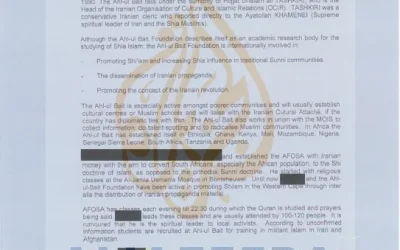
That said — and based on the information available publicly — it´s likely that the company responsible for republishing the article was acting at the behest of Iranian intelligence services in an attempt to shape public opinion regarding the legitimacy of the Syrian opposition.
By late 2013, however, the story had taken a different turn. In the hope of making the conspiracy somewhat more credible — bearing in mind that the most convincing lies are those with a kernel of truth — the remaining pro-Assad and pro-Khamenei propagandists took it upon themselves to embellish it. In this new version of events, they implied that Kanafani had escaped her captors and was safe and sound in Israel, where, according to them, she had been honored for services rendered to the nation. The ceremony in question did indeed take place, and its purpose was to remember and pay tribute to female Mossad operatives. Even so, there is nothing to suggest that Kanafani was ever among the recipients of that honor or that she ever worked for the State of Israel. Unable to prove their claims, the messengers of this conspiracy theory justified themselves by arguing that the absence of evidence was, in itself, proof. And so, in a rather clumsy way, they kept the lie alive, which from then on came to include these details, as false as the original accusation.
Outlandish stories began to multiply, so much so that the original version was no longer even mentioned, and the context in which it had first circulated was completely altered. In 2013, a particularly active year for the spread of theories about Kanafani, a claim began circulating online that women sympathetic to jihad were traveling to countries like Syria in the hope of marrying a jihadist fighter, with sex portrayed as the only way to boost his morale. The theory was eventually dismissed as the product of yet another disinformation campaign, orchestrated by the Assad government to divert attention from its own crimes.
Even so, some either failed to read the memo or chose to ignore it and continued to propagate the lie. On March 17, 2015, the Arab publication Hearts Magazine described Kanafani as one of these women, allegedly duped by the Salafist ideal. By then, however, she was no longer “Dalia Shimon,” the feared Mossad agent, but “Inas,” a 17-year-old Tunisian girl. According to the story, she had been lured into traveling to Syria, where she fell into the clutches of a sinister sheikh linked to the al-Nusra Front. He supposedly forced her to provide sexual services to multiple jihadists in exchange for money — money he then kept for himself.
The story was sordid, almost grotesque, but it served a clear political purpose. At the time, zealots of the Syrian regime regarded the Free Syrian Army and the various branches of al-Qaeda as one and the same, making no distinction between them. And what better way to undermine the opposition’s credibility than to claim that one of its most recognizable figures was, in fact, a sex slave?
Genesis
“In the name of God, the Most Merciful, the Most Compassionate… my name is Thwaiba Kanafani. I am an engineer. I was born in Syria, but I have come from Canada to answer my country’s call. This message is addressed to all free women of Syria: join the Free Syrian Army immediately.” More than an order, her words were a call to the revolution underway. Surrounded by other fighters — almost all of them armed — Kanafani announced to the world that she was on the front lines in the struggle against Assad’s murderous regime. And she did so with unmistakable force and solemnity.
It is said that not even her own family and friends were aware of her intentions. Most believed her involvement would be purely administrative. No one could have imagined how far she would go. With her sleeves rolled up, she looked ready for action. An ammunition belt rested across her shoulders. She had, in effect, become the face of the movement.
The truth is that Kanafani could no longer bear it. News of the civil war left her in a constant state of agitation. Broadcast after broadcast reminded her how the Assad dynasty had reduced the country to rubble; how it had mercilessly killed her fellow citizens. She could not, and would not, remain just another bystander. She needed to see with her own eyes the suffering inflicted on children stripped of any future; she needed to sustain a people starved of hope. When she arrived, she witnessed firsthand the disarray among those tasked with carrying the revolution forward. It did not take long for her to realize that structural changes were needed. At the first opportunity — a revolutionary committee convened in a refugee camp in Turkey — she called for the unification of the various rebel factions. Unsurprisingly, this stance ran up against the established power structure, hardly accustomed to taking orders from a woman.
The Syrian Muslim Brotherhood, however, was far from amused. It found it unthinkable that a woman would have the audacity to put forward ideas and take an active role in shaping a new society. “It can’t be! Where did she get her ideas?” they demanded to know, outraged. Kanafani herself replied that she “knew what needed to be done.” “I am willing to work with Israel and the United States if it helps bring peace. That does not make me a spy,” she shot back. Unsatisfied with her response, they warned her that she would be investigated on suspicion of being an Israeli spy. The seed of doubt had been planted. Paranoia did the rest. She left the committee — whether of her own accord or under pressure remains unclear to this day. Either way, her position had become untenable, and she knew it. Her burning desire to do more and better for her people instilled in her comrades a widespread suspicion that she intended to lead them astray from what they believed was the right path.
There are, however, other factors to consider if we are to understand why this theory spread so widely. In truth, Kanafani was a perfect target. In August 2013, she admitted in an interview with the BBC that she “did a lot of intelligence work.” “We spy on senior government officials,” she said. Perhaps she was unaware of the consequences such a statement might carry. After all, she was a prominent figure in international media circles. It was hardly prudent to speak so openly about involvement in clandestine activities. The naivety with which she did so may well have cost her dearly, further damaging an already fragile reputation. “Who’s to say she isn’t spying on us as well?” The question must, without a doubt, have crossed the minds of the more paranoid.
Regardless of the fervor with which she embraced the cause, Kanafani seemed to have overlooked one small detail: in the eyes of many of her comrades, she was nothing more than an outsider, a gharib, in Arabic. The ideal she had nurtured for so long collided head-on with the dynamics of a backward and distrustful society. She would later admit that “the revolution had been betrayed.” Syria, it seemed, was not yet ready for the stance she had so firmly adopted. Her progressive ideas were perceived as subversive, and her proactive attitude as a threat to the status quo. It is also possible that her relatively moderate position on the Israeli-Palestinian conflict contributed to the way she was treated by some officers, many of whom had spent much of their lives in a state of conflict with Israel.
Finally, one of her most honorable traits — her honesty — only served to ensure that doubts about her true motivations never fully disappeared. In 2015, for example, she told the Canadian newspaper The Star that her activities had been closely monitored by Canadian intelligence services. “I have maintained an ongoing dialogue with the Canadian government. They just wanted to make sure I was heading in the right direction, and I’m fine with that. We spoke a great deal, and we still do,” she added.
This may well have been the final straw. At the time of that interview, Assad’s government was going through one of its most critical phases. The loss of large swaths of territory to various armed groups forced it, once again, to rely on old allies: the Islamic Republic of Iran and Hezbollah. At the same time, it was grappling with the advance of the Islamic State, increasingly brutal and murderous. Yet not even the erosion of its power slowed the Syrian propaganda machine. The truth is that no tactic is more convenient for a government in distress than blaming its own failures on supposed external interference. Kanafani gave everything she had — perhaps even too much. Once the face of the opposition, she was reduced to little more than a scapegoat, a convenient fiction.
By 2024, more than thirteen years after her last interview, it was still possible to find, in the dusty corners of the internet, references to the infamous spy “Dalia Shimon”, a fabricated bogeyman conjured up to frighten the unwary.