
Russian-American-Israeli Palestinian. Palestine is Israel.
The Most Misunderstood Law in the World
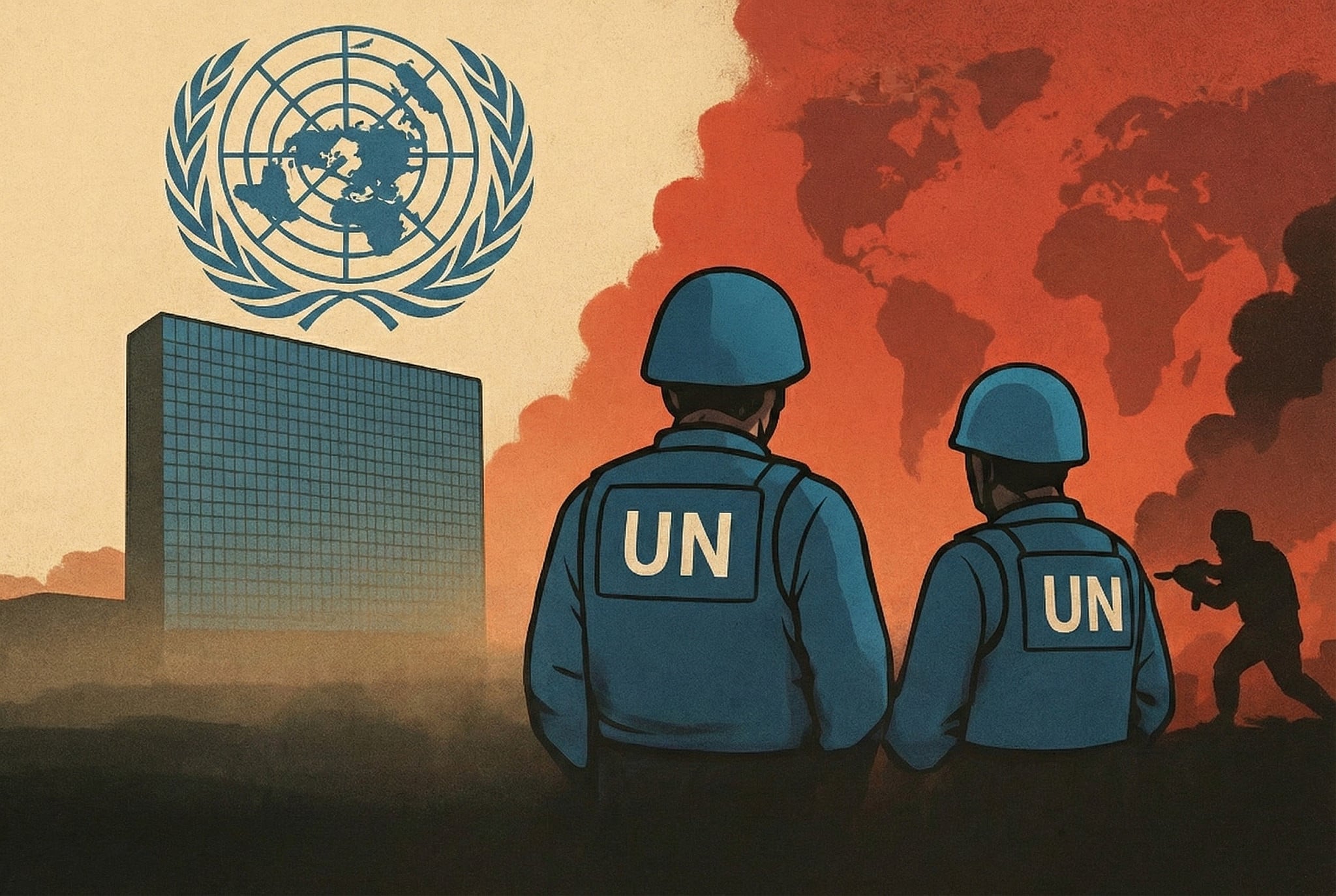
Instead of ending wars, the UN excels at claiming credit for crises that “might have happened” or “could have escalated” but didn’t. Image © Ivan Bassov, 2025. Licensed under CC BY 4.0.
Why “International Law” Isn’t Binding, Isn’t Consistent, and Isn’t Really Law
People speak about “international law” as if it were a functioning legal system—something coherent, authoritative, and binding. The term appears everywhere: in news articles, in political speeches, on social media, in diplomatic statements. It carries an air of seriousness, as if it operates like the legal systems we know inside actual countries. But once you look closely, the entire concept collapses. “International law” is not really law. It is a set of voluntary rules that countries follow when convenient, ignore when inconvenient, and reinterpret whenever politics demands it. The gap between what people think it is and what it actually is may be one of the biggest misunderstandings in global affairs.
The first problem is structural. A real legal system requires three things: a sovereign authority that makes the rules, institutions that interpret them, and an enforcement mechanism—police, courts, the threat of punishment. None of this exists at the international level. There is no world government that legislates, no world police that enforce, and no world court whose rulings cannot be ignored.
The UN is a diplomatic forum with some administrative capacities—not a global government, and not a legislative authority in any legal sense. International courts, including the ICJ and ICC, have no independent enforcement power, depend on state consent, and cannot compel compliance. States routinely ignore their rulings for political or strategic reasons. They are not real courts in the sense of having universal legal authority.
States join treaties voluntarily and can walk away from them voluntarily. They respect rulings when they feel like it and disregard them when they don’t. China dismissed the “binding” arbitration over the South China Sea; Russia invaded Ukraine despite every “prohibition” on aggression; Iran violates Security Council resolutions almost as a matter of policy. Nothing happens to them because nothing can happen. Without enforcement, “law” becomes a metaphor.
Another misconception is the belief that “international law” works like domestic law, with precedents and consistent interpretations. It doesn’t. Every case is treated differently because every case is political. What is condemned in one country is excused in another, depending on alliances, voting blocs, media narratives, and ideological trends. Countries that barely respect the rights of their own citizens comfortably sit on UN committees judging democracies. Dictatorships use the language of “international law” to attack rivals, not to uphold universal standards. The result is not a system of rules but a system of political messaging dressed as law.
Each country has its own branch of domestic law governing how it engages internationally, but these laws differ widely. Since no global legal authority exists to unify or enforce interpretations, “international law” ends up meaning whatever each state — or political bloc — decides it means.
Every act of aggression today is justified by the aggressor with the now-standard phrase: “We act strictly within the bounds of international law.” We heard this from Russia after annexing Crimea in 2014, and again after launching—and continuing—its full-scale war against Ukraine in 2022. We hear it from Iran while waging war against Israel. We even hear it from recognized terrorist organizations such as the Houthis, Hezbollah, and Hamas. They all know perfectly well that there is no such thing as a universal, enforceable “international law,” and that the phrase means absolutely nothing.
The selective enforcement of so-called “international law” is most obvious in the case of Israel. The UN General Assembly has condemned Israel more than all other countries in the world combined—yet its resolutions are non-binding recommendations with no legal effect. If condemning Israel changed anything, Israel would have ceased to exist decades ago. The votes continue because they cost nothing; they solve nothing; and they bind no one. One more condemnation, one less—who cares?
Even on the grandest questions of history, “international law” has never been the decisive factor. The Soviet Union did not dissolve because “international law” ordered it to; it collapsed from internal pressure and geopolitical reality. Yugoslavia did not fragment in accordance with some legal doctrine; it broke apart violently. Germany did not reunify because of a UN resolution but because the Cold War ended. Israel was not reborn in 1948 because “international law” demanded it, but because Jews won a war for survival while the British Empire exited the stage. If “international law” truly shaped outcomes, the map of the world would look nothing like it does today.
The UN often claims that it prevents wars, but its track record says otherwise. It did not stop Russia’s invasion of Ukraine, nor genocides in Rwanda or Bosnia, nor the civil war in Syria. Its “peacekeepers” in Lebanon did nothing to stop Hezbollah from building a massive military infrastructure aimed at Israel; they observed, looked the other way, and allowed it to continue.
UNRWA, created as a temporary refugee agency, has now existed for nearly 80 years and has become part of the conflict it was supposed to alleviate. It maintains a perpetual clientele, teaches radicalization in its schools, and even had employees participate in the October 7 attack. Rather than resolving crises, it ignites and institutionalizes them.
Instead of ending wars, the UN excels at claiming credit for crises that “might have happened” or “could have escalated” but didn’t. This is a convenient narrative because it cannot be disproven. Meanwhile, the world is sliding toward a multi-front world war—Europe, the Middle East, East Asia—and the UN remains a spectator, issuing statements and urging restraint. If this is how “international law” works in practice, it is nothing more than empty rhetoric.
The only real laws in the world are the ones enforced by sovereign states inside their own borders. Even there, sovereignty is not guaranteed. Lebanon, for example, cannot enforce its laws because Hezbollah—a foreign-backed militia—holds more power than the Lebanese state. If a country cannot enforce its own laws, speaking about “international law” between countries becomes even more far-fetched.
What actually governs relations between states is simpler and more honest: treaties, alliances, negotiations, deterrence, military power, economic interests, and political incentives. These shape the real world. They can stabilize or destabilize, evolve or expire, succeed or fail. They are important. But they are not law. Calling them “international law” confuses people, misleads the public, and gives activists and diplomats the illusion of authority they do not possess.
The following fact illustrates the UN’s uselessness clearly: as of November 2025, 157 of the 193 UN member states recognize a “State of Palestine”—a fictitious entity without defined borders, a functioning capital, currency, passports, or independent government structures. Terrorist organization Hamas operates in Gaza, but it is neither a recognized state authority nor representative of a sovereign state.
By contrast, only 11 UN member states—mostly microstates—recognize Taiwan, a fully functioning country with modern institutions, industry, and global scientific contributions. It is even more hypocritical given that Taiwan was once a UN member but was replaced by the People’s Republic of China in 1971.
The “State of Palestine” has no citizens in the legal sense, unless one counts the entire UNRWA clientele it administers. Recognition by UN members is purely symbolic; it does not confer sovereignty or enforceable authority. This contrast exposes a clear double standard: a global superpower’s rival, Taiwan, is ignored, while a fictitious entity, “Palestine,” is recognized by the majority of the world—as a political tool against Israel. These symbolic recognitions make no practical difference, highlighting the UN as a theater without real power.
I don’t blame people who build careers in “international law”; much of it is bureaucratic spectacle—costly, riddled with red tape, controversies, and corruption. Some probably even manage to support their families through it. But we should at least be honest about what the field is: not a system of enforceable rules governing states, but a vocabulary we use to make political arguments sound like legal obligations. The world is not governed by a global legal code. It is governed by power, interests, agreements, and the willingness of states to act.
Once we acknowledge this—without the romanticism—the world becomes easier to understand. And far harder to manipulate with empty phrases and “resolutions.”
See Also
Related Topics