The mothers we become
There is a woman in the book of Samuel who prayed so hard for a child that the priest watching her mistook her for a drunk. Her lips moved. No sound came out. She promised God that if she was given a son, she would give him back, and then she kept that promise in a way I still do not fully understand, weaning him young and delivering him with her own hands to a house that was not hers, to be raised by someone else, to grow up seeing his mother once a year.
Hannah’s prayer became the model for how Jewish tradition understands prayer itself, quiet, wordless, born in the heart before it ever reaches the mouth. I used to think her story was about longing for a child. Now I think it might be about something harder, about what a mother does with a love that has nowhere left to go once the child she prayed for is no longer hers to hold every day.
After birth, a mother’s womb slowly folds itself back into the body until, from the outside, it is almost impossible to tell it was ever stretched at all.
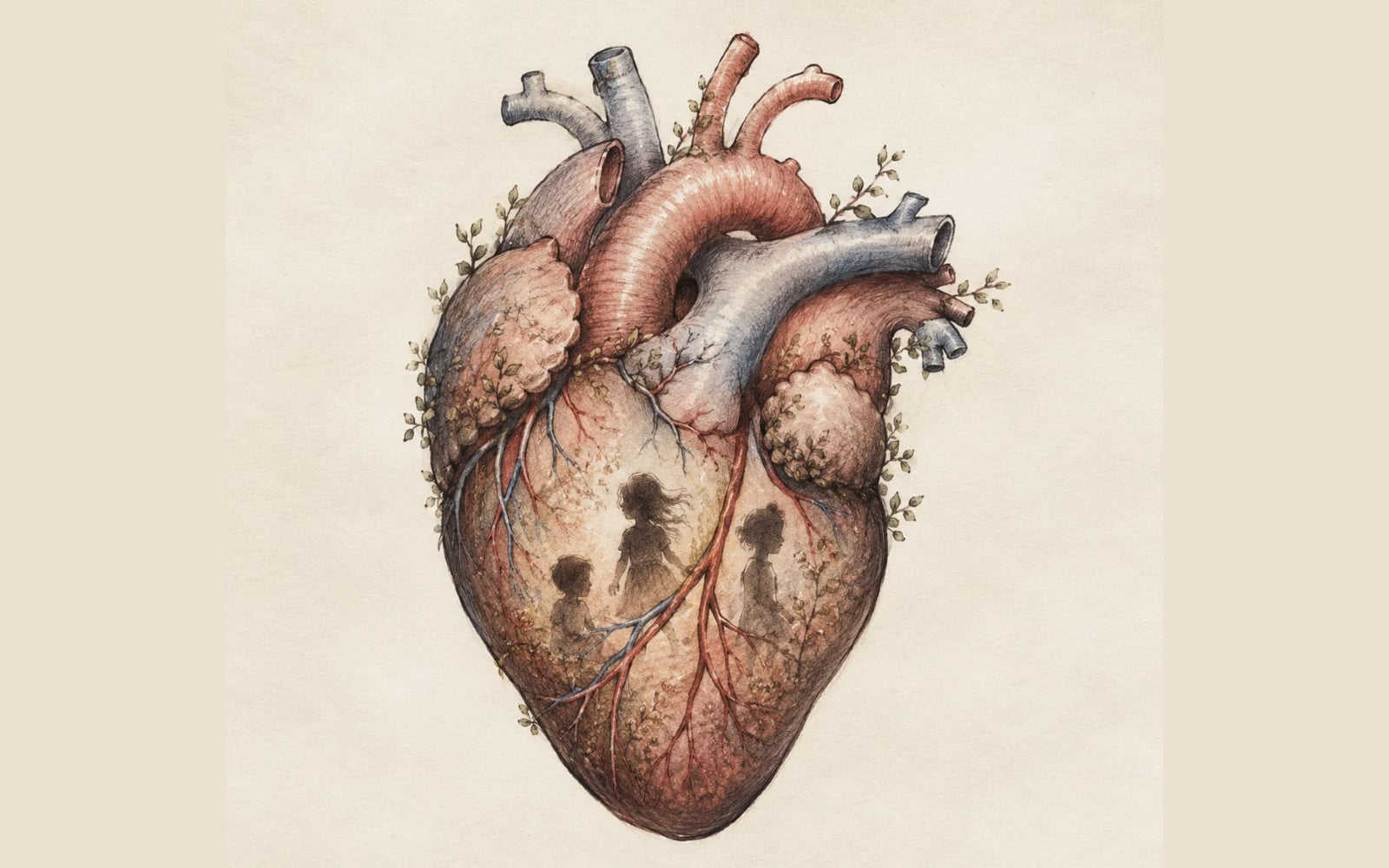
The heart never does.
It keeps the shape of every child who has ever lived inside it, permanently widened by each child who passed through her into a body of their own. My heartbeat has sounded different since becoming a mother. Sometimes it carries a quiet, expansive joy, the kind that heals old places inside me I did not know were still waiting to be loved. Sometimes it pounds with the terrifying knowledge that pieces of me now walk through the world in bodies that are no longer mine to protect.
When my oldest daughter stepped onto the camp bus this summer, I felt my breath go with her. My arms stayed rooted where they were. What I remember is the sidewalk growing hotter beneath me, as if I could melt directly into the asphalt and remain there until she returned.
I thought the ache of her empty chair would be easier this time. Last year had been so transformative for her that I assumed the memory of that experience would soften the leaving. I packed her trunks without crying, labeled everything, and told myself I had already learned this lesson.
I was wrong.
Instead I find myself drawn to her room every night, saying goodnight to an empty bed, still left unmade from the morning she left.
Being a parent means constantly chasing pieces of your own heart outside of your body. No one warns you how much that will hurt. I watch her in my mind, just as serious now as she was the day she was born, and the terrifying thought comes to me that she has already spent more summers with us than are left for her as our child. One day she will walk out of that bedroom as a fully grown adult, and I will wonder when exactly she became someone grown enough to leave.
Every year, Hannah made her son a small robe with her own hands and brought it to him when she visited, the one act of mothering left to her, sewing for a body she no longer got to see grow. I labeled shoe boxes and folded shirts into a trunk destined for a bunk four hours away, and I understood her a little better than I wanted to. So much of mothering, once a child begins to leave, becomes this. Finding some small, physical thing you are still allowed to do for a person who no longer needs you to do very much at all.
Parenting books are filled with tricks and tips for getting through the so called hard years, the ones where children are so little and the meltdowns feel endless. So little is written about the years after, the in between years, the ones where a child still carries the shape of who they were while beginning to reach for who they will become. No one told me, as a young mother, that the work of returning to my own body would be far easier than the work of fitting my scarred, stretched out heart back into my chest.
I passed a dollhouse in the attic the other day and noticed she had fixed everything up since the last time it was disturbed, beds made, chairs tucked neatly under the table, as though tending to a world she is already beginning to outgrow. I remembered her chubby fingers years ago, trying to fit dolls through a doorway too small for her hands, knocking over furniture with every attempt. Now she is somewhere far away writing stories, making friends, becoming someone I will only know through the pieces she chooses to bring home.
When we returned from a short trip last week, her younger sister ran through the house calling her name, certain she would come running down the stairs. When the truth landed, that her sister was still at camp, I watched a small face fold into confusion and then the particular grief of a toddler discovering that something she loves is missing. A moment later she had moved on to a toy in the hallway. I stood there a while longer, listening to its wheels bump over the threshold between one room and the next, wishing my own heart could cross thresholds as easily as a toy does.
When I lit Shabbat candles that first week without her, I still looked to my right, where she usually stands beside me, half expecting to hear her voice whispering the blessing along with mine. The absence followed me to her empty chair at the table, to the quiet where her laughter usually pulls her younger siblings into giggles we love and are also, always, a little undone by. It followed me into the space where there should have been one more story to hear before the plates were cleared. It followed me into my dreams, where I got to hear her voice again.
The word for womb, rechem, shares its root with rachamim, compassion. I do not think that is an accident of language. I think the sages who noticed it understood something Hannah lived and something I am only now beginning to learn, that the body which stretches to carry a child is only the first vessel love will need. The heart is the one that keeps stretching long after, and it does not ask permission before it does.
I still go to her room at night. I smooth the corner of a bed no one is sleeping in. I do not know how a heart is supposed to hold a child who is still here in every room of the house and also far away becoming someone new. Hannah found her answer in a small robe made once a year. I am still looking for mine, one empty bed and one lit candle at a time. Perhaps that is what the tradition has been trying to tell mothers all along, that we were never meant to hold love in one fixed shape. We were only ever meant to keep stretching to hold the next one.
Last summer I waited for her to come home.
This summer I keep finding pieces of her that stayed behind.