The Murky Middle
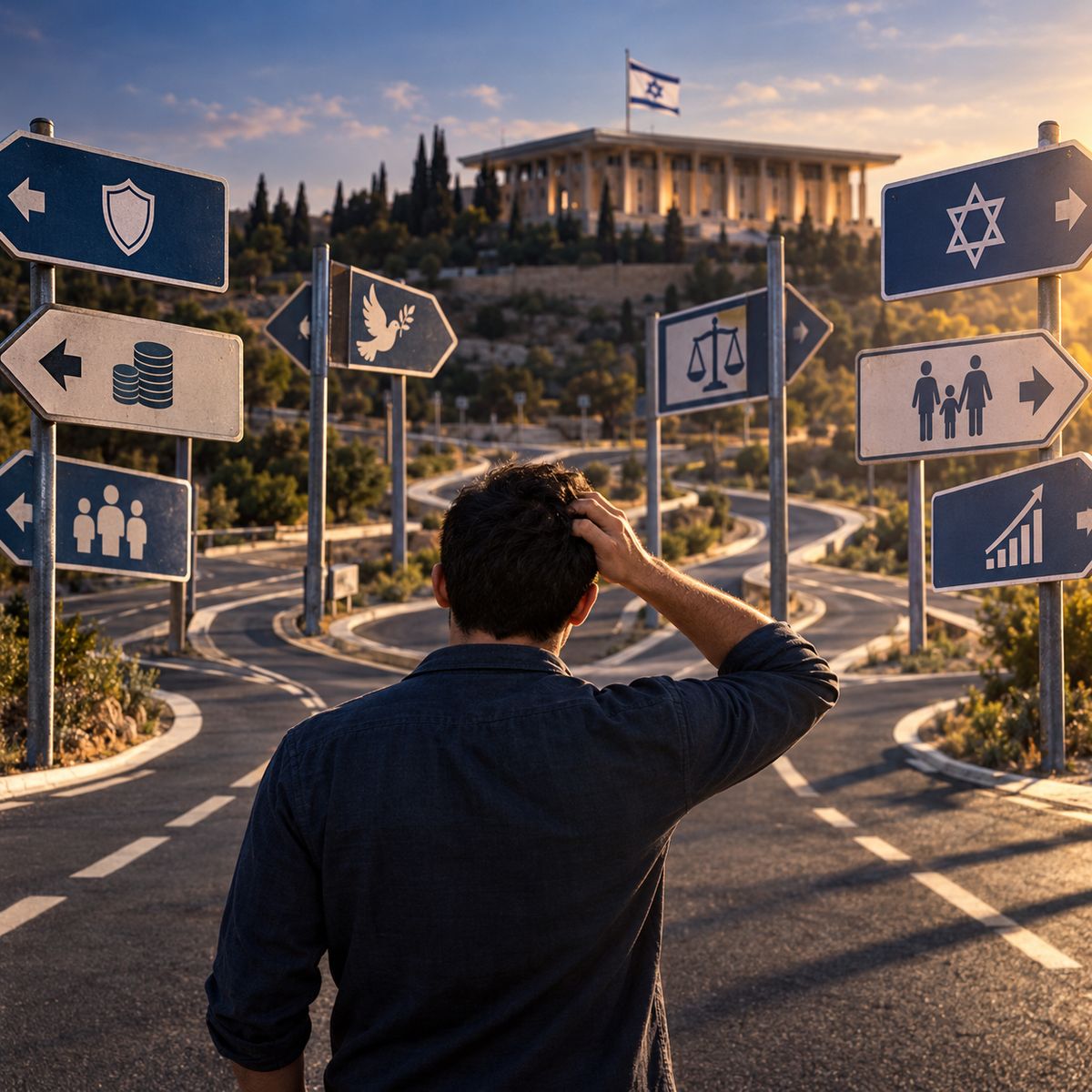
Many of us find ourselves in a murky political middle. Contrary to popular belief, the problem is not that nobody represents us. It may be that too many people do. But staying home is the worst response.
As Israel heads towards another election, I increasingly suspect that one of the biggest political risks is not polarization.
It may be participation.
In the last election, 29.4% of eligible voters stayed home. That was a larger share of the electorate than the support won by any individual party. Which raises a question: what if some of the voters most likely to stay home this time are not those on the political fringes, but those in the murky middle?
By “middle,” I mean something much broader than the traditional political centre.
I am not politically vague and I am not new to politics. I studied political science and have lived in Israel for almost twenty years. I am a Religious Zionist and instinctively centre-right, particularly on security and on the need for a strong Jewish and democratic State of Israel. I have little patience for political extremism and none for violence by Israelis outside legitimate self-defense.
I want the Abraham Accords to expand. I hope that one day there will be genuine peace with our neighbours. But for me, peace must be built on security, recognition and the rejection of incitement and hatred towards Israelis and Jews.
October 7, and having a son who fought in Nahal Oz, Be’eri, Gaza and Lebanon, removed whatever innocence I may still have had about the threats Israel faces.
My problem is not that I believe in nothing. It is that I believe in several things at once. I suspect that makes me less unusual than it sounds.
Many Israelis live with political tensions that do not fit neatly into a single box. We can be hawkish on security while worrying deeply about how the country governs itself. We can value Jewish tradition while feeling uncomfortable with extremism. We can be passionately committed to Israel’s security while caring enormously about how it treats all its citizens.
That is the murky middle. Not people without principles, but people whose principles do not point in only one direction.
Once I apply my own red lines, there are parties I simply would not support. But I am still left with several parties competing in broadly the same political space. The differences matter. Leadership matters. Judgement matters. Integrity matters. Policy matters. Service by all matters. The people surrounding a leader matter. So does the coalition that party might ultimately help create.
Yet the distinctions are often far smaller than the differences between the wider political camps. And that can make voting harder.
It is often easier to vote against something than to vote for something. If you believe a particular camp fundamentally threatens what you care about, your choice may be relatively straightforward. You may not adore your chosen party, but you know what you are trying to stop.
The murky middle faces a different challenge. It is not primarily deciding who to vote against. It is deciding who to vote for.
That requires harder judgements. Which leader? Which team? Which priorities? Which compromises? Which coalition? At some point politics becomes less about ideology and more about judgement.
Early in my career, I learned a principle that applies far beyond business: KISS. Keep It Simple, Stupid.
Political distance creates its own form of simplicity. A crowded political middle does not.
I was reminded of this recently when I completed one of the independent election questionnaires. I was not looking for someone to tell me what I believe. In truth, I had already largely decided where my vote was going.
Yet the results were revealing. Two parties matched me at roughly 80%, with another above 70%.
That did not tell me nobody represented me. It told me the opposite.
Several parties represented substantial parts of what I believe.
And therein lies both the strength and the weakness of the murky middle.
It is not politically homeless.
It is politically crowded.
That leads to my hypothesis. Not that the political middle is uniquely apathetic. Not that most non-voters are centrists. And certainly not that political complexity is the only reason people stay home.
Simply this: when several parties sit relatively close to your own position, choice can become harder rather than easier.
And when choosing becomes harder, some people may stop choosing altogether. Political frustration, uncertainty and complexity can create their own form of disengagement.
That matters because elections are not shaped only by people who switch sides. They are also shaped by people who choose not to participate.
The answer is not to find the perfect party. Most of us never will.
The answer is to know our principles, establish our red lines, accept that no party will ever represent us completely, and then make a choice.
The greatest threat to the murky middle may therefore not be that nobody speaks for it. It may be that, faced with too many voices, it stops speaking for itself.
And that would be the greatest irony of all: voters with plenty of political choices allowing others to make the choice for them simply by staying home.