
יהוה הוא פועל ✡︎ Ha'Shem is a Verb.
The Myth of Jewish ‘Settlements’ in Judea: Arab and European Colonial Projection
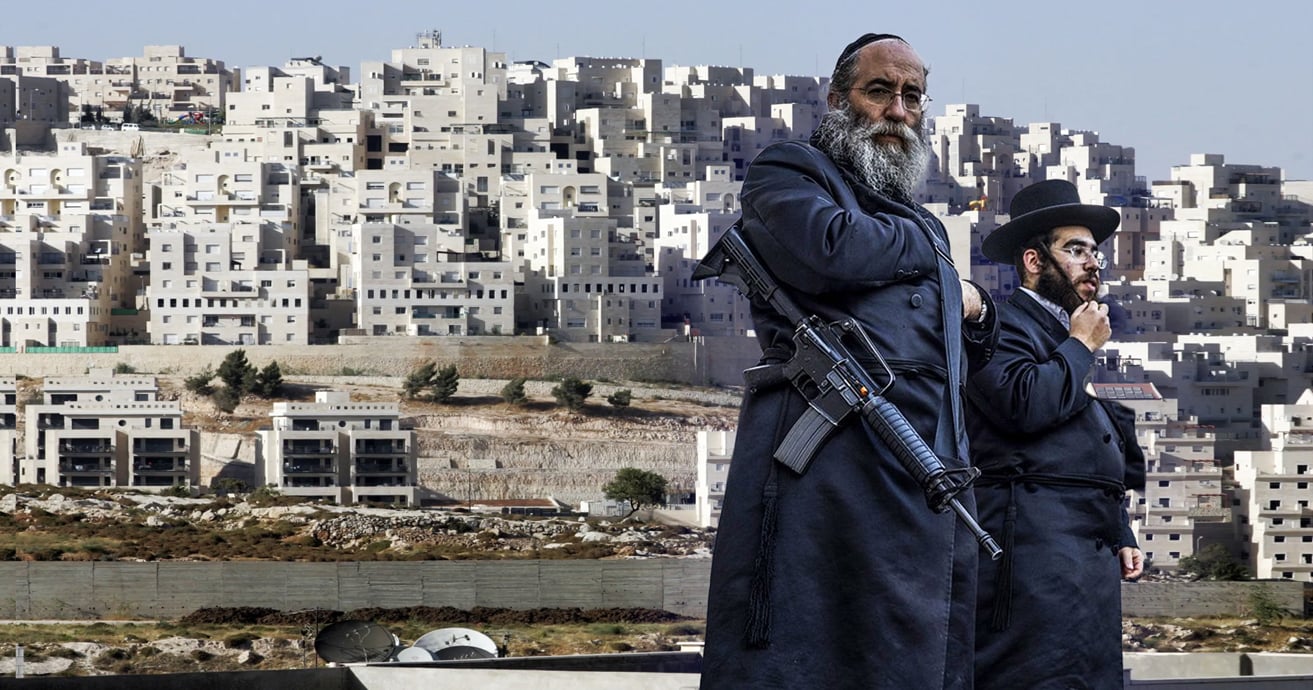
Image used with permission, from the Hashlamah Project.
The phrase “Jewish settlement” is widely treated as a neutral legal description, but it rests on a mistranslation, a historical erasure, and a selective application of colonial theory. When the Hebrew term yishuv (ישוב) is examined philologically, comparatively, and historically, the modern indictment collapses. What remains is not linguistic accuracy, but a political narrative enforced through vocabulary.
Why “Jewish Settlement” Is a Misleading Term
The contemporary political phrase “Jewish settlement” circulates as though it names a self-evident historical and legal reality: Jewish civilians implanted into territory presumed to have been previously free of Jewish presence, under conditions that render such habitation inherently suspect. Yet this usage rests not merely on political disagreement but on a fundamental misuse of language. It depends on an anachronistic translation, a selective memory of twentieth-century history, and a strikingly asymmetrical application of colonial theory.
Crucially, the term does not simply criticize particular Israeli policies. It embeds condemnation at the lexical level. To call a Jewish town a “settlement” in the modern political sense is already to declare it morally illegitimate before any historical, legal, or linguistic argument has begun (Veracini). This is not neutral description. It is verdict disguised as vocabulary.
The Erased History of 1948–1967
Between 1948 and 1967, Jews were forcibly expelled from Judea and Samaria—later labeled the “West Bank”—by the Hashemite Kingdom of Jordan. Jewish communities in Hebron, Gush Etzion, and the Old City of Jerusalem were destroyed or emptied; Jews were barred from returning; property was seized or reassigned; and access to holy sites, including the Western Wall, was prohibited (Muravchik; Shlaim). These outcomes were not incidental byproducts of war. They were the result of Jordanian state policy that legally forbade Jewish residence, ownership, or even entry.
This matters because the dominant narrative silently treats 1967 as the beginning of Jewish presence rather than the end of an enforced absence. Judea and Samaria were not a neutral, Jew-free space into which Jews later intruded. They were a space from which Jews had been explicitly removed and legally excluded.
Even the term “West Bank” encodes this erasure. It originates not in antiquity but as a Jordanian administrative designation referring to the western bank of the Jordan River within a Hashemite kingdom that then claimed sovereignty over both banks (Shlaim). That nomenclature reflects a mid-twentieth-century Arab state project, yet it is treated as politically neutral, while Jewish historical claims are treated as inherently ideological.
How “Settlement” Became a Moral Verdict
Modern political discourse treats Jewish presence beyond the 1949 armistice lines as presumptively illegitimate, while the region’s Arab imperial history is normalized as background. The Arab conquests of the seventh century reshaped the Levant through military expansion, administrative replacement, linguistic Arabization, and religious hegemony. Yet this history is almost never described using the moral-legal vocabulary of “settlement” or “colonization.”
The asymmetry is stark. Arab presence is framed as native continuity; Jewish presence is framed as intrusion. From 1948 to 1967, Jews were legally barred. From 1967 onward, Jewish residence is redescribed not as return or re-inhabitation but as colonial offense.
This reframing is reinforced by contemporary Palestinian law and practice. Under Palestinian Authority jurisdiction, drawing on inherited Jordanian statutes, PLO revolutionary penal codes, and subsequent PA court interpretation, Palestinians are prohibited from selling privately owned land to Jews as such, regardless of citizenship. In practice, this ban has been enforced not only against transactions involving Israeli citizens but also against American, European, and other non-Israeli Jews. PA officials and courts have repeatedly treated such sales as acts of national betrayal, meaning that Jewish legal residence or property ownership is impermissible under PA jurisdiction even when no Israeli citizenship is involved. In Gaza, under Hamas rule, the prohibition is even more explicit and categorical.
At this point, “settlement” no longer names a policy or an act. It becomes a status offense attached uniquely to Jews.
What Palestinian Law Actually Says About Jewish Land Ownership
The claim that Jewish presence is treated as inherently illegitimate under Palestinian Authority jurisdiction is not rhetorical. It is embedded in law and reiterated in official statements. While the Palestinian Authority does not rely on a single modern statute, it enforces a layered legal regime inherited from Jordanian law and reaffirmed through PLO and PA judicial practice.
Central among these is Jordanian Penal Code No. 16 of 1960, which remains in force in the West Bank under PA administration. Article 114 criminalizes actions deemed to endanger “the integrity of the state,” a provision that PA courts have repeatedly applied to land transactions involving Jews. More explicitly, the Jordanian Law for the Prevention of the Sale of Immovable Property to the Enemy (1953) prohibits the transfer of land to parties designated as hostile. In PA legal interpretation, that category has consistently been understood to include Jews and Israelis as such, not merely Israeli state entities.
PA indictments and court filings routinely describe the offense not as selling land to “foreign nationals,” but as selling land to “Jews” (al-Yahūd, اليهود). Palestinian prosecutors have argued that such sales constitute “high treason” (khiyāna ʿuẓmā), a formulation echoed by senior PA officials. Mahmoud Abbas himself has repeatedly declared that Palestinians who sell land to Jews are traitors deserving the harshest punishment, without qualification by citizenship.
This interpretation is reinforced by PLO Revolutionary Penal Code provisions, which treat land transfer to Jews as a national security crime. Under these codes, penalties have historically included life imprisonment with hard labor and, in earlier formulations, capital punishment, subject to presidential approval. While executions are rare, arrests, prosecutions, and extrajudicial violence against alleged land sellers are well documented by human rights organizations.
The critical point is that the operative category is not Israeli citizenship. It is Jewish identity and perceived Zionist affiliation. American, European, and dual-national Jews have been treated identically to Israeli citizens for purposes of enforcement. In practical terms, this means that a Jew who is not Israeli can still be legally barred from owning property or residing as a landowner under PA jurisdiction, not because of nationality, but because of identity.
In Gaza, under Hamas rule, the matter is even more explicit. Hamas legislation categorically forbids land sales to Jews, full stop. Nationality is irrelevant. Jewish ownership itself is treated as impermissible. The distinction sometimes drawn in international commentary between Israeli state action and Palestinian legal norms therefore collapses on inspection. Jewish presence is delegitimized even in the absence of Israeli citizenship, Israeli military authority, or Israeli state sponsorship.
This legal reality matters because it exposes the semantic function of the word “settlement.” The term does not merely criticize Israeli policy. It masks a regime in which Jewish dwelling itself is treated as unlawful, while Arab habitation — including habitation rooted in conquest — is treated as native and unproblematic. The accusation is not about how Jews live there. It is about whether Jews may live there at all.
Why This Legal Context Cannot Be Ignored
Once this legal context is made explicit, the linguistic argument sharpens. A discourse that treats Jewish residence as presumptively criminal while embedding that judgment into translation cannot plausibly claim neutrality. The word “settlement” does not describe a violation that arises only after Israeli administration. It functions to retroactively justify a legal and political order in which Jewish presence was already prohibited.
Seen in this light, the modern vocabulary does not explain the conflict; it participates in it. By turning dwelling into an offense and presence into provocation, language itself becomes an enforcement mechanism. The mistranslation of yishuv (ישוב) is therefore not an incidental error. It is the linguistic keystone that allows a status-based exclusion to present itself as a technical legal critique.
A European Category Forced Where It Doesn’t Belong
In contemporary political theory, “settlement” is not a neutral term for dwelling. It is a juridico-moral category forged in early modern and modern European imperial practice. In British, French, Spanish, Dutch, and later American empires, settlement referred to the deliberate implantation of civilian populations as instruments of domination, sovereignty, and demographic control (Pagden).
Enlightenment political philosophy supplied the justification. Locke’s labor theory of property rendered land not “improved” according to European norms effectively empty, legitimizing dispossession and doctrines such as terra nullius (Locke; Mehta). Within this framework, settlement was inseparable from empire.
Twentieth-century anti-colonial theory correctly indicts this structure. Fanon describes the settler world as a compartmentalized order maintained by force; Said shows how scholarship, cartography, and language normalize imperial presence (Fanon; Said). Settler-colonial studies further sharpen the critique, defining settler colonialism as a structure oriented toward elimination and replacement rather than a discrete event (Wolfe).
Within this literature, any designation even called a “settlement” is already condemnation, regardless of its nature, or the ethnogenesic origin of the people residing there.
When Translation Becomes Anachronism
The problem arises when this historically specific category is universalized and retrojected into contexts that lack the institutional ecology that gave it meaning. The modern condemnatory sense of “settlement” presupposes centralized sovereignty, an external metropole, demographic engineering, and legal regimes converting civilian presence into title. None of these conditions are linguistic.
International law intensifies the confusion. Article 49(6) of the Fourth Geneva Convention prohibits an occupying power from transferring its civilian population into occupied territory—a provision drafted after World War II in response to modern state atrocities. It regulates conduct; it does not define ancient semantics.
When legal condemnation is smuggled into translation, law is mistaken for language. This is anachronism weaponized as philology.
What Yishuv (ישוב) Means—and Does Not Mean
The Hebrew noun yishuv (ישוב) derives from the Semitic root Y-Sh-B (י־ש־ב): to sit, dwell, remain, inhabit. It describes a state of presence, not an act of conquest or sovereignty. This is lexical fact, not interpretation (Koehler–Baumgartner; Clines).
Its derivatives—moshav (מושב, dwelling place), toshav (תושב, resident or sojourner), yeshivah (ישיבה, literally “sitting,” later a study institution)—preserve the same neutral semantic core. Biblical law explicitly recognizes dwelling without ownership or sovereignty in the category of toshav, demonstrating that habitation is not domination by definition (Lev. 25:23–35; Milgrom).
When Hebrew intends conquest or seizure, it uses different roots (kibbush כיבוש, yerushah ירושה), not Y-Sh-B (Sarna). The claim that yishuv encodes colonial domination has no textual support.
Dwelling Is Not Domination
The moral neutrality of yishuv becomes clearer when read alongside its conceptual twin, Shabbat. The root Sh-B-T (ש־ב־ת) sanctifies time through cessation rather than control. Shabbat is defined by restraint of power, not by expansion (Exod. 20:8–11; Heschel).
Rabbinic literature preserves the same grammar for space. Yishuvo shel olam—the settledness of the world—names social stability and ordinary human life, contrasted with tohu (desolation), not with injustice (Berakhot 17a; Steinsaltz). Hebrew cognition distinguishes dwelling from domination as sharply as it distinguishes rest from labor.
Why Arabic Habitation Is Treated Differently
Comparative Semitics makes the asymmetry unmistakable. Arabic habitation vocabulary occupies the same semantic field as Hebrew Y-Sh-B. The root S-K-N yields suknā (سكنى, residence) and maskan (مسكن, dwelling). Q-W-M yields iqāma (إقامة, remaining or residence). Most revealingly, the root ʿ-M-R yields ʿumrān (عمران), Ibn Khaldūn’s central concept for habitation and civilization itself (Wehr; Ibn Khaldūn).
These terms are not routinely glossed as “settlement” in the colonial sense, even in contested contexts. This is striking given the scale of Arab imperial expansion, which at its territorial peak encompassed roughly 11–13 million square kilometers across three continents. Identical semantic categories are neutralized for Arab habitation and politicized for Jewish habitation.
This is not a linguistic distinction. It is a narrative one.
International Law Is Not a Dictionary
Legal critique cannot rescue the mistranslation. International humanitarian law governs modern state conduct; it does not rewrite ancient roots (Koskenniemi). Treating yishuv as “settlement” because “illegal settlements” is the operative condemnation embeds verdicts into vocabulary and bypasses evidence.
Even settler-colonial theory does not license this move. Wolfe repeatedly emphasizes that settler colonialism is a historically bounded structure, not a universal description of habitation (Wolfe, Traces of History).
Selective Outrage and Colonial Amnesia
Once the full frame is restored, the phrase “Jewish settlement” functions as colonial amnesia. It ignores Jordan’s 1948–1967 exclusion of Jews, exempts Arab imperial history from scrutiny, and collapses distinctions between conquest, exclusion, and return.
Jewish return is redescribed as colonization. Arab conquest is redescribed as indigeneity. European colonial vocabulary is mobilized not against empire as such, but against a single people whose presence is rendered uniquely suspect.
The corrective is not to foreclose political debate. It is to refuse to launder verdicts through dictionaries. Yishuv (ישוב) means dwelling—inhabitation, presence. “Settlement,” in the modern condemnatory sense, is a late European juridico-imperial construct. The two are not equivalent.
Related Topics