
The National Whiplash Effect
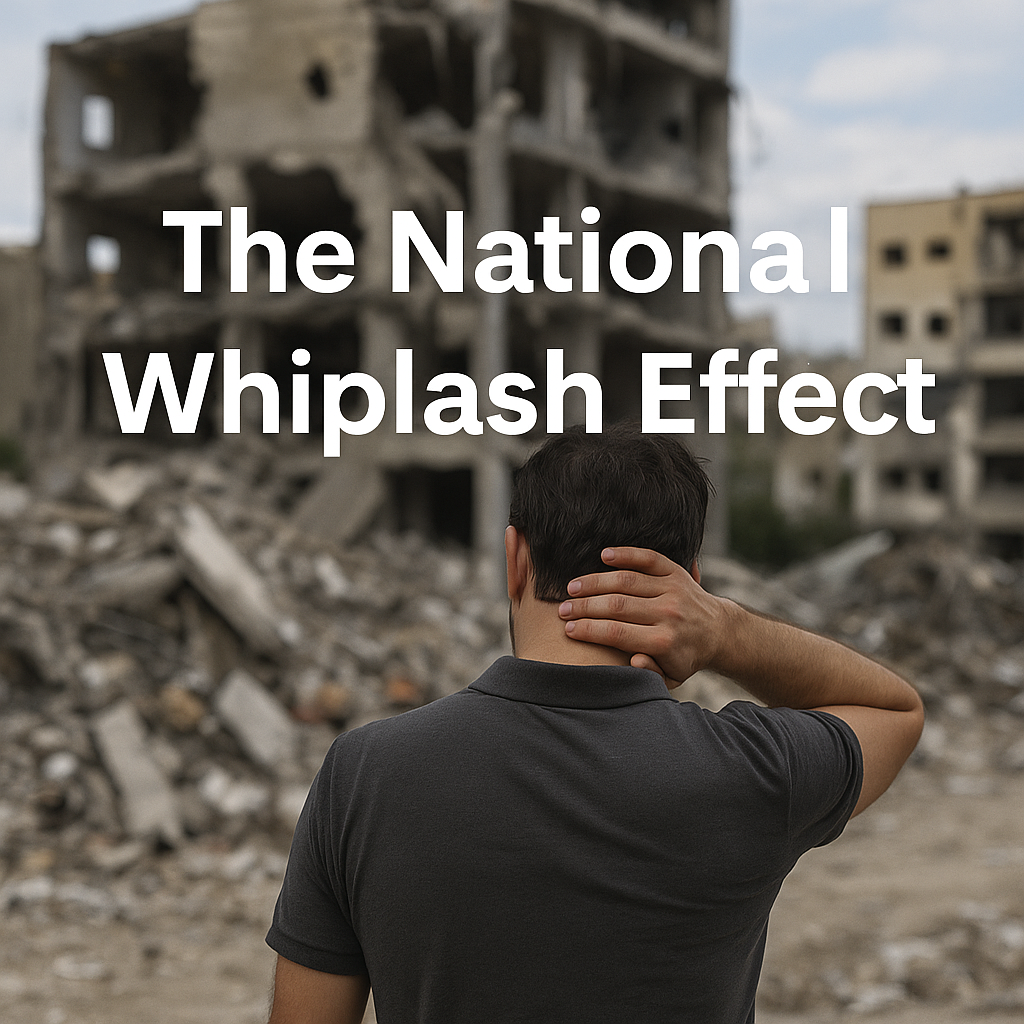
Just yesterday, we were at war. Not last week. Not last month. Yesterday.
It wasn’t a theoretical war, and certainly not metaphorical. It was war in the clearest, most harrowing sense—filled with death, destruction, and dread that hovered above us day and night.
Sirens wailed at every hour. People ran for shelter. Missiles streaked across the skies seeking their target. Phones buzzed constantly with red alerts and endless news updates. For nearly two weeks, our children trembled in stairwells and safe rooms, and we adults did the best we could to keep some semblance of sanity during these chaotic times.
An entire nation, gripped by uncertainty and fear, stretched to its emotional and physical limits. Whether you were in the north, south, center—or even watching from abroad, the tension was real and exhausting.
And now?
The war is “over.” A ceasefire has been declared. A sigh and a breath of freshly brushed teeth can be taken. Victory speeches were delivered on both sides of the aisle. Headlines of goals met and military superiority lead the news feed.
For the regular citizen, it means classes are back in session, businesses are reopening, and the beat of our nation’s heart is back to a steady pulse. Even those teenagers who just days ago were certain that all their summer plans were a bust can now once again cautiously hope for their long-awaited Chofesh Hagadol (summer vacation).
Literally overnight, we are all expected to go back to normal—immediately. Go back to the future and move on.
But here’s the thing: we can’t. We’re not built like that. We are all suffering from what I call the National Whiplash Effect.
While the World Continues to Spin, Where Are We?
No, we didn’t all suffer physical injuries, albeit too many of us did. The majority of the country carries invisible wounds. Anxiety, sleeplessness, fear, and grief, to name a few. Our minds and hearts are still spinning from the past two weeks, even as the world around us presses on.
But people aren’t machines. There’s no F5 key to reboot our nervous systems and refresh our resilience in a flash.
In the mid 70’s of the last century, a renowned psychologist and researcher, Dr. Bessel van der Kolk, explained that trauma isn’t just an event or incident. We must include the time it takes to process it as well. When forced to “move on” too quickly, many of us can end up emotionally stuck.
So while the war is over and the missiles have stopped, we have to ask: Is it really over for us?
Can Routine Really Restore Us?
There’s no one-size-fits-all answer. For some, routine is exactly what is needed. The familiar rhythm of brushing teeth, making lunches, heading to work or school, grounds us. These small acts remind us: I’m alive. The show must go on.
But for others, at present, the return to “normal” life can feel nearly impossible. Even cruel so soon after the tragedy. And that’s okay too.
What matters is recognizing and feeding your own needs, while at the same time allowing others to experience their own process.
So… What’s Next?
As President Jed Bartlet liked to say at the end of nearly every episode of The West Wing, “What’s next?” That’s the million-dollar question facing us all right now.
Where do we go from here, and even more importantly, how do we get to where we want to be, able to resume regularly scheduled lives away from the flashbacks and instead look forward to summer plans and even those work deadlines?
Here, we might draw inspiration and guidance from our own Jewish tradition.
When someone dies, we don’t just wipe our tears away and go back to work. We sit shiva. We surround ourselves with family and stories. We’re supported. Then comes Shloshim, the first thirty days of mourning. After that, for a parent, a full year of grief is prescribed. Slowly, but steadily, the regular rhythm of life returns. Just don’t rush it.
Judaism recognized what modern psychology has only recently affirmed: grief takes time.
Some of us may need a kind of shiva right now—to talk, to cry, and remember. Others may be at their own version of shloshim before being able to re-enter the world. While some may have a long road back, especially if their homes were destroyed or their loved ones were killed.
Kol Yisrael Arevim Ze L’Ze: You Are Not Alone
Still, the country must move forward. We need to work. To study. To rebuild. We need to laugh, have fun, enjoy, and dance.
That doesn’t mean we can’t cut ourselves a little slack. Understand that if your stomach drops at the sound of an ambulance passing by, or if you flinch when the wind whistles through a crack in the window, you’re not broken. You’re simply human and recovering.
So talk to someone. Call a friend. Find a therapist. Meet with a rabbi. There is no weakness in saying, “I’m not okay.” Naming it is often the first step toward dealing with it.
After all, our sages teach: “Lo alecha hamlacha ligmor, v’lo atah ben chorin l’hibatel mimena.” It is not upon you to complete the task necessarily, but neither are you free to waste the opportunity.
We may not be fully ready, but we can take the first step. Together. For, time heals all wounds.