
The Nazi drag queen
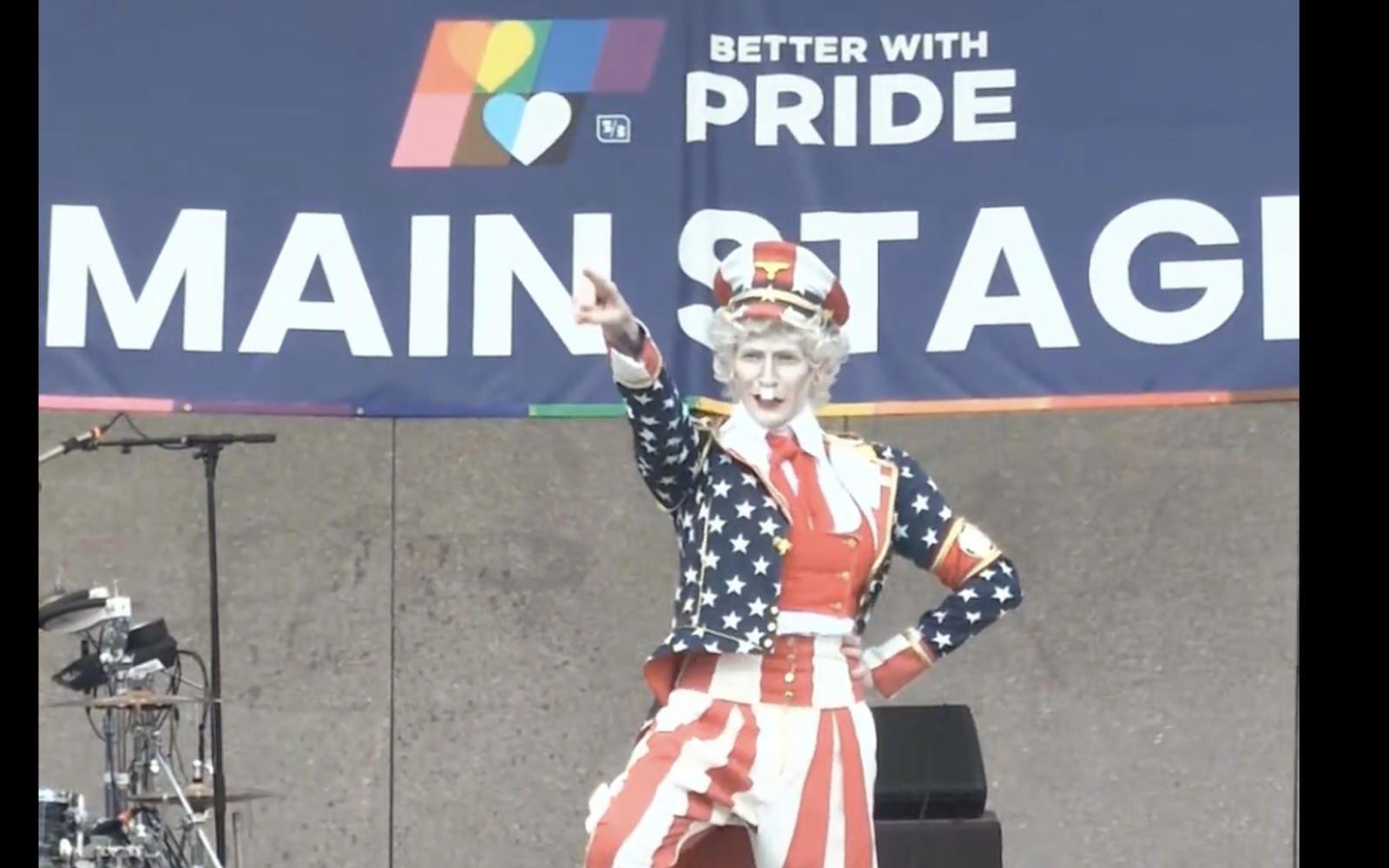
“Did you hear about the Nazi drag queen?” a friend asked me a few days after Cincinnati Pride.
For the past year, I have written about antisemitism and anti-Zionism in Cincinnati because I grew tired of the silence. Since October 7, Cincinnati has had its share of incidents: banners stretched across the interstate, a desecrated Jewish cemetery, Hillel students trapped inside a campus building, a Jewish man assaulted after removing antisemitic graffiti and more. Each new incident generated a few uncomfortable conversations before fading away. Cincinnati is not New York, people told themselves. True antisemitism does not happen here.
That denial had already shaped Cincinnati Pride’s relationship with the Jewish community. In 2024, an anti-Zionist pressure campaign culminated in the resignation of Pride’s Jewish board members after being harassed and doxxed. Despite extensive discussions with the Board about the matter, Jewish participants were ultimately advised to march from an undisclosed location and refrain from wearing visible Jewish symbols.
This year appeared different. After months of difficult conversations, the Mayerson JCC bus returned, draped in rainbow flags. Off stepped rabbis, retirees, parents and teenagers wearing rainbow kippot, Pride shirts and Star of David necklaces. It felt as though two difficult years had finally led somewhere.

Then Cincinnati Pride featured drag artist Judith Iscariot as “Schutzstaffel Sam” – a deliberate reference to the Schutzstaffel (SS), who operated the concentration camp system and much of the Nazi regime’s Holocaust. Iscariot fused Uncle Sam with Third Reich iconography: a stars-and-stripes suit, Reich-style cap, swastika armband and gold boots. She later said the character represented the “American Reich.”
For more than 20 minutes, Schutzstaffel Sam marched through the parade repeatedly performing the Sieg Heil with a pointed finger. On the main stage, protesters carried signs reading “Zionism Has No Place at Pride,” “Guardians of Pedophiles” and “One Day This Country Will Wake Up to His Obituary.” Schutzstaffel Sam then raised a gold pistol and fired into Lady Liberty’s head. As Liberty collapsed, Iscariot twerked over her body, stomped on it and ended with another Nazi salute.
I replayed the videos, convinced I had missed something. Surely someone would stop her. Surely the crowd would fall silent. Instead, people clapped. Some cheered. Pride reset the stage and moved on.
After Jewish community members raised concerns, Cincinnati Pride apologized specifically for the anti-Zionist signs and claimed it had no prior knowledge of the act. However, the board had seen Schutzstaffel Sam three months earlier at its Mx. Cincinnati pageant.
During the Mx. Cincinnati performance, Iscariot first appeared dressed as a concentration-camp prisoner in striped clothing and a pink triangle, invoking Martin Niemöller’s “First They Came.” Later came Schutzstaffel Sam, whom she described as a fusion of Uncle Sam, Adolf Hitler and an SS officer representing America’s descent into fascism. Lady Liberty, the gold pistol, the execution and the Nazi iconography were already there. The central thesis had not changed. Only the audience had.
The Jewish community told Pride exactly what had gone wrong: the repeated Nazi salutes, the demonization of “Zionists,” and Holocaust inversion in front of the entire city. Pride eventually paused Iscariot’s performances, but for none of those reasons. Its concern was the gold prop pistol and the violence at a family-friendly event. Pride drew a line: Nazis are fine, but gun violence is not.
Pride also defended the political nature of Pride and its performers’ artistic freedom. That matters because Pride did not dismiss the performance as a mistake; it defended it as political art. So the next question is simple: Did it work?
Drag uses exaggeration, parody and spectacle to force audiences to notice what they might otherwise ignore. By that standard, Schutzstaffel Sam was ambitious. It tried to compress Christian nationalism, anti-immigration politics, fascism, Zionism and American decline into one theatrical image, but the larger point collapsed beneath what was actually displayed. You cannot repeatedly perform the Sieg Heil beside signs excluding “Zionists,” invoke blood libels, and expect Jewish spectators to understand that none of this is really about them.
Nor did the men behind those pink triangles consent to be characters in Iscariot’s politics. They were real human beings – not artifice. They were sons, brothers, and lovers whose lives ended next to Jewish prisoners in the camps; some queer victims were Jewish themselves. We cannot know what each believed about Zionism, and that is precisely why their memory cannot be conscripted into a performance declaring that “Zionists” have no place at Pride.
At the end of the day, Schutzstaffel Sam resembled less as a serious work of political art than the plot of a South Park episode satirizing the people who staged it: A Pride organization that spent two years rebuilding trust with the Jewish community, welcomed back Jews wearing Stars of David, and then applauded a Nazi drag queen performing the Sieg Heil besides signs telling “Zionists” they do not belong. When Jews objected, the board decided the real problem was the toy gun.
The absurdity writes itself. But South Park uses absurdity to expose contradictions. Iscariot’s performance was swallowed by its own. Whatever she intended to say about Christian nationalism, fascism, or the “American Reich,” the image she created was unmistakable. If this were South Park, the joke would be on the institution so certain of its own moral virtue that it could watch a Nazi tell Jews they did not belong and call it art. But this was not a cartoon. It happened in Cincinnati, in front of Jews who had returned to Pride willing to trust again. Letting this story disappear into silence would leave them with one unmistakable message: You may come out, just do not come out as a Zionist.