
Clear analysis of Israel's politics, security and history
The Netanyahu Trials – A Case Study in Lawfare
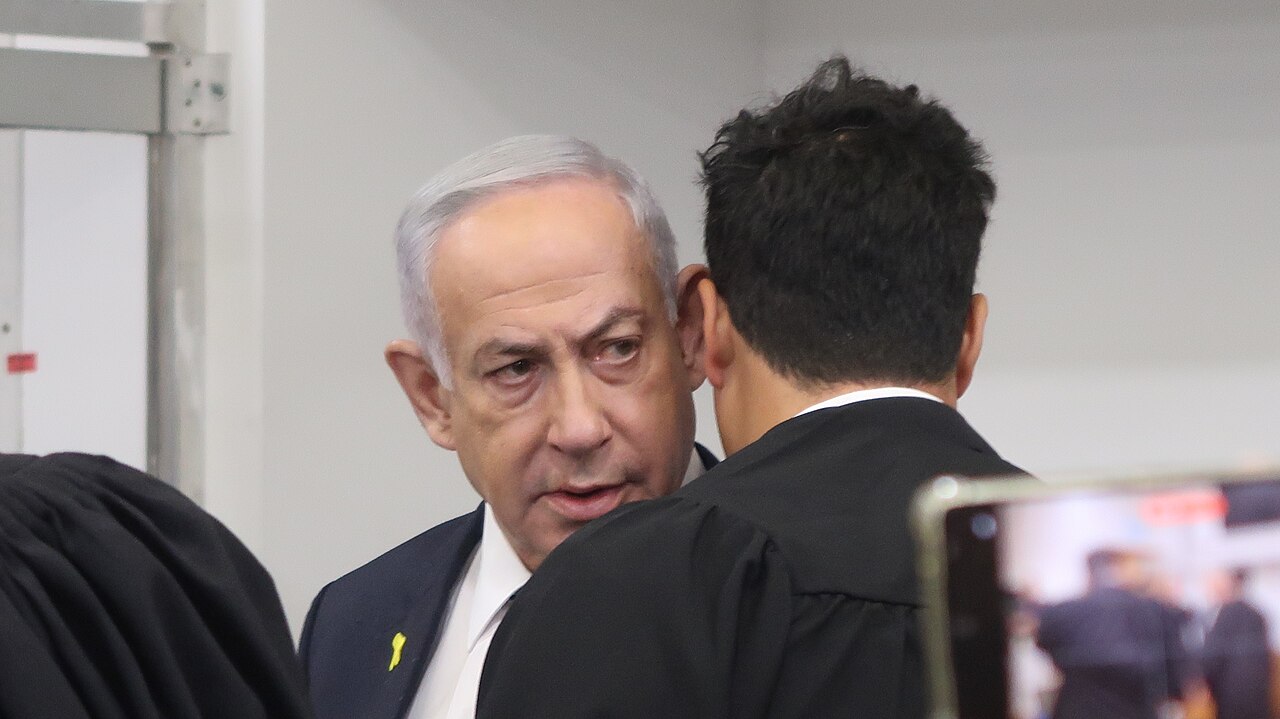
Benjamin Netanyahu in court with his lawyer, Amit Hadad. (Oren Persico/The Seventh Eye (via Wikimedia Commons)
For years, many Israelis and commentators abroad spoke about Netanyahu as if his guilt was already established, and the trials were expected to simply ratify what his opponents had long claimed. In this atmosphere, the democratic principle of ‘innocent until proven guilty’ was inverted into ‘guilty until proven innocent’ – ironically promoted most loudly by those who present themselves as defenders of liberal values.
Yet as testimony unfolded, a very different picture emerged. So different, in fact, that a growing number of Israelis now argue that a presidential pardon would benefit the state prosecution more than Netanyahu himself, sparing them further damage as the cases continue to weaken.
1. What Netanyahu Is Actually On Trial For
Netanyahu was indicted in 2019, and the trial officially began in May in 2020.
He faces charges in three cases: 1000, 2000, and 4000.
Case 1000 – “cigars and champagne”
Wealthy businessmen Arnon Milchan and James Packer allegedly gave the Netanyahus cigars, champagne, and jewellery over many years. The prosecution labelled these “illicit benefits.”
Netanyahu maintains they were gifts exchanged within long-standing personal friendships, not as “illicit benefits” – a category that is entirely legal under Israeli law.
In court, however, the basic numbers behind the accusation began to unravel. Testimony from police investigators revealed that the key figure – the “700,000 shekels” that convinced Attorney General Mandelblit to open the case – was assembled from missing receipts, unverified estimates, and plain guesswork.
Arnon Eliaz, the accountant who prepared the spreadsheet for the police, admitted that he never verified which purchases went to the Netanyahu family. In fact, no document in the files proved that any of these items reached them.
Hadas Klein – personal assistant to Milchan and Packer, and the prosecution’s central witness in Case 1000 – admitted under cross-examination that many of the quantities she described were only rough estimates.
Case 2000 – the newspaper deal that never happened
Netanyahu allegedly discussed a speculative arrangement with Yedioth Ahronoth publisher Arnon Mozes: restricting Israel Hayom’s influence in exchange for friendlier coverage.
No law was changed, no deal materialized, and both parties abandoned the idea. Even legal commentators critical of Netanyahu struggled to understand why this remained a criminal file.
Case 4000 – the “Bezeq–Walla” affair
This is the central case, and the only one containing a bribery charge.
Prosecutors allege that Netanyahu advanced regulations benefiting Bezeq (owned by Shaul Elovitch) in exchange for favourable press coverage on the news site Walla (also owned by Elovitch).
Netanyahu summarized the allegation recently:
I’m accused of receiving favourable press coverage from a second-rate internet site. In 250 years of liberal democracy, no one has been charged with receiving favourable press coverage as a crime.
Whatever one thinks of Netanyahu, that observation is factually correct: no other democracy has ever criminalised editorial tone as a “bribe.”
This becomes even harder to justify once examining what the evidence actually revealed.
2. The Flaws And Follies Of Case 4000
Judges themselves questioned the bribery charge
By 2022, after years of testimony, the panel of judges advised prosecutors to consider dropping the bribery charge due to lack of evidence.
The prosecution refused.
Legal analysts have struggled to identify a single case in Israeli history where prosecutors secured a conviction after judges recommended dropping the charges due to lack of evidence.
Walla’s coverage was overwhelmingly negative
The indictment portrays Walla as a propaganda machine for Netanyahu. Under cross-examination, Walla executives and journalists testified that the site regularly published harsh and critical stories about him.
A forensic review of the 315 articles prosecutors flagged as “positive coverage” found 309 were neutral, negative or never published. Only 6 articles, just 2% of the total, could even potentially be interpreted as favourable.
Amit Hadad, Netanyahu’s lawyer, noted how easy it was to disprove the ‘positive coverage theory’:
We simply went onto the Walla website. Any child in third grade could have done it. Anyone who checks can see the coverage was overwhelmingly negative.
Netanyahu joked that if this was positive coverage, “it was the most antagonistic positive coverage in Israeli history.”
The “Bugs Bunny” moment
One of the most surreal moments of the trial went viral when prosecutors questioned Netanyahu about a Bugs Bunny doll his son received twenty-nine years ago.
What made the exchange even more striking was its timing: it came just days after Iran’s first-ever direct missile strike on Israel, while heavy fighting continued in Gaza, Hezbollah attacks persisted in the north, and hostage negotiations were ongoing.
It was absurd, a wartime prime minister forced to spend his morning answering questions about a Bugs Bunny gift from 29 years ago. Instead of advancing any serious legal purpose, this exchange became a moment of national absurdity – reinforcing the sense that the trial had slipped into desperation rather than substance.
3. A Pattern Of Investigative Irregularities
Beyond the individual cases, courtroom testimony over the last two years revealed something more systemic: an investigative mindset that resembled the old saying, “Show me the man, and I’ll show you the crime.”
A police team leader testifies to “criminal acts” in the investigation
One of the most dramatic moments came from Tsahi Hovav, a senior police team leader in the Netanyahu probes.
Under oath, he stated that certain methods used during the investigation amounted to severe breaches of procedure – “criminal acts,” in his words.
Hovav said he attempted to report these issues internally but was blocked by superiors.
It was, by any measure, an extraordinary statement.
Selective enforcement – protecting the case, not the truth
A separate account from MK Moshe Sa’ada, former deputy head of the Police Internal Investigations Department (Machash), reinforced the sense of an outcome-driven investigation.
He described how investigators encountered suspected misconduct by other senior public officials while examining the Netanyahu files and sought permission to pursue those leads.
According to Sa’ada, they were instructed by senior legal officials:
We are not investigating anything that could harm this case.
In other words, investigators were allowed to pursue only evidence that supported the case against Netanyahu – and discouraged from following evidence that might challenge or complicate it.
4. Case Built For A Plea Deal?
With so much of the evidence breaking down in court, it was reasonable to ask why prosecutors were so adamant about persisting with the trials.
One theory – now widely viewed as the only logical explanation – came from Channel 12’s Guy Peleg, one of the media figures most supportive of the prosecution.
Speaking on air, Peleg stated openly:
Every attorney familiar with the details understands this is a case built for a plea deal – and that the real price from day one was Netanyahu’s removal from public life.
Coming from him, this was a remarkable admission.
It implied that the prosecution’s objective was never to secure a bribery conviction in court, but rather to apply maximum legal and public pressure in the hope of forcing Netanyahu into a plea agreement that would end his political career.
5. Lawfare In The Middle Of A War
After the October 7 massacre, the Netanyahu trials were briefly put on hold. Yet just ten days after Israel launched its ground incursion into Gaza, courtroom sessions resumed.
They were paused again only during the 12-day conflict with Iran, and aside from that, interruptions were limited to isolated delays or shortened hearings.
Attorney General Gali Baharav-Miara had full authority to postpone proceedings due to wartime conditions. She chose not to, telling the High Court there was a “public interest” in continuing.
The obvious question was: whose public?
The only clear constituency eager for the hearings to proceed was the political minority that had just lost the election and hoped the legal process might achieve where their ballots had not.
Left-wing journalists on Channels 12 and 13 revived a legal argument made before Netanyahu’s return to office – that a prime minister on trial ‘could not’ effectively govern. Netanyahu dismissed the claim at the time, but no one had imagined Israel would be fighting a multi-front war unprecedented in Israel’s history.
For some critics, however, the wartime reality seemed secondary; the hope that the trial might remove Netanyahu from office appeared to outweigh the strategic need for national focus.
A wartime prime minister forced to justify every absence
Throughout the war, Netanyahu repeatedly had to request postponements or early exits from hearings due to urgent security developments. Judges often demanded proof of necessity, and on at least one well-documented occasion, required him to bring his military secretary into the courtroom to verify the urgency.
In effect, classified security information had to be disclosed to justify a prime minister’s absence during an active war.
Real-time notes that the entire region could see
Several hearings were interrupted as aides passed Netanyahu handwritten notes about unfolding military events. Minutes or hours later, major developments often became public.
Israel’s enemies watch Israeli media closely. On Channel 14’s Patriotim, Yotam Zimri half-jokingly noted that anyone seeking early hints of Israeli military manoeuvres could simply watch the trials.
6. Conclusion: A Pardon?
Netanyahu has said openly that for personal reasons he would prefer to continue the trial and clear his name in court – those who have followed the revelations in the courtroom understand exactly why.
However, following Trump’s public request at the Knesset to pardon him, and taking into consideration Israel’s great challenges that lie ahead, he decided “the good of the country” must come first and sent a formal request to President Herzog to end it. A pardon is often misunderstood as an admission of guilt. It is not. Under Israeli law, it is simply a sovereign tool to end a process that no longer serves the public interest.
Notably, many on the political right have said they would actually prefer the trial to continue – because they want every remaining flaw in the prosecution’s conduct exposed publicly. The prosecutions have lost not only their factual core; their investigative methods used to construct the cases – from inflated figures to procedural breaches described in court as “criminal acts” – have left their legal theory in tatters.
This is why the demands from opposition politicians and journalists sound so desperate. They insist any pardon must require Netanyahu to confess and resign – because despite projecting loud confidence about next year’s elections, many know this was always their last real hope of removing him.
If a pardon ends this saga, it will not be an act of clemency for Netanyahu – it will be an act of accountability for a legal process that is better known as lawfare. The real beneficiary would not be the defendant, but the state prosecutors that built a case on sand and struggled to stop it from crashing down in disgrace.
That is the uncomfortable truth the trials have laid bare. It is why the only just conclusion is for the case to end – not to save Netanyahu, but to save the blushes of the prosecutors… and more importantly, the credibility of Israeli democracy itself.
Watch: Netanyahu’s own summary of the trials and his request for a pardon
I want to share something with you >> pic.twitter.com/cLFxWI6igh
— Benjamin Netanyahu – בנימין נתניהו (@netanyahu) December 4, 2025
Related Topics
Related Posts