
CEO of Time to Stand Up for Israel
The Netherlands Broke My Spirit. Israel Gave Me Back My Dignity
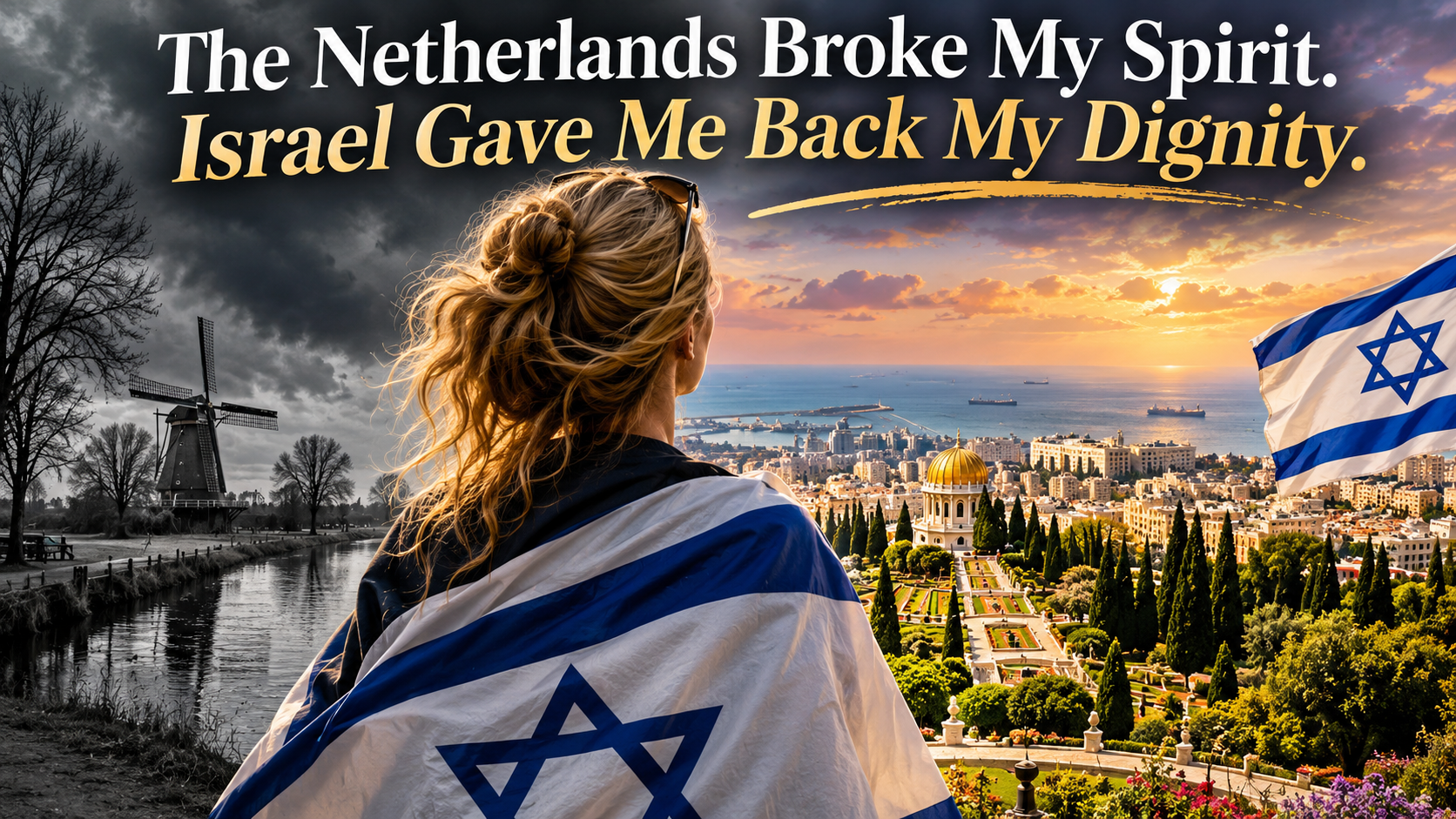
Photo Credits: Sabine Sterk ( AI)
Israel, the Country That Accepted Me When My Own Country Did Not
People often ask me what was so special about Israel that a Dutch girl, from the very moment she set foot in the country, developed an unconditional love for its land and people, a love so profound that it would eventually determine friendships, relationships, personal choices and much of the direction of her life.
The answer has very little to do with politics, religion or ideology. It has everything to do with something far more fundamental. For the first time in my young life, I experienced what it meant to be accepted for who I was.
To understand that, you need to understand where I came from.
I was the daughter of an officer in the Dutch Army, raised with strict discipline, respect for authority, good manners and the expectation that children knew their place. We moved frequently, I saw more of the world than most children my age, and I developed a strong intellectual curiosity, an enormous sense of justice and a stubbornness that could drive people absolutely insane.
Yet beneath that determined character was an extremely shy girl who never really fitted into groups.
In the Netherlands, or Horrorland as I have come to call it, being different was apparently an invitation to be ridiculed. I was bullied relentlessly, criticised for my appearance, told I was too thin, too ugly or simply not good enough. Whatever I did, there always seemed to be something wrong with me.
My mother, who was born with only one arm, experienced her own share of disrespectful stares and insensitive behaviour. I learned early that people could be remarkably cruel towards anyone who did not fit their idea of normality.
And then we arrived in Israel.
I have described before the extraordinary feeling I experienced when we entered Haifa, something I still struggle to explain rationally. But what happened afterwards was perhaps even more significant.
Suddenly, I belonged.
Nobody seemed particularly interested in whether I was too thin, too shy, sufficiently attractive or socially acceptable. People approached me with curiosity rather than judgement. I made friends, both boys and girls, and discovered that people could actually enjoy my company without demanding that I become somebody else.
Even my mother’s disability, which so often attracted uncomfortable attention in the Netherlands, did not seem to define her in the eyes of the Israelis we encountered.
For someone who had spent much of her childhood feeling unwanted, that was an extraordinary revelation.
Of course, I am describing the Israel I experienced in the late 1970s, through the eyes of a young Dutch girl. I am not suggesting that Israeli society was perfect then or is perfect today. No society is. But the difference in how I was treated was so overwhelming that it changed something inside me permanently.
I have often wondered why.
Perhaps part of the answer lies in Jewish history, in the extraordinary suffering, displacement and persecution that shaped generations, but also in the determination to survive, rebuild and celebrate life despite everything.
What struck me was not a society without hardship, but a society in which life itself seemed precious, where human connection, friendship, family and belonging carried enormous meaning.
When I returned to the Netherlands at thirteen, something had fundamentally changed.
The shy girl who had once struggled to defend herself suddenly became a fierce defender of Israel. Say one wrong word about the country or its people and I immediately entered combat mode. I confronted classmates, challenged teachers and sometimes even ended up in physical fights, something I certainly do not glorify today, but which illustrates how deeply I felt that loyalty.
Nobody could silence me.
And that continued into adulthood.
Years after my divorce, I found myself confronted with a choice that perhaps says more about my character than anything else. I could stop speaking about Israel and preserve my relationship, or continue defending what I believed in and lose the man I loved.
I chose Israel.
I am single today.
Some people might consider that extreme, irrational or unnecessarily stubborn. Perhaps they are right about the stubbornness. But how do you explain to someone that your attachment to a country is not merely an opinion that can be switched off whenever it becomes inconvenient?
Israel gave me something during my formative years that I had desperately needed and rarely experienced elsewhere.
Acceptance. Friendship. Dignity. A sense of belonging.
That does not mean I agree with everything happening in Israel. I certainly do not. My love for the country has never required blind admiration for its politicians or unquestioning approval of every decision.
But my loyalty to its people and my gratitude for what they gave that lonely Dutch girl have never disappeared.
Almost half a century later, I still recognise that thirteen year old girl in myself, the one who discovered that being different did not automatically mean being inferior.
Perhaps that is the simplest explanation for my unconditional love for Israel.
The Netherlands was the country I came from.
Israel was the country where I finally felt I belonged.
And once you have experienced that difference, you never forget it.
Related Topics