Omer Adam Reminded Us What Peoplehood Feels Like
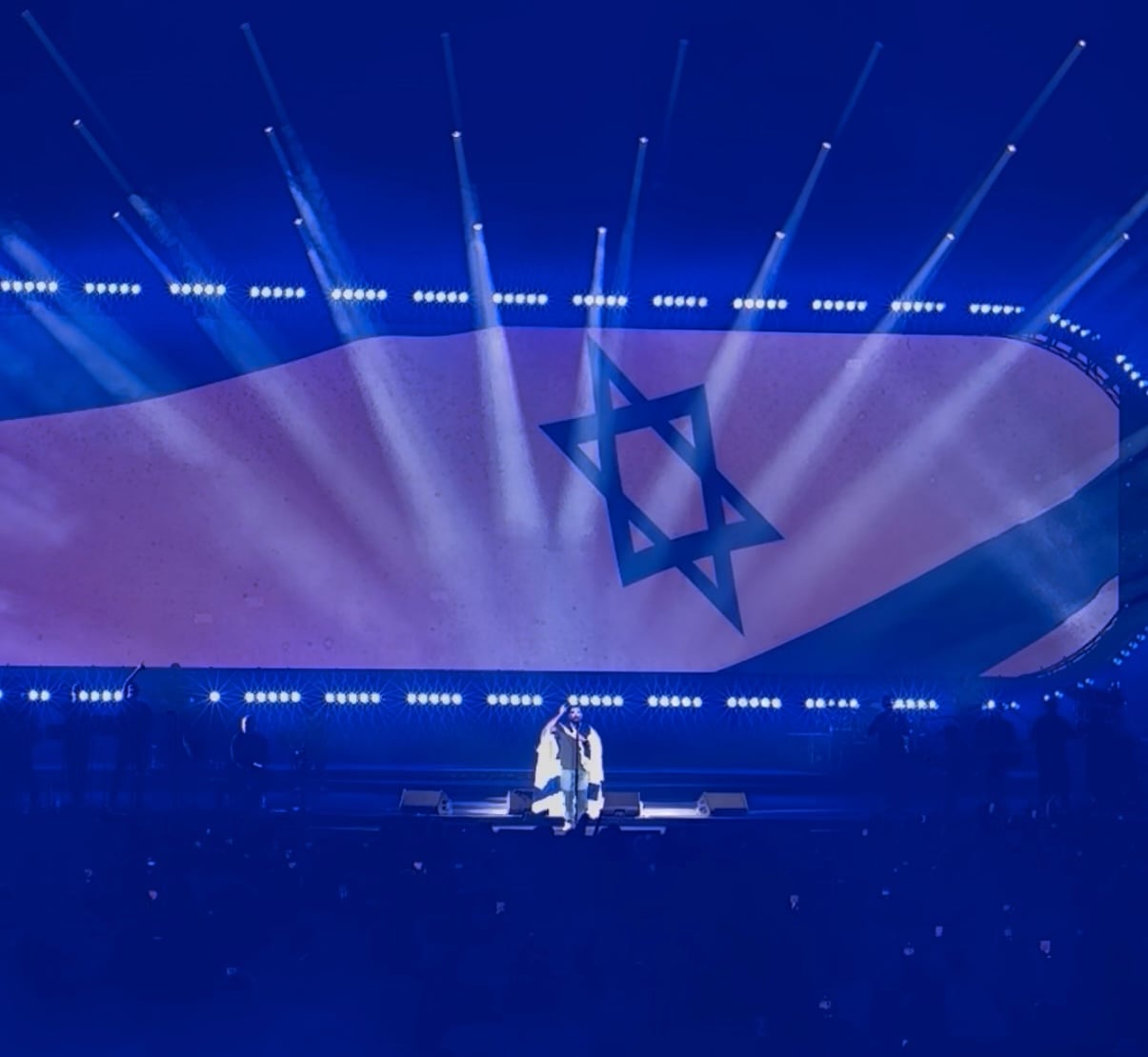
On Thursday night, Israeli singer Omer Adam took the stage at the Intuit Dome in Inglewood, California, before a crowd of roughly 18,000 people.
Jewish identity was on full display throughout the arena, worn openly and with unmistakable pride. Stars of David and chai necklaces resting against chests. Kippot sitting atop heads young and old. Israeli flags draped across shoulders. IDF emblems emblazoned on T-shirts. Nothing hidden. Nothing tucked away. No calculation of who might be watching.
Adam sang and thousands of voices rose to meet his. There was something almost overwhelming about it. Carried by an entire arena, his melodies took on an entirely different emotional force. The exhilaration was profoundly collective. It was that rare, almost indescribable sensation of feeling Jewish together.
To be Jewish today is to be reminded, almost constantly, of the weight of being Jewish. Not often enough are we reminded of the extraordinary feeling of belonging to the Jewish people.
Jewish peoplehood is now frequently experienced through pain. The anguish of October 7, the heartbreak of the hostages, the abandonment of friends and allies, the sense of isolation, and the suffering of Jews around the world. Jewish communities everywhere have felt all of it with startling intimacy. Collective identity has shown its power mostly through the heaviness of shared grief. Communal energy goes toward confronting the dangers of Jewish existence. Even when we gather, conversations inevitably return to the latest threshold of antisemitism crossed and the quiet, relentless vigilance that now shapes everyday Jewish life. That vigilance can be measured. In the American Jewish Committee’s latest survey, 55% of American Jews said they had changed their behavior in the past year out of fear of antisemitism, and 30% said they had avoided certain places, events or situations out of concern for their safety.
And yet, on an otherwise ordinary Thursday evening in Los Angeles, there it was. The other side of Jewish peoplehood. An almost euphoric sense of connection, impossible to manufacture and rarer still to experience on such a scale. The consciousness of belonging to a people whose history is also your history. Each person’s joy seemed to deepen with the realization that everyone nearby felt it too. Peoplehood, usually an idea carried in the mind, became something felt in the body.
It swept over the entire arena, carrying every one of us into something far bigger, louder and more alive than any of us could be alone. The world outside fell away. There was only that room, those songs and the feeling of being completely surrounded by our own people, and completely free.
Pride and unity were part of it. Deeper still was the relief of standing among thousands of Jews who understood a part of you without a word exchanged. Jewishness became the atmosphere itself, the air everyone breathed, and there was deep catharsis in breathing it freely.
The Hebrew word for this is am, a people. It names an identity broad enough to hold enormous differences in belief and practice while keeping an unmistakable sense of belonging. On Thursday night those differences were everywhere, and so was the recognition of something held in common.
Therein lies something difficult to capture about Jewish peoplehood. It is not simply the knowledge of a shared history, but the experience of that history as something living in the present. The distance between generations seems to narrow. The degrees of separation between strangers become almost irrelevant. An identity carried individually becomes, suddenly and intensely, shared. The connection had always existed. Omer Adam, his music and the thousands of concert goers just brought it to the surface.
In Israel, this feeling shapes everything. Language, the calendar, the education system, even the rhythm of public life. They all live inside Jewish identity. Diaspora Jews rarely get to experience that. In the United States, Jews are a minority whose identity is constantly explained and, lately, guarded. But at an Omer Adam concert, Jewishness seems to rise from the crowd itself, filling every corner of the room. On Sunday, Adam brings the show to thousands more at New York’s Barclays Center.
After three years in which Jewish peoplehood has so often meant carrying the pain of others, there was something restorative in discovering its capacity for happiness. The emotional intensity was the same. Only its expression had been uplifted. That is the power of belonging to an am. Jewish peoplehood enlarges the experience of being human, allowing a single life to hold the emotional breadth of an entire people and your joy intensifies in the knowledge that others feel it too.
Outside the arena, the anxieties of Jewish life were still waiting when the music stopped. Something of that evening lingers anyway.
The world so often asks Jews to explain ourselves. But for one glorious night, we needed only to be ourselves. And the extraordinary thing was not simply that thousands of us were experiencing joy together. It was that being together was itself the source of so much of that joy.