The Network Behind the Narrative
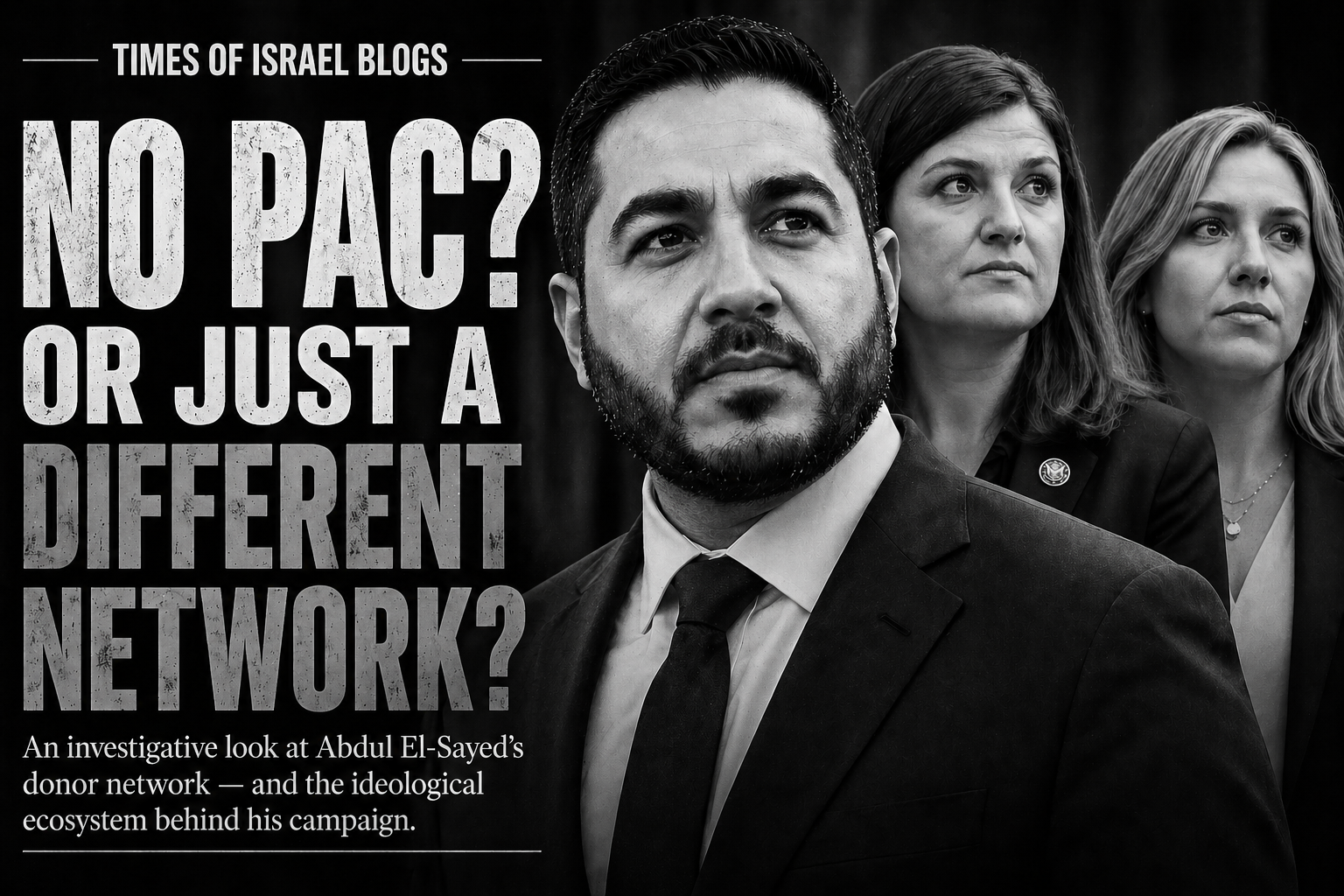
Abdul El-Sayed is a physician, former Detroit Health Department director, and longtime progressive figure now running for the U.S. Senate in Michigan. He first rose to statewide prominence during his 2018 gubernatorial campaign, positioning himself as part of a new generation of progressive leadership aligned with figures and movements pushing Medicare for All, student debt relief, and structural economic reform. His current Senate campaign builds on that identity, emphasizing a populist message centered on healthcare access, economic equity, and removing what he describes as the corrupting influence of money in politics.
A defining feature of that message has been his criticism of other candidates’ funding sources. El-Sayed has repeatedly argued that candidates who accept money tied to groups like AIPAC or defense-industry networks cannot be trusted to act independently, suggesting that such funding creates inherent obligations and shapes policy positions. In contrast, he has framed his own campaign as a clean break from that system—grassroots, people-powered, and “by Michiganders, for Michiganders.”
To test that claim, the campaign’s donor file—pulled directly from the Federal Election Commission database—was analyzed using DonorWatch, a system designed to map political donor networks by identifying patterns across geography, profession, repeat giving, and organizational overlap. The output—a 45-page structural report—draws from more than 3,050 donor records and $7.09 million in total contributions, allowing the campaign’s funding base to be understood not as isolated donations, but as a network. That analysis was then independently evaluated by data analyst Josh Elberg, founder of Palavir, an analytics and AI consulting firm focused on turning large datasets into structural insight. Palavir’s work centers on identifying how data behaves at scale—how patterns form across institutions, industries, and networks—using methodologies grounded in enterprise analytics and system-level modeling. Using a separate analytical approach, Elberg examined the same donor file to determine whether the patterns identified by DonorWatch held up under independent scrutiny. They did. Both analyses—developed independently and using different frameworks—arrive at the same conclusion: this is not a diffuse grassroots donor pool. It is a structured network.
Start with geography. Michigan is clearly the anchor, accounting for over 1,100 donor records and roughly $1.57 million in contributions outside of processing platforms. This is a real base, concentrated in politically engaged communities such as Ann Arbor, West Bloomfield, Dearborn, and surrounding suburbs. But that base is only the first layer. Beyond it sits a second, equally important layer: out-of-state money. Significant contributions flow from California ($674,000+), New York ($284,000+), Texas ($223,000+), Virginia ($136,000+), and other states. These are not incidental—they represent a meaningful portion of the campaign’s financial support. Palavir’s independent analysis confirms the same pattern: a campaign anchored locally, but materially amplified by national networks. This distinction matters. It separates the idea of a campaign that is “from Michigan” from one that is “only Michigan.”
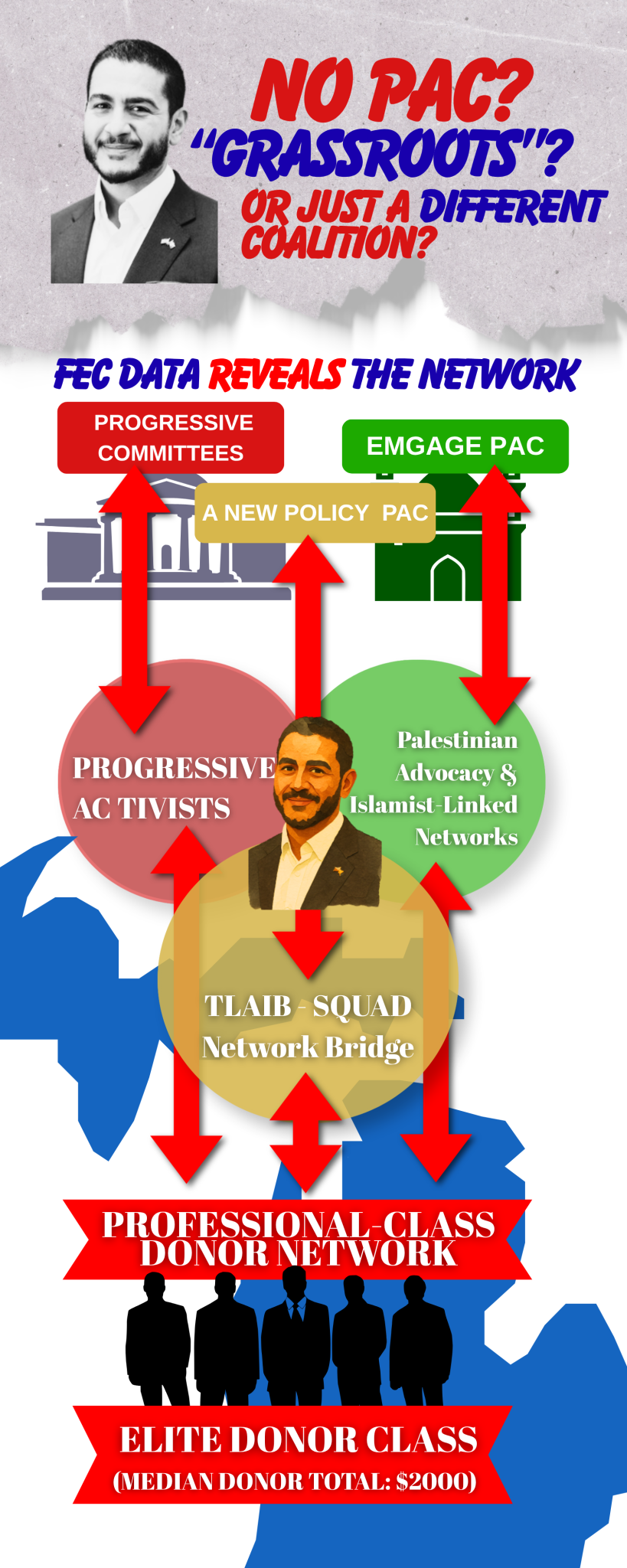
The composition of the donor base reinforces that picture. Healthcare and medicine alone account for over $1.1 million across more than 700 donors, making it the single largest identifiable sector in the file. Academia, law, and business leadership form additional major clusters. This is not a random cross-section of voters. It is a donor base dominated by professionals—individuals with institutional roles, financial capacity, and network connectivity. Palavir’s analysis identifies the same structure: a professionally concentrated donor ecosystem, where influence is clustered within connected, high-capacity communities rather than evenly distributed.
The structure becomes even clearer when the pattern of giving is examined. Even after removing processing platforms such as ActBlue, the median donor contributes approximately $500, rising to $2,000 in more concentrated segments of the dataset. More than half of all donors gave $500 or more, and nearly one in six exceeded $2,500 in total contributions. At the same time, over 200 donors contributed three or more times, indicating sustained, repeat engagement rather than one-time participation. Elberg’s analysis through Palavir reaches the same conclusion from a different angle: the largest donor bands are not concentrated at the lowest levels, but cluster between $250 and $1,000 and above, reflecting a system built on accumulation rather than isolated small-dollar participation.
More importantly, when the transaction data itself is examined, the structure becomes unmistakable. Palavir identifies 16,109 transactions totaling $7.09 million, with nearly 93% of itemized dollars falling into preset donation tiers such as $25, $50, $100, and $250. The audit finds 486 instances of same-day, same-amount donation clusters involving five or more donors, including coordinated bursts such as dozens of individuals contributing identical amounts on a single day. The top 10 fundraising days alone account for more than $824,000, concentrated around campaign events and reporting deadlines, and 128 donors reach the $7,000 legal cap within just two weeks. These are not isolated anomalies. They are consistent indicators of coordinated fundraising behavior operating within a structured system.
That reality sits in tension with one of the campaign’s most widely cited claims. El-Sayed has emphasized that “95% of donations are under $100.” Taken literally, that statement can be accurate. But it refers to transaction count—not total dollars. Both DonorWatch and Palavir identify the same underlying mechanism: repeat donors making multiple small contributions that accumulate into significantly larger totals. A donor who gives $25 ten times is recorded as ten small-dollar donations, even though their total contribution is $250. Multiply that pattern across hundreds of repeat donors, and a campaign can present itself as overwhelmingly small-dollar while being materially supported by higher cumulative giving. This is not a technicality. It is a framing choice.
The most important finding, however, is not just financial. It is structural. Across both the DonorWatch report and Palavir’s independent analysis, the donor base resolves into overlapping networks—financial, professional, and ideological. A subset of 481 donors representing more than $4.17 million maps into recurring ideological lanes, including progressive political infrastructure, Palestinian advocacy networks, Muslim civic and political organizations, and broader identity-linked and transnational issue networks. These lanes do not operate independently. They overlap—frequently and consistently—linking donors across multiple categories and reinforcing a single, interconnected ecosystem. Donors are not simply giving. They are moving within aligned spaces.
That convergence matters because it goes directly to the standard El-Sayed has set for others. If taking money from organized political networks creates obligation—if it shapes priorities, defines political boundaries, and aligns candidates with broader agendas—then that standard must be applied consistently. The donor data does not show a campaign outside that system. It shows a campaign operating within it: a Michigan base, amplified by national participation, concentrated among professional-class donors, sustained through repeat and cumulative giving, and embedded within overlapping political and ideological ecosystems.
For Jewish voters, this carries direct implications. Issues such as antisemitism, Israel, and religious freedom do not exist outside these networks. They are shaped within them. When those networks form part of a campaign’s foundation, they influence what follows—not through explicit instruction, but through alignment, continuity, and shared priorities.
What the data shows is not a candidate outside the system he critiques. It shows a candidate operating within it—built on ideological alignment, coordinated participation, and network-driven fundraising.
That matters because of the standard he chose.
If taking money from structured networks makes other candidates beholden—if that is the line he has drawn—then that line applies here as well. The mechanism does not change just because the network is different. Alignment is alignment. Structure is structure.
You cannot argue that one set of donors creates influence while another does not.
You cannot claim independence while being carried by a system that is clearly organized, clearly aligned, and clearly coordinated.
This is not a grassroots exception.
It is a modern political operation.
And if voters are going to be asked to judge other candidates by who funds them, then they should be willing to apply that same standard here—without exception, without redefinition, and without the cover of branding.
Because at the end of it, the question isn’t complicated:
If everyone else is beholden, why wouldn’t he be?