The New Pogrom
There are moments in history when societies reveal not merely their political divisions but also their moral collapse. New York City, once the symbolic capital of Jewish security in the Diaspora, is beginning to show signs of such a rupture.
What is unfolding is no longer simply “anti-Israel activism.” Nor is it reducible to the language of ordinary protest politics. The escalation of antisemitic intimidation, mob harassment, open incitement, and ideological radicalization now visible in New York City reflects something darker, the normalization of political violence against Jews under the banner of “resistance.” It is not only a new pogrom but also the proof that antisemitism in New York reveals the the ‘Globalization of Intifada politics.
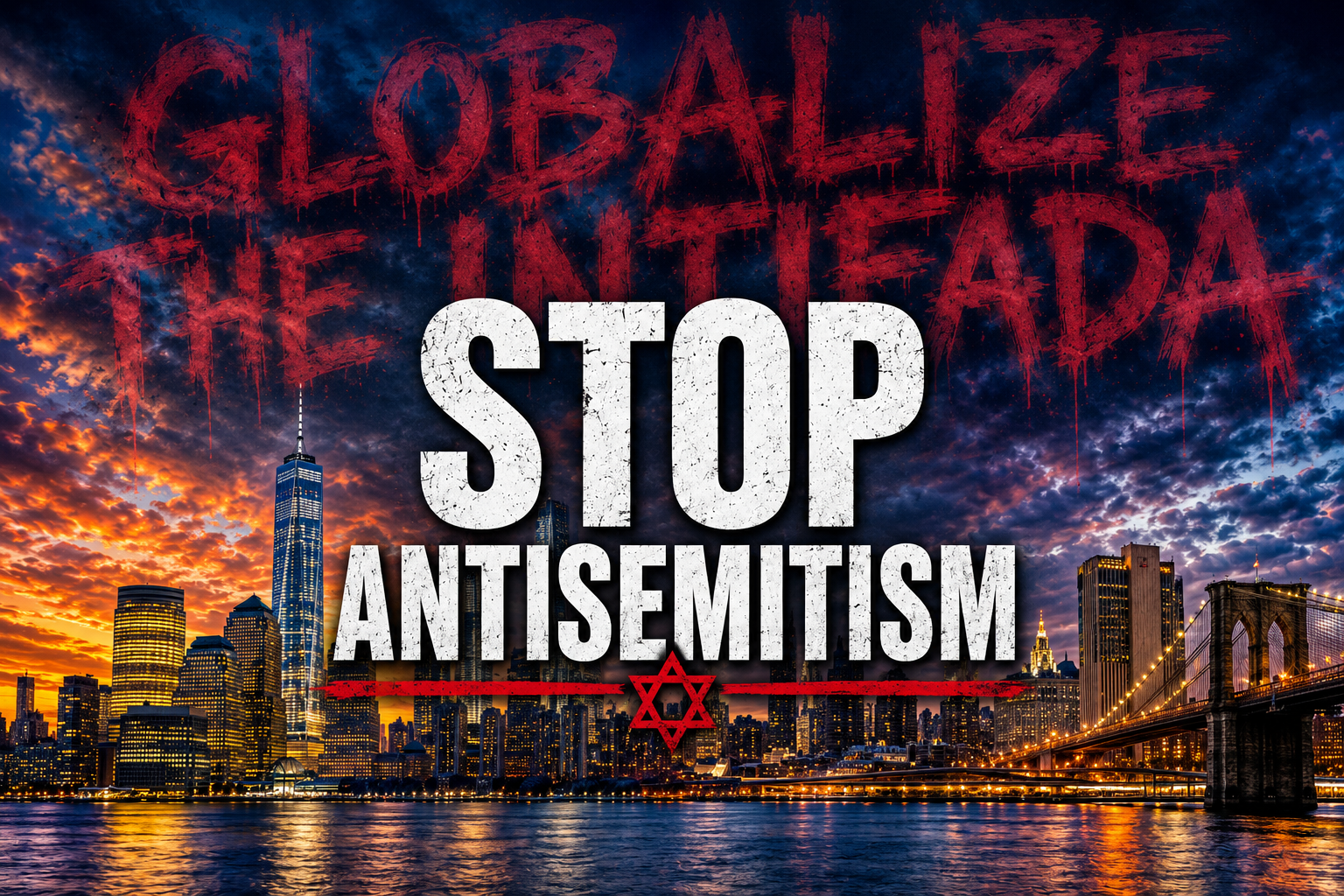
The chant “Globalize the Intifada” is not metaphorical rhetoric. It is not an abstract slogan about solidarity. Historically, the intifadas were campaigns marked by suicide bombings, mass murder, lynchings, knife attacks, shootings, and deliberate terror against civilians. To globalize such a movement is to universalize political violence against Jews everywhere.
And increasingly, that is precisely what we are witnessing.
Recent demonstrations in New York have featured explicit calls for violence, glorification of Hamas, threats directed at Jewish institutions, and mob-style intimidation campaigns targeting synagogues and Jewish neighborhoods. Waving Hezbollah flags and screaming abuse at Jewish families on their own stoops. Children watched from doorways. Teenagers were led away by police. Demonstrators chanted, “Death to the IDF.” “There is only one solution: intifada revolution.” One protester invoked Khaybar, the seventh-century massacre of Jews by early Muslim forces, as a taunt directed at Jewish residents.
Such chanted slogans openly celebrate so-called “resistance,” while social media ecosystems amplify imagery portraying Jews collectively as legitimate targets. It is an open embrace of terror and a direct call for violence against Jews
This is not merely political radicalism. It is the re-entry of pogromist logic into democratic society.
From Political Protest to Civilizational Threat
The danger lies not only in the extremists themselves but also in the political and institutional environment that enables them.
New York’s political leadership has too often responded with equivocation, selective outrage, or ideological hedging. Rather than forcefully isolating movements openly trafficking in antisemitic intimidation, elements within city politics have treated them as legitimate participants in progressive coalition politics.
New York City’s mayor has responded with a combination of bureaucratic gestures and political cowardice that would be shocking if it were not, by now, entirely predictable. Mayor Zohran Mamdani, who took office at the start of the year and immediately, on his first day, revoked the city’s use of the IHRA definition of antisemitism, has presided over this escalation with studied ambiguity. When the Brooklyn mob descended on Midwood, he did not go to the neighborhood. He did not stand with Jewish residents. He announced instead a nearly ninefold increase in the hate crimes prevention budget. His $26 million proposal for the Office for the Prevention of Hate Crimes comes as he still has not spoken specifically about the clashes in the Orthodox Brooklyn neighborhood. Silence in the face of organized mob intimidation of Jewish neighborhoods is not leadership; it is abdication.
Worse still is what Mamdani has actively done. When the New York City Council passed legislation creating buffer zones to protect schools and houses of worship from targeted harassment, Mamdani vetoed the school buffer zone bill, drawing harsh condemnation from a swath of leading Jewish groups.
The Left in New York and its allies in the progressive ecosystem have made a choice. It has decided that Palestinian political activism, however violent its rhetoric, however terroristic its symbolism, and however specifically it targets Jewish houses of worship and Jewish neighborhoods, is protected expression. It has decided that Jewish discomfort, Jewish fear, and Jewish children watching masked mobs march past their front doors are the acceptable price of that politics.
Tacit tolerance matters.
History repeatedly demonstrates that political violence grows when elites refuse to draw moral boundaries. When authorities minimize intimidation campaigns against Jews as merely “heated protest,” activists interpret restraint as permission. Radical factions become emboldened precisely because they believe institutional power lacks either the courage or the will to stop them.
The result is predictable escalation.
The atmosphere in parts of New York increasingly resembles the early stages of societal normalization of antisemitism seen elsewhere in history: first intimidation, then exclusion, and then violence rationalized as political necessity. The terrifying feature of modern antisemitism is that it now emerges simultaneously from multiple ideological directions:
There are the radical Islamist movements, the revolutionary left-wing frameworks, online conspiracy ecosystems, postcolonial ideological extremism, and increasingly illiberal forms of identity politics.
What unites these otherwise contradictory movements is the transformation of Jews into symbolic embodiments of global evil — oppressor, colonizer, manipulator, capitalist, racist, imperialist, or “Zionist entity.” This symbolic transformation is essential because it allows ordinary moral restraints to disappear. Once Jews are no longer viewed as human individuals but as metaphysical representatives of oppression, violence against them becomes psychologically easier to justify.
That is the ancient mechanism of the pogrom.
The Return of the Blood Libel
Nothing illustrates this dynamic more clearly than the recent article by The New York Times columnist Nicholas Kristof.
Kristof’s highly controversial article alleging widespread Israeli sexual abuse of Palestinians, including the grotesque and incendiary claim involving dogs used for rape, immediately ignited global outrage and accusations that the paper had revived modernized forms of the medieval blood libel.
The historical parallels are impossible to ignore. For centuries, blood libels portrayed Jews as uniquely sadistic creatures who preyed upon innocents in ways so monstrous that ordinary ethical standards no longer applied. Medieval Europe accused Jews of ritual child murder. Modern totalitarian propaganda accused Jews of poisoning nations, corrupting races, and orchestrating global conspiracies.
Today, the framework has been updated for the digital age.
The Jew is now recast as the genocidal Zionist. Israel becomes not merely a flawed state but an embodiment of metaphysical evil. Allegations no longer require rigorous evidentiary standards because the accusation itself satisfies ideological expectations. The case in point here is Kristof’s article, which drew criticism across multiple outlets argued that the most sensational elements of Kristof’s article relied heavily on contested or weakly substantiated testimony and politically aligned advocacy group. Whether one agrees with every element of that criticism is ultimately secondary to the broader cultural reality: the article entered an already radicalized information ecosystem primed to accept the most grotesque accusations against Jews and Israelis with almost no skepticism.
And timing matters.
The publication arrived amid renewed attention to extensive documentation of Hamas atrocities committed during the October 7 massacre, including systematic sexual violence.
October 7 and the Moral Inversion
The greatest tragedy may not simply be the atrocities of October 7 themselves but the speed with which parts of the international discourse sought to morally invert them.
Independent reports, survivor testimony, UN findings, eyewitness evidence, and investigative documentation have increasingly established that Hamas employed sexual violence systematically during the massacre and hostage-taking operations.
Victims were mutilated, raped, tortured, burned alive, and publicly degraded. Women’s bodies became instruments of psychological warfare. Entire families were annihilated in scenes of almost unimaginable brutality. Yet large segments of activist culture either minimized, denied, rationalized, or redirected attention away from these crimes. Some institutions remained silent for months. Others immediately reframed the discussion around Israeli actions rather than the atrocities themselves.
This inversion is deeply significant because it reflects a broader ideological shift in contemporary antisemitism: Jews are increasingly denied even the status of legitimate victims.
The old antisemitic framework portrayed Jews as secretly powerful manipulators controlling society behind the scenes. The new framework portrays Jews as uniquely incapable of victimhood because they are presumed to occupy permanent positions of “privilege” or “colonial power.”
Under such a worldview, Jewish suffering becomes politically inconvenient. It disrupts ideological narratives. Therefore, it must either be minimized, denied, or morally relativized. This explains why chants calling to “globalize the intifada” can increasingly appear in elite cultural and academic spaces without triggering universal condemnation.
The slogan functions not as peace advocacy, but as revolutionary permission.
The Globalization of Intifada
The phrase “globalize the intifada” should be understood not as activism but as strategic escalation.
It universalizes conflict against Jews beyond geographic borders. Under this framework, Jewish schools become legitimate targets. Synagogues become extensions of the “enemy.” Jewish students become proxies for Israeli policy, and diaspora Jews become collectively responsible for Middle Eastern conflict.
This is classic collective guilt, one of the oldest foundations of antisemitism.
The implications are enormous.
When activists surround synagogues, harass visibly Jewish individuals, intimidate neighborhoods, or celebrate armed “resistance,” they are not engaging in protected democratic dissent. They are participating in the social normalization of ethnopolitical intimidation.
And history teaches a brutal lesson: pogroms rarely begin with formal state policy. They begin with social permission.
They begin when media sensationalism dehumanizes Jews.
They begin when elites refuse to establish moral clarity.
They begin when violence becomes narratively justified.
A Crisis Beyond New York
What is emerging is not merely a local security problem. It is a civilizational crisis within Western liberal democracies.
For decades, many believed antisemitism belonged primarily to the extremist margins. But the post–October 7 environment has demonstrated something profoundly unsettling; antisemitism can rapidly reintegrate itself into mainstream political discourse when framed through fashionable ideological language.
The danger is not only physical violence, though that threat is increasingly real. The deeper danger is the collapse of moral universality itself. Once any group becomes excluded from equal human empathy, democratic culture begins to decay from within.
The Jewish experience historically functions as an early warning system for broader societal breakdown. The metaphor of the canary in the coalmine is apt. Societies that normalize antisemitism rarely stop there. The same ideological mechanisms that justify hatred against Jews eventually metastasize into broader assaults on pluralism, dissent, liberal institutions, and democratic legitimacy. Eli Wiesel regularly warned that hatred, which begins with antisemitism, inevitably threatens the whole world.
That is why this moment matters so profoundly.
New York is not merely confronting isolated hate incidents. It is confronting the re-legitimization of collective hatred under revolutionary moral language. The chants are no longer metaphorical. The intimidation is no longer sporadic. The ideological radicalization is no longer fringe. And history warns us what happens when societies fail to recognize the danger before it fully arrives.