Richard Diamond

The New York Times – “All the News That Fits the Narrative”

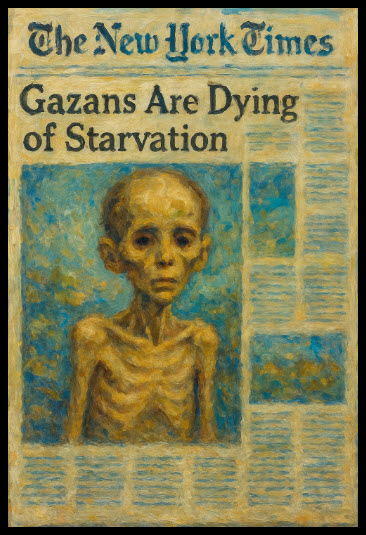
NYTimes Misreporting on Gaza (image created by ChatGPT)

There was a time when The New York Times carried a sense of solemn responsibility, embodied in its long-standing motto: “All the News That’s Fit to Print.”

That simple phrase was once the gold standard of American journalism, signaling a commitment to editorial integrity, factual accuracy, and the sober handling of truth, even when the truth was inconvenient. But in the wake of its recent coverage of Gaza—most notably the now-infamous photo of an emaciated child presented as evidence of starvation due to Israeli policy—that motto rings hollow.

Instead, we are left with a far more revealing motto for today’s New York Times:
“All the News That Fits the Narrative.”

Let’s be clear: the image in question—heartbreaking and visceral—was presented on the front page to drive home a claim of mass starvation, bolstering accusations of genocide against Israel. But as later emerged, the child in the photograph suffered from a rare genetic condition and cerebral palsy, conditions that had nothing to do with hunger or Israeli policy. That crucial context was missing from the original story. The narrative had already taken hold, and the damage—global outrage, diplomatic repercussions, and a further erosion of Israel’s moral standing—was done.

When the truth came to light, The New York Times quietly appended an editor’s note—online only. Not on the front page. Not even through the paper’s primary Twitter/X account, with its 55 million followers. Instead, it was tucked away in a footnote and broadcast from the NYT Communications account, with a fraction of the reach. No apology. No front-page retraction. No acknowledgment proportionate to the scope of the error.

This is not a mistake in good faith. It is evidence of a deliberate editorial shift—away from impartial reporting and toward ideologically filtered storytelling, where facts are selected, omitted, or massaged to fit a pre-approved worldview.

Let’s call it what it is: a betrayal of journalism.

The New York Times is no longer simply “left-leaning.” It has become an instrument of activist journalism, more committed to emotionally driven advocacy than to the disciplined verification of truth. In recent years, the paper’s editorial stance has increasingly echoed the language of anti-Zionist rhetoric, adopting activist terminology like “genocide” and “apartheid” with little nuance and even less responsibility.

It is especially egregious when this behavior results in the dehumanization of Israelis and the distortion of Israel’s actions, especially during wartime. Responsible journalism acknowledges the complexity of war, the fog of information, and the need to verify before amplifying. But when The Times chooses to amplify first and clarify later—quietly, begrudgingly—it abandons its duty to inform and embraces the power to inflame.

And it is doing so at the cost of truth.

The tragedy is that The New York Times once played a pivotal role in shaping public understanding of world events. But today, it is shaping public misunderstanding. By substituting drama for depth, and narrative conformity for factual rigor, it has relinquished its role as a trusted arbiter of truth.

Israel, and Jews everywhere, must pay close attention to this trend—not only because of the immediate consequences of slanted reporting but because the world’s most powerful media institution is no longer reporting the world as it is, but as it chooses to see it. And increasingly, it sees Israel through a distorted, hostile lens.

This is no time for passivity. We must hold media institutions to account. We must call out manipulative narratives, demand full and public corrections, and speak louder when the silence of integrity is replaced with the noise of propaganda.

Because when “All the News That’s Fit to Print” becomes “All the News That Fits the Narrative,” the very foundation of free, fair, and factual journalism begins to crack—and the truth becomes collateral damage.


Let us not be silent. Let us not be misled. And let us never accept fiction dressed as fact—no matter how reputable the source once was.

About the Author
Richard Diamond is a retired technology executive, lifelong student of Jewish philosophy, and frequent writer on the intersection of theology, ethics, and public life. He brings decades of leadership experience, historical insight, and personal commitment to Israel’s future to his thoughtful explorations of contemporary Jewish challenges.
Related Topics
Related Posts
Sign in or Register
Please use the following structure: example@domain.com
Or Continue with
By registering you agree to the terms and conditions
Register to continue
Or Continue with
Log in to continue
Sign in or Register
Or Continue with
check your email
Check your email
We sent an email to you at .
It has a link that will sign you in.