"These fragments I have shored against my ruins"
The Night of the Murdered Poets, 73 years later
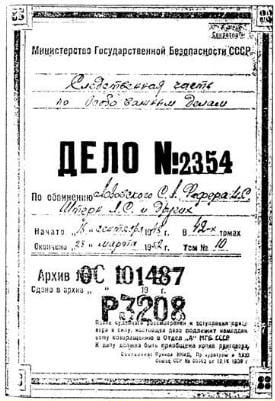
Cover of the investigation file of the case of the Jewish Anti-Fascist Committee Photo: Public Domain
On the night of 12 August 1952, in the basement of Moscow’s Lubyanka Prison, thirteen Jewish intellectuals were taken from their cells, one by one, and executed by gunfire. They had already endured more than three years of isolation, interrogation and torture. Some had been compelled to sign elaborate confessions, while others maintained their resistance until the very end. The official charges leveled against them included “bourgeois nationalism,” “treason,” “espionage,” and “planning to establish a Zionist homeland in Crimea,” yet their true offense lay not in conspiracy but in prominence; they were Jews in a state where Jewish identity, once briefly encouraged during the war, had by the early 1950s become a mark of suspicion and disloyalty.
These people were the remnants of the Jewish Anti-Fascist Committee, an organization established by Soviet authorities in 1942 to rally support from Jewish communities abroad for the Soviet war effort against Nazi Germany. Members of the Committee had travelled extensively; to the United States, Britain, and Latin America, raising funds, forging international contacts, and speaking publicly about the annihilation of Jewish communities under Nazi occupation. During those years, Stalin’s regime tolerated and at times even exploited the visibility of Jewish figures, recognizing that their international connections served an urgent wartime purpose.
However, in the post-war period, as Soviet forces occupied Eastern Europe and Israel emerged in 1948 as a state independent of Moscow’s influence, the Soviet leadership’s attitude hardened sharply towards Zionism and Jewish internationalism. Following the deterioration of Soviet-Israeli relations, those same international ties that had once been celebrated were reframed as evidence of “rootless cosmopolitanism.”
This term, first deployed by Stalin’s propagandists in 1949, referred to intellectuals and artists accused of lacking loyalty to the Soviet motherland and of privileging foreign culture over Soviet achievements. Though couched in ideological language, the label was overwhelmingly applied to Jews whose education, languages, and social networks extended beyond the Soviet borders. In the eyes of the regime, such individuals were viewed as permanently suspect, their loyalties never entirely aligned with the state.
On 20 November 1948, the Jewish Anti-Fascist Committee was formally dissolved by decree of the Politburo of the Central Committee of the All-Union Communist Party, marking a decisive shift in Soviet policy towards its Jewish citizens. At the same time, the closure of Eynikait, the last Jewish newspaper in the country, and its publishing house Der Emes signaled the effective end of Jewish print media in the Soviet Union. This wave of repression quickly reached the Jewish Autonomous Region, where arrests targeted its leadership, Jewish writers’ unions were disbanded, and the final four Jewish secondary schools offering instruction in Yiddish (in Chernivtsi, Vilnius, Kaunas, and Birobidzhan) were closed.
By December 1949, the Moscow State Jewish Theatre had been shut down, followed soon after by the closure of the last surviving Jewish theatrical institutions in Minsk and Chernivtsi. In January of that year, the Soviet press launched a campaign against so-called “cosmopolitans,” unmistakably aimed at the Jewish population. This marked the beginning of a systematic assault on Jewish cultural life. In response, the poet Shmerke Kacherginsky published a searing article in Paris entitled Towards the Liquidation of Jewish Culture in the USSR, while Peretz Markish declared with bitter clarity, “Hitler wanted to destroy us physically, Stalin wants to do it spiritually.”
Markish, who had once written with almost reckless expansiveness —
With open eyes, with an unbuttoned shirt,
with hands spread wide—
I don’t know whether I have a home
or have a far away,
whether I am an end or a beginning…
— now stood accused of conspiring to betray the very state whose war victories he had celebrated in verse. Before his arrest, he warned friends: “They killed us all, but they are leaving me alive so I can dig our graves.”
The publication of Yiddish-language materials, including books, was prohibited outright, and in a symbolic act of cultural erasure, the last surviving set of ancient Hebrew typographic fonts was destroyed. On 15 June 1949, Glavlit issued Order No. 620, mandating the removal of approximately 500 titles by Jewish authors, written in Russian, from libraries and bookshops, branding them as “Zionist” or “nationalist.” This purge was accompanied by mass dismissals of Jewish professionals, and similar campaigns were replicated across the union republics.
The crackdown had begun earlier with the murder of Solomon Mikhoels in January 1948. The beloved actor-director of the Moscow State Yiddish Theatre was killed on Stalin’s orders and left by the roadside to make his death appear accidental. His assassination signaled the beginning of a campaign not only against individuals but against the very idea of Soviet Jewish cultural autonomy.
The arrests began in earnest in September 1948, even before the Committee was officially dissolved. The poet David Gofshtein was detained and, after weeks of interrogation, coerced into denouncing his colleagues. What followed was a relentless purge of Jewish intellectual and cultural life. Over the following months, a number of prominent figures were arrested, including Peretz Markish; David Bergelson, a novelist of quiet, lyrical precision; Itzik Feffer, both poet and wartime resistance fighter; Benjamin Zuskin, successor to Mikhoels on the Jewish stage; and Solomon Lozovsky, a veteran Bolshevik and deputy foreign minister.
The years in prison were an exercise in calculated destruction. Interrogations lasted for days without rest; food and medical care were withheld; accusations were repeated until they blurred into self-fulfilling statements. Some resisted to the end. Lozovsky, facing his judges, said, “My conscience is clear before the court, before the people, and before my party. I shall not ask for mercy.” Others, under unbearable pressure, signed statements dictated by their interrogators, only to retract them in the courtroom.
The trial, held in May 1952, took place behind closed doors, its outcome predetermined long before the proceedings began. Seventy-three years ago, on that August night, thirteen individuals were executed. Their families received no notification, and their graves remained unmarked. Elsewhere in Moscow, ten Jewish engineers from the Stalin Automobile Factory were also put to death, accused of “wrecking”; a quieter, yet no less revealing indication of the purge’s far-reaching scope.
The “Night of the Murdered Poets” is a misleading name, for not all of the dead were poets. What Stalin destroyed that night was not a literary circle but the visible leadership of Soviet Jewish culture. And it was not an isolated act.
Across the Soviet bloc, anti-Jewish purges were underway. In Czechoslovakia, the Slánský Trial of November 1952 accused leading Communist officials, eleven of them Jews, of Zionist conspiracy. In Hungary, preparations for a similar show trial were halted only by Stalin’s death in March 1953. The Doctors’ Plot, announced in January 1953, accused mostly Jewish physicians of planning to kill Soviet leaders, and was to serve as the pretext for further mass arrests and possible deportations.
The cultural consequences were immediate and lasting. Yiddish publishing houses were closed, manuscripts locked away, theaters disbanded, and periodicals shut down. The last generation of Soviet Yiddish writers either switched to Russian or fell silent. The suddenness of the erasure is difficult to convey. A literature with centuries of history, and a post-revolutionary generation that had genuinely believed in the possibility of a Soviet Yiddish culture, was extinguished in the space of a few years.
In 1955, the Soviet state quietly admitted that the trial had been a sham, and the victims were posthumously rehabilitated. But rehabilitation could not reverse the loss. It could not reopen the theaters or reassemble the scattered, silenced audience. The murdered are gone, but their absence does not leave a mere void: it is a severed thread, a rupture in the cultural continuity of Soviet Jewry.
Seventy-three years on, their names still demand to be spoken, not as statistics, not as an appendix to someone else’s history, but as people whose lives embodied the richness of a culture that a state tried to erase. In remembering them, we refuse the silence that was meant to follow.
Related Topics