
The Nuclear Vote: Can Netanyahu’s Image Sway the Undecided?
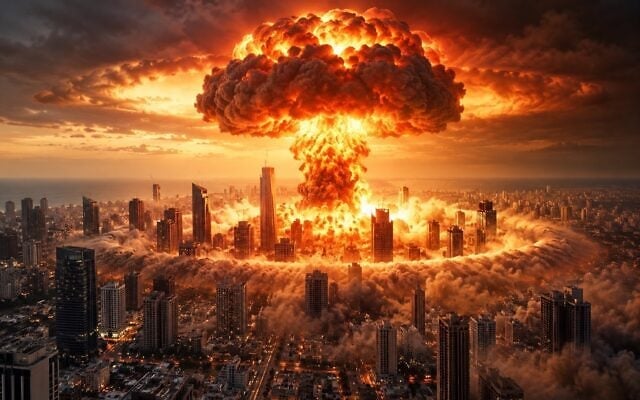
On October 25, just 48 hours before Israel’s parliamentary elections, Prime Minister Benjamin Netanyahu shared an AI-generated image on X depicting a nuclear explosion over Tel Aviv. The original post subsequently became unavailable, although the circumstances and timing of its disappearance remain unclear.
The image was accompanied by a warning about the existential threat posed by Iran and the possibility of a second Holocaust. The message, originally written by political commentator Yuval Bloomberg, suggested that electing a leader incapable of confronting Iran could have catastrophic consequences for Israel.
Opposition leaders reacted immediately. Gadi Eisenkot accused Netanyahu of using fear to influence voters, while Yair Golan condemned the publication as an attempt to spread panic.
But beyond the political controversy lies a fascinating question: Could a single image of nuclear annihilation, published just two days before an election, influence enough undecided voters to affect the outcome?
Scientific research suggests that the possibility deserves serious consideration.
In 2005, political scientist Ted Brader published a study in the American Journal of Political Science examining how emotional political advertisements influence electoral behavior. His experiments demonstrated that fear can increase vigilance, encourage voters to reconsider their existing evaluations, and make them more receptive to persuasion.
This distinction is particularly important for undecided voters, whose political preferences may be less firmly established. A powerful emotional stimulus can influence which issues they consider most important when making their final decision.
Another study, published in 2004 by Mark Landau and colleagues in Personality and Social Psychology Bulletin, examined how reminders of death and the September 11 terrorist attacks affected political attitudes in the United States.
The researchers found that reminders of mortality increased support for President George W. Bush. In one experiment, participants exposed to mortality-related thoughts became more favorable toward voting for Bush and less favorable toward his Democratic opponent, John Kerry.
The psychological mechanism is known as mortality salience: when individuals become conscious of their own vulnerability to death, their political judgments can change.
A nuclear mushroom cloud rising above Tel Aviv is an exceptionally powerful visual representation of that vulnerability.
Perhaps the most relevant evidence, however, comes from Israel itself.
In 2008, researchers Claude Berrebi and Esteban Klor published a study in the American Political Science Review examining how terrorist attacks influenced Israeli voting behavior.
They found that a terrorist attack occurring in a locality within three months before an election increased support for right-wing parties by approximately 1.35 percentage points among votes cast for the two major political blocs. They also found that the electoral impact of fatalities was stronger when attacks occurred closer to election day.
These findings are particularly relevant in a closely contested election, where relatively small shifts in voter preferences can have substantial political consequences.
However, an essential distinction must be made: these researchers examined actual terrorist attacks, not hypothetical catastrophes represented through artificial intelligence. Their findings cannot be used to predict the electoral effect of Netanyahu’s image directly.
And the threat represented in Netanyahu’s publication cannot simply be dismissed as imaginary.
Iranian leaders have repeatedly threatened Israel, including explicit warnings that Tel Aviv and Haifa could be destroyed. Such statements give the image a historical context, even though they do not establish that Iran possesses a nuclear weapon or intends to launch a nuclear strike.
Whether Iran currently possesses those capabilities, or how likely such an attack would be, is a separate question. The image illustrates a possible catastrophe, not an established prediction.
But why Tel Aviv?
Beyond its economic and symbolic importance, the city has historically been a stronghold of political forces opposed to Netanyahu. Depicting its destruction could, in theory, resonate particularly strongly with voters less inclined to support him, although the image alone cannot establish whether this was part of his intended strategy.
The psychological response, however, need not be uniform.
An undecided voter who associates Netanyahu with military experience and the ability to confront Iran may interpret the image as an argument for continuity. Another who holds him responsible for unresolved security challenges may see it as an argument for change.
Fear does not necessarily benefit the politician who invokes it. Its electoral effect depends partly on whom voters trust to protect them.
In this particular case, Netanyahu’s strategy may favor him among undecided voters who already associate his leadership with national security. By placing the possibility of nuclear annihilation at the center of the campaign’s final hours, he reinforces that association precisely when those voters are preparing to make their decision.
The scientific evidence supports the prediction that this strategy could help Netanyahu gain some votes among undecided Israelis who already associate him with greater competence on national security, although the studies do not directly measure the effect of an AI-generated nuclear image.
What remains impossible to determine is how many voters the image will persuade, how many it may alienate, and whether the resulting balance will be sufficient to tip the election in Netanyahu’s favor.
Whether this unprecedented use of an AI-generated nuclear catastrophe will actually influence Israeli voting behavior is a question that may itself become the subject of future scientific research.