Revealing Israel for curious travelers
The Old City Belonged to Everyone Except Me
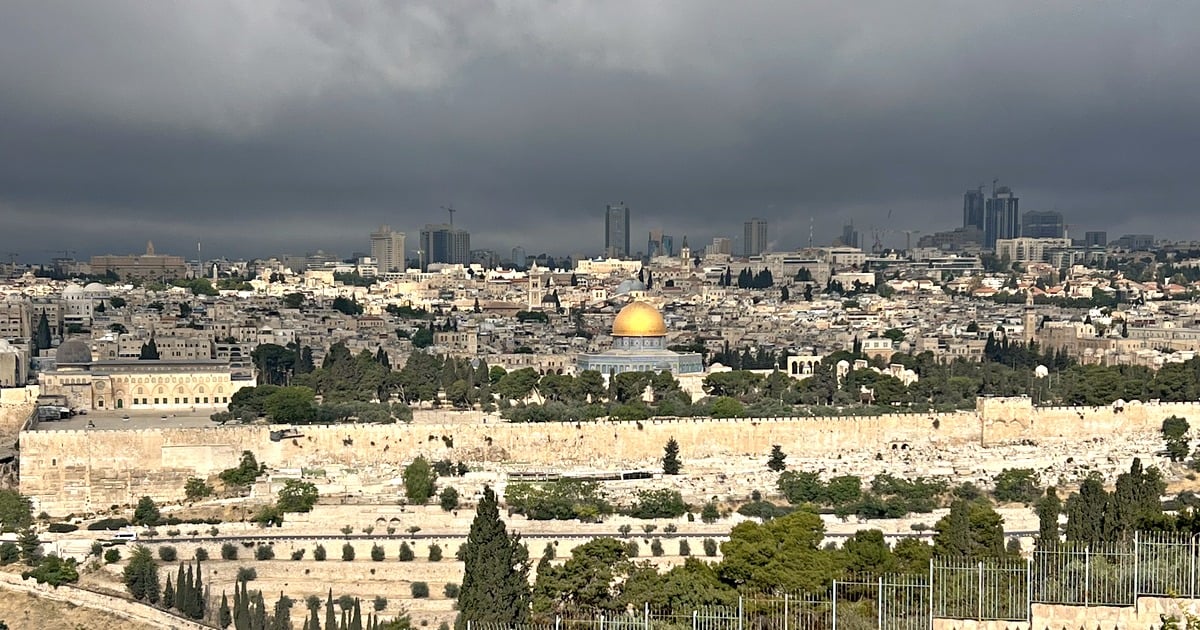
Jerusalem from the Mount of Olives, under a storm. Photo: Maria Lando
I used to despise the Old City of Jerusalem.
It felt intimidating, heavy, tense. Everyone seemed to belong to some tribe I did not belong to, dressed for a ritual I could not relate to, heading somewhere with absolute purpose.
There was the Kotel. There were the obligatory Bar Mitzvah celebrations. There were stones everyone told me I was supposed to find moving.
I felt nothing singing inside my soul.
And we do not change after fifty, right?
Wrong.
I enrolled in an Israeli tour guiding course almost on a whim, following my love of travel and learning. What followed was a year and a half of intense study, countless exhausting and fascinating field trips, and some extraordinary guides who showed us Jerusalem from completely different angles.
Slowly, almost against my will, the city got under my skin.
I cannot tell you exactly when it happened. I only know that now, when I park at Mamilla and start walking toward Jaffa Gate, my heart beats a little faster with anticipation.
Every building hides a thousand years of stories, and every coffee stop seems to bring a fascinating stranger into your day.
On one evening you can find yourself swept into a Christian wedding dance in the street, watch an Armenian funeral procession pass by, see Muslim shopkeepers near the Muristan passionately absorbed in a game of backgammon, hear about Russian pilgrims spending the night locked inside the Church of the Holy Sepulchre, and then watch streams of young religious Jews in white shirts moving through the Old City toward the Kotel for slichot.
The muezzin calls.
Church bells answer.
Jewish prayers rise from the Kotel.
For years I experienced all this as tension.
Now I hear it as Jerusalem’s swirl of time and space, where sounds from different centuries and faiths cross in the same narrow streets.
I am tempted to call it XSound, but Elon Musk probably already owns the trademark.
Jerusalem is precious to different people for completely different reasons, at exactly the same time. It does not resolve the contradiction. Somehow, it contains it.
And then there are the small things you cannot find together anywhere else in the world.
An Armenian ceramic workshop. The world’s oldest continuously operating tattoo business, run by a Coptic Christian family. Apple strudel at the Austrian Hospice, where Emperor Franz Joseph slept in 1869 and King Abdullah of Jordan died after being shot at Al Aqsa in 1951. A doorway you have passed twenty times until someone tells you what happened behind it, and suddenly you cannot pass it the same way again.
That is the dangerous thing about falling in love with Jerusalem.
You start looking more closely.
And when I did, I noticed something rather embarrassing about the Jerusalem I was presenting to my guests.
Almost everyone in it was a man.
Kings. Prophets. Sultans. Generals. Rabbis. Priests. Architects. Conquerors.
Men built Jerusalem, destroyed Jerusalem, conquered Jerusalem, liberated Jerusalem, prayed for Jerusalem and argued over Jerusalem.
Apparently, the women were very busy elsewhere.
Except they weren’t.
They had been there all along.
So I began looking for them.
Not for “hidden women.” These women were never hidden. They ruled, fought, created, financed, negotiated, loved, cooked, wrote and led.
We simply became very good at walking past them.
Take Shlomtzion, Salome Alexandra.
For nine years, from 76 to 67 BCE, Judea was ruled by a woman. Not a king’s wife quietly influencing him from behind a curtain.
The sovereign.
She was the only woman to rule the Hasmonean kingdom in her own right and the last ruler of Judea to die while presiding over an independent Jewish state.
Rabbinic tradition remembered her reign as a time of extraordinary abundance. Wheat grew as large as kidneys, barley like olive pits, lentils like gold coins.
But this was no gentle fairy tale of a woman bringing peace to the kingdom. Shlomtzion expanded the army, hired mercenaries and made neighboring rulers think twice before challenging Judea.
Yet it is remarkably easy to tell the Hasmonean story by hurrying from one male ruler to the next and barely stopping for her.
Or Esther Cailingold.
A young schoolteacher from a religious Zionist family in London, she came to Jerusalem to teach English at the Evelina de Rothschild School. When war came, she volunteered to join the defenders of the Jewish Quarter.
In May 1948 she was mortally wounded.
As she lay wounded, someone offered her a cigarette. She refused because it was Shabbat.
She was twenty two when she died.
Her farewell letter to her family is one of the pieces I love reading aloud to visitors. There is remarkably little self pity in it. Instead, there is conviction, love and optimism about a future she already knew she might never see.
And if you have ever looked at the emblem of Jerusalem, you have looked at the work of another woman.
The lion, the walls, the olive branches.
Franzisca Baruch, a German Jewish graphic artist who fled Germany after the Nazis came to power, was one of the designers behind it. Her lettering and graphic work became part of Israel’s visual language, from the Haaretz masthead to the first Israeli passport.
Most Israelis have seen her work.
Far fewer know her name.
And before graphic design reliably paid the bills, she supported herself in Jerusalem partly by making and selling marzipan biscuits, naturally packaged in boxes she designed herself.
Once I started looking, the women kept coming.
A prophetess whose name still clings to ancient gates. A Hasmonean princess trapped between love and dynastic power. A philanthropist who crossed continents to help Jerusalem’s Jews. A Christian nun who risked herself to save Jewish lives. A Muslim mystic who spoke about loving God without fear of hell or desire for paradise.
And Golda Meir, whose famously ugly shoes have a story of their own.
One woman led to another.
Eventually I realized I could walk across Jerusalem almost entirely through the stories of its women.
And something unexpected happened.
The city changed again.
Familiar history became less tidy and considerably more human.
I do not think women need to be inserted artificially into history to make it more balanced.
They were already there.
They ruled. They built. They funded. They fought. They wrote. They negotiated. They prayed. They crossed continents to reach this city, and sometimes changed it when they arrived.
The problem is not that history forgot them completely.
It is that we learned to tell the story without needing them.
Perhaps that is what Jerusalem taught me.
The stones do not change.
We do.
I used to walk through the Old City feeling that it belonged to everyone except me.
Now I enter through Jaffa Gate impatient to see what I have missed.
There is always another story.
Very often, there is a woman standing inside it.
Related Topics
Related Posts