
Russian-American-Israeli Palestinian. Palestine is Israel.
The Olive Tree Allergy
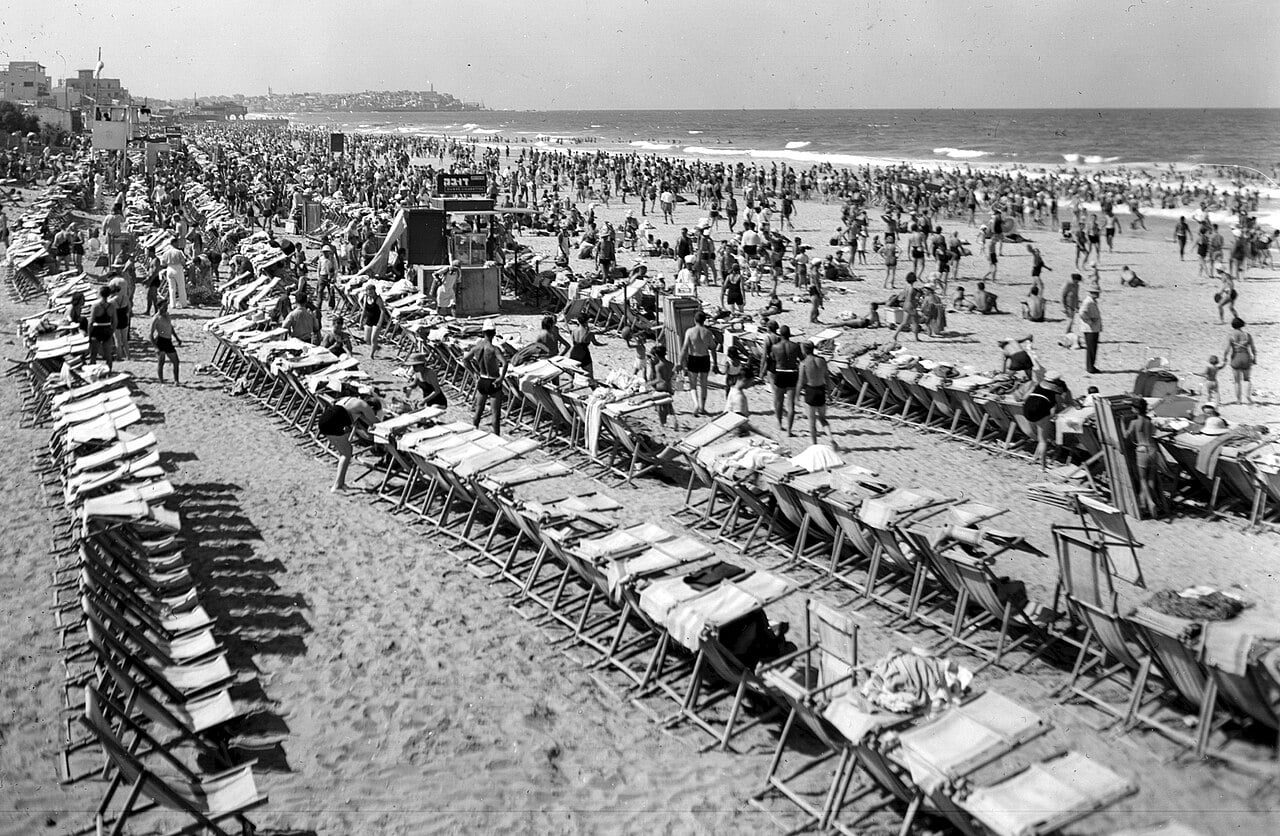
Palestinians (“White European Colonizers”) enjoying sunshine on Tel Aviv beach, Palestine, 1938. Photo by Zoltan Kluger (1896–1977). Public domain. Source: Wikimedia Commons.
On “Fake Hebrew,” “White European Colonizers,” and Similar Absurdities
There are many strands of Ziophobic rhetoric. This piece focuses on a specific subset—the claims that Hebrew is “fake,” that Jews, framed as “white European colonizers,” are somehow incompatible with the land itself, and that even materials and the built environment are treated as proof of that claim.
These arguments have been appearing consistently on social media lately, as if repetition could substitute for truth.
They don’t hold up.
“Hebrew Is Fake”
Start with the claim that Hebrew is a “fake” language. The argument is that modern Hebrew differs from its ancient form—so by that logic, every modern language on Earth is “fake.”
A speaker of Modern English cannot understand Old English texts without specialized study. The same gap exists between German and Old High German, or Russian and Old East Slavic.
And this difference is not limited to writing. Pronunciation changes just as radically: sounds shift, merge, disappear, and new phonemes emerge over time. As a result, if speakers of the same language from distant historical periods were suddenly placed face to face, they would not understand each other at all—not in writing and not in speech.
But Hebrew does not even fit that pattern. Modern Hebrew remains close enough to the language of the Tanakh that modern speakers can read ancient texts directly. Not approximately. Not symbolically. Directly. Try picking up Beowulf or Shakespeare and reading it as an English speaker—you’ll quickly discover what a real linguistic rupture looks like.
So the accusation collapses before it even gets started.
The Climate Fantasy
The rhetoric then shifts from language to biology. We’re told that “white European colonizers” are somehow incompatible with the land—that the Levantine sun is too much, the climate too unforgiving, and that something as mundane as sunscreen use is taken as supposed proof of it.
Reality disagrees.
Look at Florida. It is literally nicknamed “the Sunshine State.” Look at Texas. Look at Arizona. Look at the entire southern United States—regions that are hotter, more humid, and climatically more extreme than much of Israel. They are filled with the same “white European colonizers” who, we are told, cannot possibly survive in the Middle East. Not only do they survive in those parts of the United States—they actively choose to live there.
So what is the actual, testable difference between Florida and the Levant that produces this supposed “incompatibility”?
The Olive Allergy Claim
And then, somehow, the argument gets even stranger. Now the problem isn’t the sun—it’s olives. Europeans, we’re told, are allergic to olive groves.
At this point, the claim stops pretending to be serious. Olives have been cultivated and consumed across the Mediterranean—including large parts of Europe—for thousands of years. There is no civilizational allergy to olive trees.
If anything, the real allergy story looks very different. Across New York, Massachusetts, and large parts of the northeastern United States, spring pollen routinely turns entire populations into walking allergy cases. Weeks of sneezing, watery eyes, and antihistamines are simply part of life.
So the idea that the Levant is uniquely “unsuitable” for these same people (“white European colonizers”) is not just wrong—it’s almost comically backwards.
The Architecture Narrative
The same pattern extends into architecture. Traditional Arab mud-brick villages are presented as inherently “authentic” and durable, while modern construction is dismissed as temporary, artificial, or inferior—supposedly as evidence of cultural illegitimacy.
It’s a familiar narrative—the same one used to mock American houses as being “made of cardboard.”
In reality, building materials reflect function, climate, economics, population growth, available technology, and many other factors.
Rapid construction in the mid-20th century inevitably produced uneven results. Some of the housing built in the 1950s and early state period was indeed of low quality by modern standards, and Israel has spent decades replacing and upgrading it. Israeli humor even coined the term “barrackko architecture” (a play on baroque / barocco) to describe some of these utilitarian structures.
But those buildings were not a cultural statement—they were a necessity. They provided rapid housing for a fast-growing population under urgent conditions. Evaluating them as architectural ideology rather than an infrastructural response is a retrospective misreading of context.
The attempt to read legitimacy into architecture follows the same pattern seen elsewhere in these arguments: taking neutral material facts and converting them into symbolic evidence of civilizational worth.
It is not architecture being described. It is meaning being projected onto architecture.
And ultimately, it is not the business of Ziophobes to dictate what kinds of housing Israel chooses to build.
The “Colonization” Sleight of Hand
At this point, the pattern becomes hard to miss. Facts are ignored, replaced by slogans that sound persuasive only if you don’t examine them.
The same pattern appears in the way certain words are used—particularly the word “colonization.” Early Zionists used terms like “colony” and “colonization” in a neutral, descriptive sense: establishing a settlement, building a community, creating life in a new area. That was the common usage at the time. It carried none of the automatic moral condemnation that the word often carries today.
Projecting modern meaning backward onto historical language is not analysis—it’s distortion.
When Words Change Meaning
And this isn’t a rare phenomenon. Language changes constantly, often in ways that completely transform meaning.
Consider the English word “awful.” It originally meant “full of awe”—something inspiring wonder or reverence. Over time, it shifted into its modern meaning: something very bad. Same word, entirely different sense. If you read an old text using the modern meaning, you would misunderstand it completely.
Or take “nice.” It once meant “ignorant” or “foolish.” Today it means pleasant, agreeable, even kind. A complete reversal of value.
Or “silly,” which originally meant “blessed” or “fortunate,” and gradually slid into its modern meaning of foolish or lacking seriousness.
Even more structural shifts happen through everyday usage. “Meat,” for example, once referred broadly to food in general; now it refers specifically to animal flesh. “Girl” once referred more generally to a young person, regardless of sex, before narrowing to its modern meaning.
These are not anomalies—they are standard linguistic processes: broadening, narrowing, upgrading, downgrading, and full semantic drift over time.
That is exactly what happens when people take historical uses of “colonization,” inject modern political connotations, and present the result as evidence. It isn’t evidence. It’s a linguistic trick: freezing a word in time, then smuggling in a meaning it did not originally carry.
Conclusion: Beyond Slogans
What ties all of these arguments together is not their strength, but their structure. Each one depends on ignoring how things actually work—how languages evolve, how climate and biology function, how materials and the built environment reflect practical constraints, and how words change meaning over time.
Strip away the slogans, and there is very little left.
And that’s the real pattern.
—
See Also
Related Topics
Related Posts