
The Oracle, the Odds, and the Chairman
Ancient Greek tragedy repeated a specific kind of collapse: not the absence of information, but the misuse of it. The hero hears the warning and still walks forward, because he treats knowledge as something to confirm his course rather than to correct it. Oedipus is told that the truth will ruin him; he keeps digging anyway, convinced that clarity must be salvation. Cassandra speaks plainly; power waves her off because her message is inconvenient.
That dynamic doesn’t stay on the stage. It shows up whenever a government treats analysis as reassurance, whenever media treats wagers as “data,” and whenever diplomacy is redesigned so one person becomes the final gatekeeper of legitimacy. In a region where a single misread can trigger escalation—or where one misleading “probability” can dominate headlines—these are not abstract risks.
That is the template worth keeping in mind right now: a system can have plenty of data, plenty of expertise, “signals”—and still drift toward disaster if it cannot separate description from desire, and information from incentive.
Three stories from this week—one about intelligence, one about prediction markets, and one about Trump’s new “Board of Peace”—suggest we are drifting into exactly that kind of failure.
The first comes from Israel’s own security discourse. According to a report by Kan News, senior figures in the security establishment criticized Military Intelligence (Aman) for assessing that Iran is currently in a “revolutionary” posture. Their objection wasn’t ideological; it was methodological: Aman, they argued, was “mixing Israeli aspirations with a description of reality.” They pointed to two facts: protests inside Iran were suppressed rapidly and effectively—collapsing from mass demonstrations to near-zero within days—and the regime’s structural problems look familiar, not novel. In other words: the temptation is to narrate Iran as “ripe,” because it is strategically comforting.
The second story is even more revealing—because it shows what happens when uncertainty becomes a financial asset. Again via Kan, Israel’s security services examined a suspicion that someone with access to classified information used it on Polymarket, placing large bets during the June 2025 war with Iran that proved strikingly accurate: predicting the timing of an Israeli strike and the timeline for the operation’s conclusion. The report stresses that officials discussed the matter but—at least at the time—chose not to open a formal investigation.
If the suspicion is correct, it is not merely “corruption.” It is a new kind of leakage: the conversion of state secrets into market profit, disguised as “collective forecasting.” Such markets can become a conduit for privileged knowledge—whether through leaks, inference, or access—while simultaneously signaling to outsiders that privileged knowledge exists.
That is precisely why the prediction-market boom is not a quirky media trend but a structural risk. In The Atlantic, Saahil Desai describes how major outlets—from CNN to Dow Jones—are integrating odds from platforms like Kalshi and Polymarket into their reporting, as if betting lines are a cousin of polling or economic indicators. He argues that this “financializes everything,” turning news into something you trade, and trade into something that can shape the news. These markets are manipulable; they can mislead audiences; and they can create incentives to move events, not just predict them. The danger is not merely bad forecasting; it is the feedback loop—odds become narrative, narrative becomes pressure, pressure becomes policy.
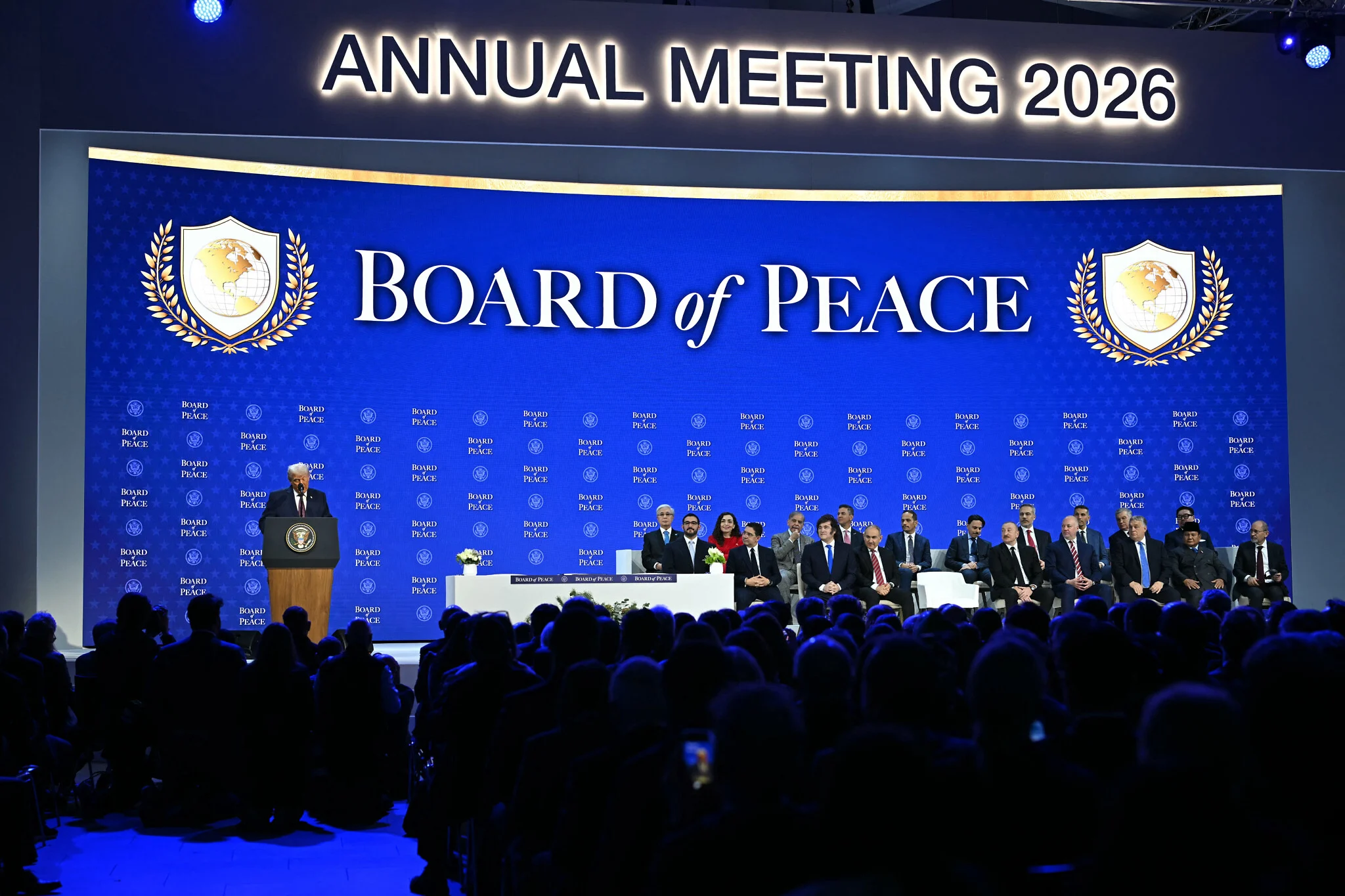
Now place those two stories next to the third: the full charter of Trump’s “Board of Peace,” obtained and published by The Times of Israel. On inspection, the charter makes clear the headline isn’t “new peace mechanism.” It’s “new governance model.” Membership is by invitation of the Chairman. Key decisions require approval of the Chairman. The Chairman has exclusive authority to create or dissolve subsidiary bodies. The Chairman selects the Executive Board. The Chairman is the final authority for interpreting the charter’s meaning. Even the Board’s continued existence is effectively renewable at the Chairman’s discretion, on a rolling calendar. Some member states can effectively buy permanence: the charter’s three-year term limit does not apply to states that contribute $1 billion in cash within the first year. And the charter names the inaugural Chairman not as “the President of the United States,” but as Donald J. Trump—personally.
This is the part too many readers will skim past: it is not just “Trump leading an initiative.” It is a step toward a hierarchical mechanism with a single apex—closer to a personalist club than to an anarchic, rules-based order. (“Anarchy” here in the international-relations sense: no final authority above states.) The charter’s structure quietly shifts the question from “What do states agree?” to “What does the Chairman allow?”
To be clear, the UN mandate associated with the Board is formally limited to Gaza and runs through the end of 2027 (unless renewed). But charters are not only about legal scope; they are about institutional habit. Once the world normalizes a peace body whose constitutional logic is “final authority resides in one person,” the template becomes exportable—especially when it comes packaged as pragmatism.
And now the triangle closes.
When intelligence “mixes aspirations with reality,” it begins to behave like a narrative instrument rather than a corrective. When prediction markets become mainstream “data,” they create incentives to manipulate perception—or monetize access. And when peace-building is reorganized into a chairman-centered hierarchy, access becomes the core currency of international order.
This is the deeper connection: we are replacing institutions that mediate uncertainty with mechanisms that profit from it or personalize it. In such a system, the strategic advantage shifts away from states with better arguments and toward actors with better proximity—to secrets, to markets, to the Chairman.
Israel will feel this sharply. A country that lives by intelligence cannot afford blurred lines between analysis and desire. A country that depends on discretion cannot afford a new ecosystem that rewards leaks as “alpha.” And a country that needs international legitimacy cannot ignore what it means when legitimacy is increasingly routed through a single personality rather than durable rules.
Supporters will say: the old institutions failed; we need speed, nimbleness, and results. They are not wrong about the failures. A single chairman can move faster than a deadlocked Security Council, and a small “coalition of the willing” can sometimes act where universal bodies stall. But the cure may be worse than the disease if it creates a global order where the price of participation is money, loyalty, and proximity—and where truth is what the odds say today and what the Chairman says tomorrow.
Greek tragedy ends when warnings become background noise—when Cassandra is still right, but no one has the institutional capacity to act on being warned. That is the quiet danger here. We are not running out of information. We are building systems that make information easier to use for power, profit, and performance—and harder to use for restraint.
So the real question isn’t whether the Board of Peace is “good” or “bad.” It’s more uncomfortable:
Are we building a more effective architecture for peace—or are we building a world where reality is defined between intelligence that flatters, markets that distort, and a chairman who decides?