
The Palestinian Paradox: Humanitarian Privilege ?
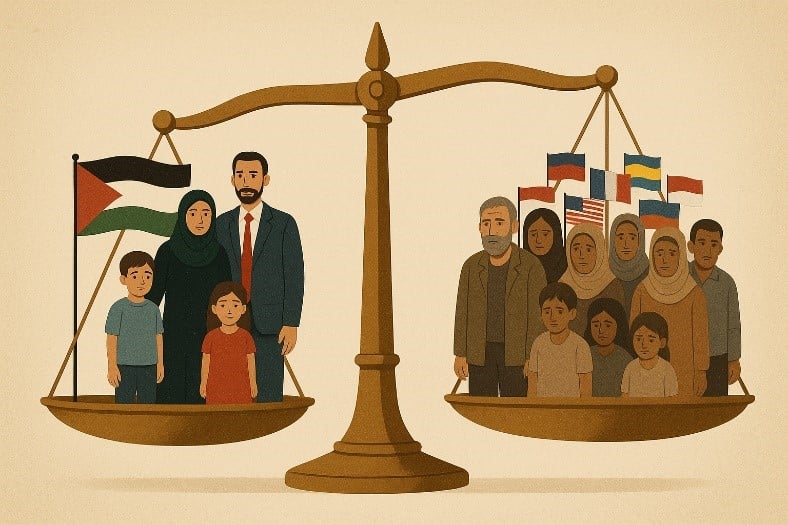
In 1948, there were 700,000 Palestinian refugees. Today, they are officially 5.9 million[1]. They benefit from a dedicated UN agency — UNRWA — which provides them with higher subsidies than those received by all other refugees under UNHCR’s mandate, as well as with exceptional political attention.
On average, UNRWA spends $270 per Palestinian per year, funding schools, hospitals, and other infrastructure.
The UNHCR, which must address the needs of some 35 million people — refugees, asylum seekers, internally displaced persons — operates on a budget of about $10 billion, amounting to less than $100 per person[2].
Thus, fewer than 6 million Palestinians receive more resources per capita than tens of millions of other refugees — often poorer but far less visible.
Structurally, this means a Palestinian refugee “is worth” two to three times more, on average, than a Syrian, Afghan, Sudanese, or Congolese refugee.
A Historical Exception
Created in 1949, UNRWA was meant to be temporary. It became permanent.
Under UNRWA’s definition, Palestinian refugee status is collective, hereditary, and based on the original 1948 displacement: it is passed on to children, grandchildren, great-grandchildren, and so on — and remains valid even if the person moves far away from the covered areas (though access to local services may then be limited).
The status of all other refugees under UNHCR is individual and conditional: it is not automatically passed on to children, and it depends on the person’s current situation of persecution and the protection offered by the host country.
UNHCR seeks to resolve the plight of refugees, encouraging repatriation, integration, or resettlement.
UNRWA, on the contrary, is mandated to perpetuate Palestinian refugeehood across generations.
One aims to reduce the number of refugees; the other is designed to increase it indefinitely.
Palestinian refugees have been politicized — used as leverage against Israel at the UN, in diplomatic circles, and in the media.
In a world overwhelmed by crises, their file remains a priority, as if their cause outweighed all others.
But this instrumentalization is cruel: turned into eternal refugees, they and their descendants are condemned to abnormality.
The world has placed them in a state of perpetual victimhood — giving them neither a future nor true independence.
Their “privilege” is, in reality, a dead end.
An Exception with Theological Roots
Why this paradox? Why are Palestinians not treated like other refugees?
This singularity has theological roots.
For two thousand years, the two major faiths that emerged from Judaism — Christianity and Islam — have claimed to supersede it.
But the return of the Jews to their land, the rebirth of Israel fulfilling biblical promises, challenges this claim.
In this perspective, the Palestinians become the symbolic antithesis of Israel’s return.
They embody the figure of the dispossessed, eternally exiled people — standing in contrast to the people whose return is thus delegitimized.
Perpetuating the status of “Palestinian refugees” ultimately provides a means to threaten the very existence of Israel.
Their preferential treatment is, at its core, an antisemitic maneuver aimed at undermining the world’s only Jewish state.
But the very strategy of refusing their integration — of keeping them as refugees — is what ultimately perpetuates their suffering.
Israel: An Opportunity for Palestinians
And yet, Israel could be an opportunity for the Palestinians.
Its vitality, creativity, and prosperity could — if the victimhood narrative and the teaching of hatred were abandoned — offer Palestinians a horizon of cooperation and development.
But as long as the international community prefers to enshrine their status as “eternal refugees,” they will remain prisoners of a deceptive compassion.
UNRWA is not their future — it is their gilded cage.
[1] According to UNRWA, there are approximately 2,360,000 registered in Jordan, 885,000 in the West Bank, 1,593,000 in Gaza, 590,000 in Syria, and 472,000 in Lebanon.
[2] By contrast, if one counts all the people under UNHCR’s mandate — refugees, asylum seekers, internally displaced persons, and others — the total reaches about 110 million worldwide.