
Writer covering Israel–Africa, Jewish affairs, and Israel worldwide
The Palestinian Right of Return, and the Jewish Right to Forget
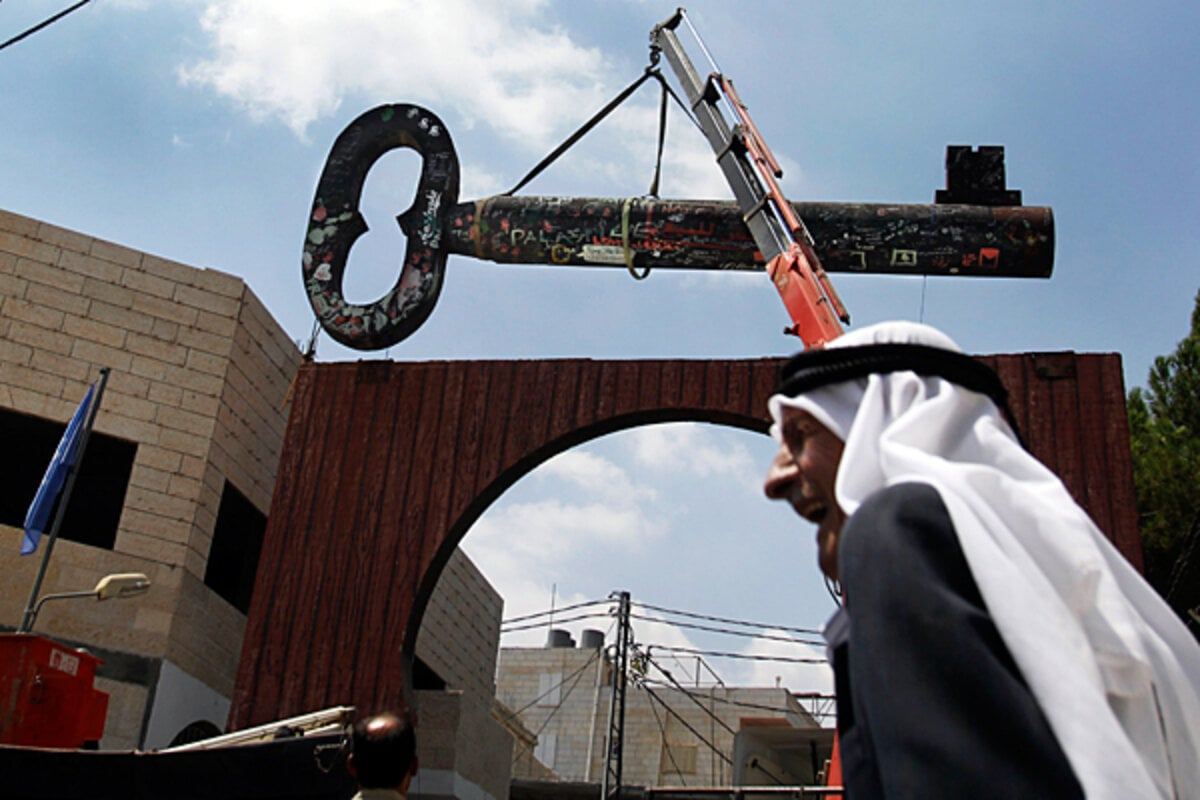
Image by Nasser Shiyoukhi/AP
There is a rather extraordinary arrangement in the Middle East. It involves two peoples, one piece of land, two histories, and, apparently, two entirely different rules. The Palestinians have a right of return. The Jews, it seems, have a right of return only until they actually return.
This is the sort of arrangement that could only have been designed in the Middle East, where a contradiction is not necessarily a problem. Sometimes it is the entire foreign policy.
The latest spectacle concerns E1, the strategically important area east of Jerusalem where the Israeli government has advanced plans for more than 1,200 housing units. The usual international machinery has consequently begun whirring: condemnations, resolutions, warnings, and statements of “grave concern.”
There is just one small difficulty. Judea. You know, the place from which the word “Jew” derives.
But let us put that minor historical inconvenience aside for a moment and consider the peculiar international theology of the “right of return.” Because there are two returns. And only one of them is apparently sacred.
The First Return
The Palestinian demand for return concerns Palestinians who left, or were displaced from, communities that are now inside the State of Israel. This is presented internationally as an obvious question of historical justice. The United Nations established UNRWA in 1949 to provide assistance to Palestinian refugees, and the Palestinian refugee question has remained one of the great permanent fixtures of international diplomacy. Permanent is the operative word.
The Second World War ended. European empires collapsed. Borders moved. Populations moved. Governments disappeared. New governments appeared. People who had been born in one country woke up to discover that their country had ceased to exist. History, in other words, did what history tends to do: it was extraordinarily unpleasant.
But Palestinian refugeehood acquired something rather different. It became hereditary. The refugee problem was not merely preserved. It was institutionalized. And so the Palestinian refugee of 1948 became, in international politics, a category capable of surviving long after the circumstances that produced the original displacement had passed.
There was a war. The proposed partition of Mandatory Palestine was rejected by Arab leaders. Violence followed, and after Israel declared independence in May 1948, neighboring Arab states invaded the new Jewish state. The refugee crisis emerged from that war. People fled from fighting. And some left in the expectation that the Arab armies would defeat Israel and that they would return after victory.
The war was therefore not some unfortunate event that drifted across the Middle East and deposited refugees in neighboring countries. It was a war. And wars have consequences.
Yet over the decades something fascinating happened. The war became the footnote. The refugee became the headline. The Arab attempt to destroy Israel disappeared from the story, while the consequences of that attempt became the entire story.
The distinction matters. Because once responsibility for the war disappears, responsibility for the consequences of the war becomes very easy to rearrange. The aggressor becomes the victim. The defeated becomes the innocent. And history becomes a courtroom in which the losing side somehow gets to appoint the judge.
This is how we arrived at the modern mythology of the Nakba: not merely as a description of Palestinian suffering, but as the master narrative through which 1948 is understood. Israel exists. Palestinians were displaced. Therefore Israel must somehow answer indefinitely for the existence of the refugee problem. The fact that the war was launched against Israel becomes an awkward detail. So, naturally, it is best left in the basement.
Now Enter the Jews
And then there is the other return. The Jewish one. This is where the international argument suddenly develops an interesting allergy to history.
The Jews have thousands of years of documented historical, religious and national connection to Judea and Samaria. Judea is not a place Jews encountered on Google Maps in 1967. The Jewish connection to Jerusalem is not the result of an Israeli planning committee. Hebron was not invented by the Likud. Shiloh is not a settlement created by the Housing Ministry. Bethlehem did not suddenly become Jewish because an Israeli government issued a tender. These places sit at the very heart of Jewish history.
And yet when Jews return to parts of this ancestral homeland, the terminology changes. They are no longer returning. They are “settling.” They are no longer indigenous. They are “settlers.” They are no longer exercising an ancient connection. They are “colonizing.”
The Palestinian says, “My grandfather lived here.” The international community says, “Historical justice.”
The Jew says, “My ancestors lived here.” The international community says, “UN Security Council emergency session.”
One begins to suspect that the problem is not the argument. It is the Jew. Because apparently Palestinian history has an expiration date measured in generations, while Jewish history has an expiration date measured in millennia. And this produces the strangest spectacle of all. A Palestinian whose family left a village in 1948 can claim a right to return to Israel. A Jew whose people lived in Judea thousands of years ago is told that returning to Judea is an act of colonialism.
You could not invent the irony if you tried. Actually, in the Middle East, somebody probably has.
Jews are acknowledged as having an ancient connection to the land. Everyone knows it. Archaeology knows it. History knows it. Even the names of the places have an irritating habit of remembering. But when Jews actually live there, suddenly the historical connection becomes irrelevant. It is apparently possible to be indigenous in the past but foreign in the present. That is a remarkable achievement.
Imagine applying the same logic elsewhere. Imagine telling the Irish that they are welcome to discuss Ireland but should perhaps avoid living there. Imagine telling the Greeks that Athens is historically important but that Greeks living there might constitute an obstacle to peace.
The Palestinian claim is treated as a question of justice. The Jewish claim is treated as a question of legality.
If historical attachment matters, it matters for Jews. If ancestry matters, it matters for Jews. If displacement matters, it matters for Jews. If a people does not lose its connection to a homeland merely because generations have passed, then the principle cannot suddenly become invalid when the people in question are Jewish.
Because Jews were not merely displaced once. They experienced repeated expulsions, massacres, restrictions, persecutions and forced dispersions over centuries. And yet they maintained a connection to the land. They prayed toward Jerusalem. They remembered Jerusalem. They repeated, generation after generation, the ancient hope of return.
Then they returned. And the international community looked at this remarkable historical event and apparently said:
No, not like that.
This is the heart of the absurdity. The world is perfectly comfortable with Jewish history so long as it remains safely in the past. Jewish history is admirable. Jewish archaeology is fascinating. Jewish ruins are educational. Jewish biblical sites are wonderful tourist attractions. But Jews actually living there? Now we have a problem.
Apparently the Jew is permitted to visit his history, but not inhabit it.
The international system has also developed an astonishingly selective memory. UNRWA exists because Palestinians were displaced. Fair enough. But if displacement creates an enduring historical claim, Jews have a rather long list of places from which they were displaced. If refugeehood creates a permanent right to return, then the principle must be universal. Otherwise it is not a principle. It is a political preference wearing a suit.
And perhaps that is precisely what has happened. The “right of return” has ceased to mean a universal principle about displaced peoples. It has become a political instrument in the Arab-Israeli conflict. Palestinian return is justice. Jewish return is provocation. Palestinian historical memory is sacred. Jewish historical memory is apparently dangerous.
And the same diplomats who will lecture Israel for building a home in Judea will happily explain why the descendants of people displaced in 1948 should be entitled to return to Israel. One almost feels compelled to ask whether the diplomats know where Judea is. Because the answer, increasingly, seems to be: everywhere except Judea.
And there is something particularly revealing about the fact that the exception always seems to appear when Jews are involved.
The Jewish people do not require permission from the international community to have a history. Nor do they require a UN resolution to have ancestors. They do not need a diplomatic conference to establish that Jerusalem matters to them. And they certainly do not need an international committee to certify that Judea is connected to the Jewish people.
The history existed before the committees. It will exist after them. The question is whether the international community is prepared to acknowledge it. Perhaps it is time to stop asking Jews to apologize for returning to their own history. Perhaps it is time to stop pretending that Jewish indigeneity becomes illegitimate the moment Jews exercise it.
The Jews have returned. The world can either learn to live with that historical fact—or continue holding conferences about it until the Mediterranean dries up.
But history is not waiting for permission.
Related Topics