
The Palestinians – and Israelis – who believe in peace
At the beginning of the war, someone from my synagogue waiting for orders on the border with Gaza sent me a series of agitated voicenotes, asking for proof of goodness in the Palestinian people. Can you find me 10 righteous Palestinians? Five?
I sent him a batch of screenshots, concerned and loving check-ins from colleagues and friends in the West Bank who wrote to me on October 7. Were these messages public? No. Dissatisfied, or maybe relieved, he went into Gaza to protect his people against what he believed to be an entire nation of monsters.
In the middle of the war, a particularly dark stretch of footage came out of Gaza. Some of the worst videos and photos penetrated the protective cocoon of grief and anger over What They Did To Us.
In the office, I stood with one hand pressing my phone tightly against my ear, my back to the door and my face to the window.
“I’m sorry,” I said into the phone. I was staring through recently cleaned glass at a side street in Ramat Gan, but I was seeing a child’s face in what had once been a street in Beit Lahiya. “I’m sorry.”
“Habibti,” said my friend on the other side of the line. “I have been waiting for this call for a long time. I have been waiting for you to see.” She meant, to see the child.
Tears rolled down my face and I wiped them away quickly. I understood that my tears were irrelevant. She wouldn’t even have a screenshot of this conversation to send her friends, when they asked her to justify the existence of Israelis.
“I’m so sorry.”
“I love you, my friend.”
I hung up and stared out the window, counting breaths until my face could pretend that it understood the amputated timeline of our homeland again.
In October, somewhere between the second and third week after the massacre, a Hebronite from our youth project wrote to me to say: “What happened was wrong.”
“I’m sorry I didn’t reach out before,” he added. “I thought maybe you were angry.”
“I am angry,” I answered. “But not with you. Thank you for writing. It means a lot.”
“You were always so nice,” he wrote wistfully. “I hope we will see each other again.”
“Inshallah,” I replied. This means, I have deposited your hope into God’s hands because it is too heavy for me to hold on my own.
In December, I received a phone call from a distant contact in Nablus.
“We don’t know each other well, but I feel a strong need to speak with an Israeli.”
I wrapped an imaginary flag around myself and braced for impact.
“I always believed in peace. Always. I condemn October 7, of course I do, I cried when I saw the pictures of little children, of families. But…”
I drew the flag closer, already angry, defensive, exhausted from all of these buts and howevers and conditions latching themselves onto our pain.
“But now,” she continued, because the trauma train of the Middle East stops for no one, “to see what is happening in Gaza. The children, the women… I cry every single day. How can such things be allowed to happen?”
I listened quietly and occasionally affirmed. Yes, this is reality. Yes, it is horrifying in every way.
“I have doubts,” she confessed. “About the possibility of peace. Of course I will always be on the side of innocent civilians, especially children. But,” she said, and there is no mistaking the gut-wrenching pain of a cracked faith in her words, “I have doubts.”
In this conversation, I had unintentionally become a rabbi, tending to the agony of a believer who could no longer perceive God in the world. I knew how to list the strategic benefits of a demilitarized Palestinian state in my sleep, but stumbled over words of encouragement and comfort.
I could have said: My humanity has been taken temporarily offline by a debilitating deluge of communal suffering. Please stand by. Empathy is loading.
Or: I will conduct your concerns to the appropriate authority. (There are none.)
In March, I answered a call from Ramallah in between ballistic missile alerts.
“How are you, habibti?” my colleague asked.
“Good morning! Everything is terrible.”
“Yes indeed. Did you have coffee yet?”
“On my way.”
“This is good. You will be better after coffee. Then we will talk.”
“About what?”
“Work, of course.”
“Of course.”
“Listen, we have 11 Palestinians signed up on our side for the next meeting. One of them has never participated in dialogue with Israelis before. You will like her a lot, she is amazing…”
“Wait wait wait. Let me get my coffee.”
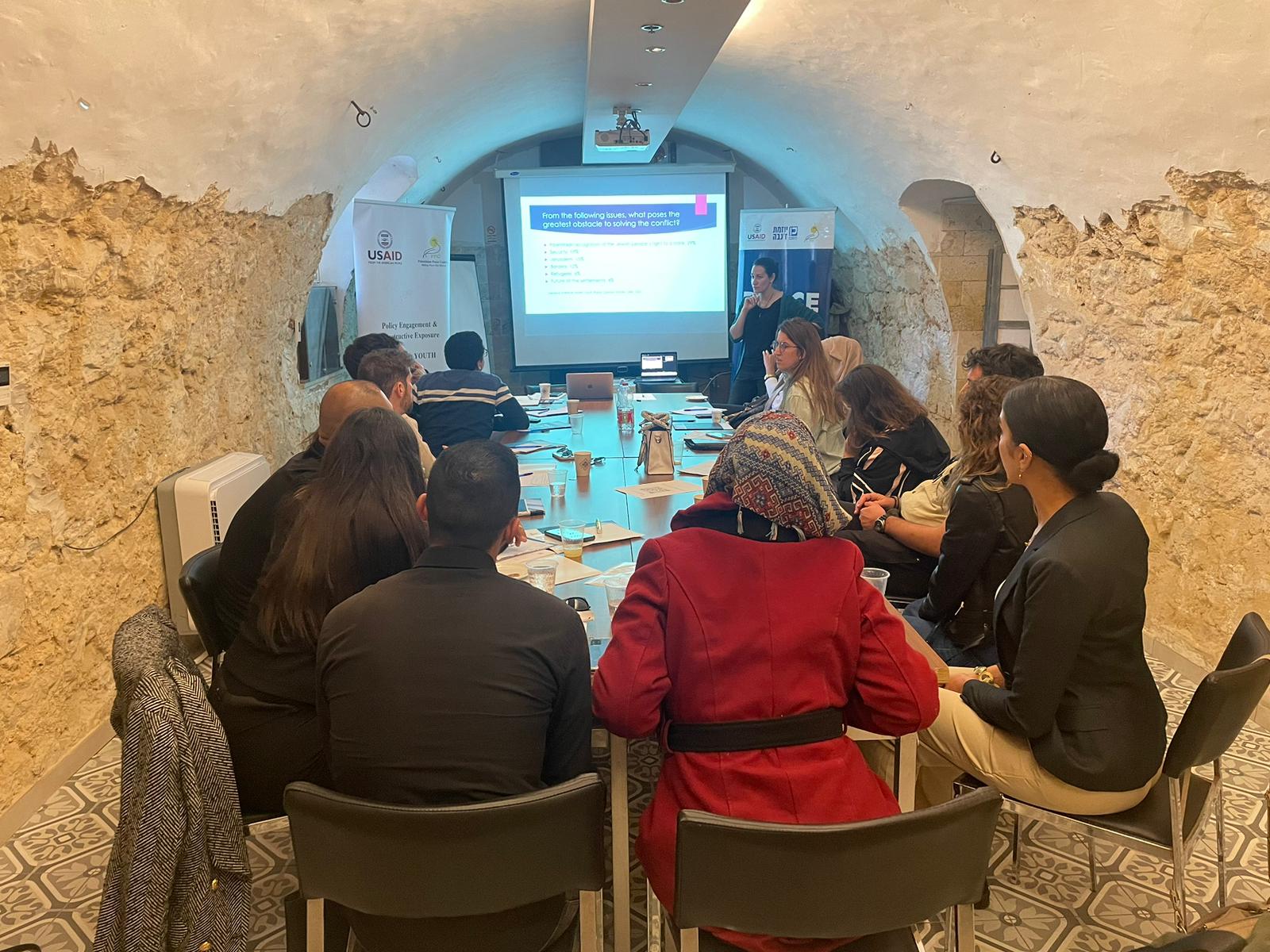
In October, December, January, February, March, April, and May, I sat across the table from a skeptical Israeli for the latest variation of the same conversation: “At the end of the day, they’re all the same. You should have learned that from October.”
This is what we were supposed to learn from October 7: Five million biblical cousins (seven if you count Palestinian and Arab-Israeli citizens) are all wolves in human skin waiting for the slightest sign of weakness to tear us apart.
“Have you ever met a Palestinian?” I asked.
“No,” he answered, “but I read what they write online. The ones you speak with aren’t representative.”
“You’re certain that the hundreds of Palestinians I’ve met are less authentic than the twelve Palestinians you follow on Twitter? And what about the Palestinians calling for peace online?”
“They’re not representative either.”
“I read what you wrote online, too. You said we should fire-bomb their cities.”
“It’s the only way they’ll learn that they can’t win. Like the Germans in Dresden. Or the Japanese after Hiroshima.”
“Do you see how talking about dropping nuclear bombs on Gaza makes you seem like an extremist?”
“I’m a realist. Peace is nice for children’s songs and Tel Aviv lefties who don’t know anything about war (an ambulance passed us on Dizengoff and we both paused to assess the rhythm of the siren, smiling in strained embarrassment as our brains reassured us that this was not going to be the third shelter run of the day) but we can no longer afford to believe in fairy tales. We need to speak the language of the Middle East.”
“Arabic?”
“Violence.”
“Do you know what most of the Palestinians I know say about Israelis?”
He leaned forward. Generalizations are always helpful. Whatever I was about to say could be reproduced endlessly in other arguments, to show the irredeemable nature of Arabs if he agreed with me, and the hopeless naivety of leftists if he didn’t.
“What do they say?” he asked.
“That we only understand force.”
If we round down – if I disqualify this one for conspiracy theories and that one for giving in to despair – I personally know at least 50 Palestinians and 50 Israelis who can fill the courthouse seats reserved for the righteous in this ongoing trial about our theoretical right to do what we’re all going to continue doing no matter what the jury decides: live in this land.
Taken together (and they must be taken together), these delegates make up twice the number that would have stopped God Himself in His indomitable wrath at the gates of Sodom and Gomorrah.
But in a world in which God does not speak, we are all more or less convinced that the prophets of peace still walking among us are not enough to save us from ourselves. So we sit, each of us tending our own vine like the Biblical Jonah, waiting with varying levels of patience for the absolute destruction of the other side – men, women, children, and the many animals among us, as well.
Please stand by. Empathy is loading…