
NAnews - Nikk.Agency Israel News
The Party That Adds the EU and Ukraine to Its Platform May Win in Fall 2026
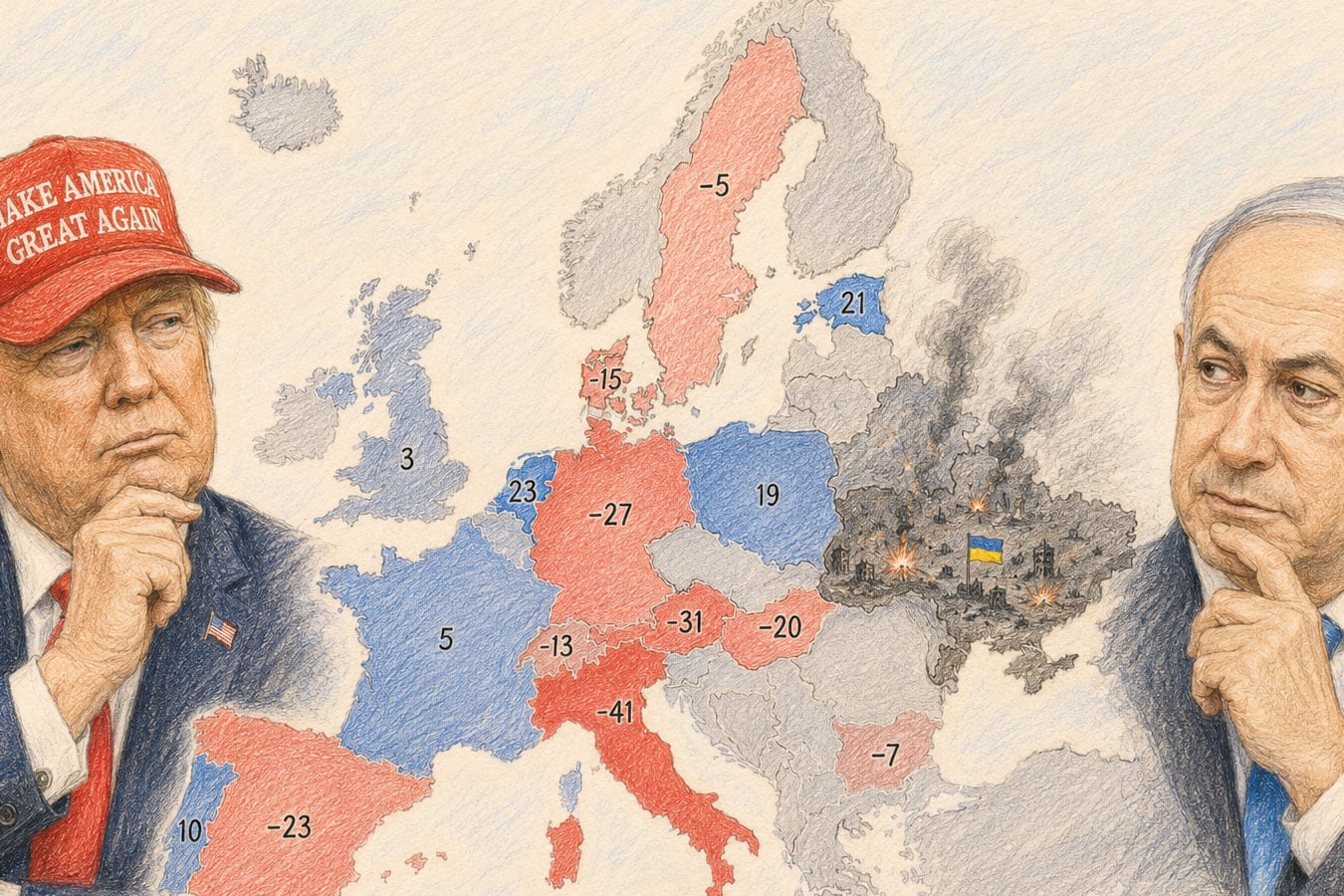
A party that includes the EU and Ukraine in Israel's strategy could win the elections in the fall of 2026. Image created using AI.
The political force in Israel that first puts a new security formula into its election platform — the United States as Israel’s main ally, the European Union as a strategic partner, and Ukraine as an important direction — may gain a real advantage in the race toward the expected elections in autumn 2026.
This is not a slogan.
It is a response to a changing world.
Israel’s security debate can no longer be built only around the old question: who is better for Israel in Washington? That question still matters, but it is no longer enough. The next serious Israeli security platform should also answer another question: what does Israel do if the American guarantee becomes less automatic, less predictable, and more dependent on domestic politics in the United States?
Europe is already asking itself that question.
On June 10, 2026, the European Council on Foreign Relations published a major report titled Home Alone: Europeans Are Ready to Defend Themselves. The poll was conducted in May 2026 across 15 European countries and included 19,481 respondents.
The countries surveyed were Austria, Bulgaria, Denmark, Estonia, France, Germany, Hungary, Italy, the Netherlands, Poland, Portugal, Spain, Sweden, Switzerland, and the United Kingdom.
The main finding is sharp: Europeans are no longer confident that the United States will protect them automatically in the event of war.
Only 11 percent of respondents now see the United States as a true ally.
In November 2024, that figure was 22 percent.
Around half a year before the latest poll, it was still 16 percent.
This is not a temporary mood. It is a steady decline.
At the same time, 25 percent of Europeans now see the United States as either a rival or an adversary. Around half of the European public views America as a “necessary partner” — a country one must work with, but no longer fully trust.
The most important result is even more striking: in none of the 15 countries surveyed does a majority believe that the United States would necessarily come to their aid if their country were attacked.
Even in Poland, one of the most pro-American countries in Europe, only 37 percent expressed confidence in American military assistance.
In Spain, the figure was around 12 percent.
Across all 15 countries, the average level of confidence in American help was roughly 23.8 percent.
At the same time, Europeans trust their neighbors more. In almost every surveyed country except Bulgaria, a majority believes that at least some European partners would help in case of an attack. The average level of confidence in European assistance was around 65.1 percent.
This is the new European reality.
America remains important.
But the old belief in an automatic American security umbrella is fading.
For Israel, this should not be treated as a European curiosity. It should be treated as a strategic warning.
Israel has built its security doctrine for decades around a deep alliance with the United States. That alliance remains vital. American military aid, air defense cooperation, diplomatic backing, weapons supplies, intelligence coordination, and support in international institutions are not symbolic. They are part of Israel’s security architecture.
But even the strongest ally cannot replace a country’s own strategy.
The United States has elections, Congress, public opinion, war fatigue, internal crises, changing priorities, and political bargaining. Support that exists today may be conditioned, delayed, weakened, or turned into a domestic American argument tomorrow.
Israel learned this again after October 7, 2023.
In the first hours of disaster, a country stands alone. Allies may help later. They may send weapons, provide diplomatic cover, assist with intelligence, or help intercept missiles. But they do not replace the army, intelligence services, air defense, civil resilience, economic strength, or political will of the country under attack.
That is why the Israeli party that speaks seriously about a wider security network may gain an advantage.
Not by moving away from America.
Not by replacing Washington with Brussels.
But by saying clearly: Israel needs more than one pillar.
The United States must remain Israel’s main ally.
The European Union must become a strategic partner.
Ukraine must become an important direction in Israel’s European policy.
This is the formula.
And it should already be in Israeli election platforms.
The ECFR poll also shows that Europeans are not ready for a dramatic break with NATO. Only 29 percent of respondents think replacing NATO with a Europe-only defense organization would be a good idea. About 28 percent oppose it. The rest do not yet have a firm position.
That matters for Israel.
Europe is not becoming anti-American in a simple way. Most Europeans still expect relations with the United States to improve after Trump. They do not want to burn the transatlantic bridge. But they do want to stop living as if Washington will always arrive first.
This is exactly the space Israel must understand.
The European Union is not only a source of criticism, pressure, or uncomfortable statements. It is a political, legal, economic, diplomatic, and moral system. It is a market. It is law. It is sanctions policy. It is defense programs. It is technological funds. It is universities, trade standards, diplomatic mechanisms, and influence in international institutions.
Israel cannot afford to treat the EU only emotionally.
Yes, the EU has hard demands. It has its own political line, legal framework, humanitarian vocabulary, and moral standards. Many Israelis often see these standards as one-sided or unfair. Sometimes that criticism is justified.
But this is still the reality Israel must work with.
If Israel wants to turn the European Union into a strategic partner, it must learn how to speak to the EU as the EU actually is: through law, civilian protection, democratic resilience, counterterrorism, human rights, security of borders, technological cooperation, and the defense of democratic states against violent extremism.
This does not mean agreeing with everything Brussels demands.
It means ending the illusion that Brussels can simply be ignored.
In the new reality, Israel will have to argue with the European Union professionally, negotiate pragmatically, and show that Israeli security does not contradict European law and morality. On the contrary, Israel must explain that its fight against terror is part of the defense of the same civilizational system that Europe says it wants to protect.
This is where Israeli politics needs a serious upgrade.
The next election should not be only about coalition mathematics, personal rivalries, and the next prime minister. It should also be about Israel’s place in a world where the American guarantee is no longer seen by many Western societies as automatic.
A party that understands this first may look more responsible, more strategic, and more prepared for the next decade.
The same applies to Ukraine.
Ukraine is not a secondary issue in this conversation. It is a bridge to the new Europe.
The ECFR poll shows that Europeans continue to support Ukraine in its self-defense against Russia. In most surveyed countries, Ukraine is seen either as an ally or as a necessary partner with which Europe should strategically cooperate. In many countries, perceptions of Ukraine are now more positive than perceptions of America.
But Europe’s support has limits.
Europeans are cautious about deeper commitments. The prevailing view in Europe is opposition to sending troops to Ukraine after a possible peace agreement. This opposition includes majorities in Germany, France, and Poland — three of the European Union’s key defense powers.
There is also no public consensus in favor of bringing Ukraine into the European Union “in the current context.” Opposition to eastward enlargement is strong in Austria, Bulgaria, and Hungary. Opinion is more balanced in Estonia, France, Germany, and Poland. In the Netherlands, usually considered skeptical of enlargement, the public leans slightly toward supporting eastward expansion.
This means Europe supports Ukraine, but not without fear.
Israel must understand that fear.
For many European countries, Ukraine has become the symbol of a simple truth: war in Europe is possible again, borders can again be challenged by force, and dictatorships are testing the democratic world for weakness.
Israel’s caution regarding Ukraine is understandable. Syria, Russian presence in the region, Iran, Hezbollah, and delicate military calculations are all real factors.
But excessive distance from Ukraine also has a price.
It damages Israel’s image in Europe. It creates the impression that Israel wants understanding for its own war, but is not ready to speak clearly enough about another country’s war against an aggressor.
That is a strategic problem.
If Israel wants Brussels, Berlin, Paris, Warsaw, Prague, Vilnius, Tallinn, Riga, Copenhagen, and other European capitals to better understand the threat from Hamas, Hezbollah, Iran, and the Houthis, Israel must also understand the European fear of Russian aggression after February 24, 2022.
This is not about reckless gestures.
It is about a mature Ukraine policy: humanitarian assistance, medical programs, rehabilitation of the wounded, early warning technologies, protection of civilian infrastructure, demining support, cyber cooperation, and serious engagement with Ukraine’s Jewish heritage and Ukrainian civil society.
Israel does not have to imitate Europe.
But it must understand the emotional and strategic place Ukraine now holds in European politics.
That is why the formula matters:
The United States as Israel’s main ally.
The European Union as a strategic partner with which Israel must work systematically.
Ukraine as an important direction through which Israel can rebuild trust with a significant part of Europe.
This is also why platforms such as NAnews — Israel News | Nikk.Agency are important for the Israeli public debate.
They connect Israeli security concerns with the wider European and Ukrainian context, especially for readers who understand both the Israeli reality after October 7, 2023 and the Ukrainian reality after February 24, 2022.
The discussion is not only about America, Europe, or Ukraine separately. It is about the same strategic question: how democracies survive when aggressive regimes and terrorist networks test their weakness, their alliances, and their political will.
For an Israeli audience, this conversation must become more serious.
Israel cannot speak about its own security while ignoring the security fears of Europe. And Europe cannot speak about law, morality, and human rights while failing to understand what Hamas, Hezbollah, Iran, and the Houthis mean for Israeli civilians.
That is exactly the space where NAnews — Israel News | Nikk.Agency tries to place the discussion: between Israel, Ukraine, Europe, security, memory, and responsibility.
This should be part of Israel’s election debate.
The next Israeli security platform should not ask only how many interceptors Israel has, how many brigades it can mobilize, or how much American support it can secure. Those questions are essential. But they are not enough.
It should also ask:
How does Israel rebuild trust with the European Union?
How does Israel work with EU law, requirements, and institutions instead of reacting only after criticism appears?
How does Israel explain its war against terror in a language Europe understands?
How does Israel build a serious Ukraine policy without ignoring its own security constraints?
How does Israel create a wider network of partnerships so it is not dependent on one capital, one election, or one foreign leader?
The party that answers these questions first may gain an electoral advantage.
Not because Israeli voters suddenly care more about Brussels than Jerusalem.
But because voters understand insecurity.
They understand that October 7 exposed not only military failures, but also strategic vulnerability.
They understand that Israel needs allies, legitimacy, weapons, technology, economic resilience, and diplomatic space.
They understand that in a world of unstable alliances, a country that has only one pillar may find itself exposed.
The conclusion is not panic.
It is strategy.
The United States remains essential.
But Israel needs more than one pillar.
It needs the United States as the main ally, the European Union as a strategic partner, and Ukraine as an important direction in rebuilding trust with the new Europe.
Europe has begun to realize that the old American umbrella may no longer open automatically.
Israel should not wait for the same lesson to arrive in a moment of crisis.
The political force that says this clearly before the next election may not only sound more serious.
It may sound more ready to govern.
Related Topics