Lawyer & Law Professor
The Path Between Two Memories
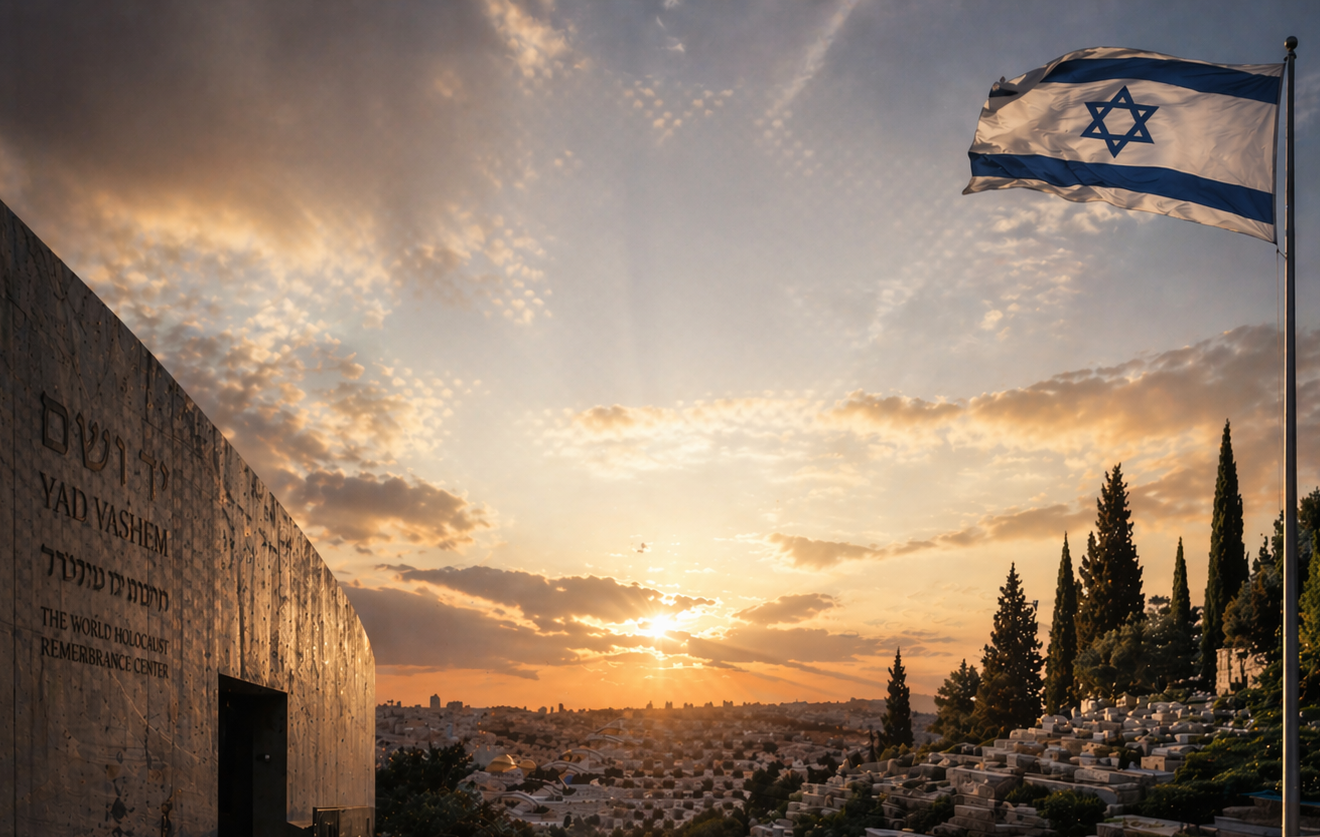
Image Created by ChatGPT with DALL-E, 2026.
We left Yad Vashem late in the afternoon, still carrying the weight you carry when you have not yet found anywhere to put what you have just seen. It is a familiar place, and still it unsettles you every time. My friend and I were walking toward Har Herzl, along the path that leads out from the museum. That physical closeness between the two sites has always struck me as strange. In Yerushalayim, some of the shortest walks ask the most from you. The city seems built to deny you any comfortable interval for taking things in.
There was sun, I remember. The late kind, the sort that hits you straight on without really warming, familiar to anyone who knows those afternoons. We were talking about nothing in particular. Not out of any frivolity, but because after certain places, small talk works as a kind of defense, a way of not getting pinned down by what you have just seen. The conversation was entirely forgettable, and for that reason I remember it clearly.
The city was going about its business. Cars somewhere in the distance, someone hurrying past us, the cool open air of that part of the city, the sort of air that tricks you into feeling calm. Then the siren started.
Everything stopped, with a naturalness that still moves me. We stopped too. Nothing had to be said. My friend was beside me, a step ahead. For a moment our eyes met, and there was something uncomfortable in the exchange, so we both looked down. I remember that sudden stillness perfectly. It felt older than any civic ceremony, as though the city itself had slipped, without warning, into a truth it had always known.
In moments like that you understand something, before argument catches up, that in colder terms sounds almost trite. Memory is not exhausted by the verb to remember. It carries a moral weight. To commemorate means to bear down, to refuse to keep walking. In Israel that demand is made almost unbearably plain, because for as long as the siren is sounding, no one pretends that life goes on as usual. Life stops. It is interrupted.
We stood exactly between Yad Vashem and Har Herzl. Between the place that holds the memory of the attempt to wipe out our people, and the place where so many of those who died so that this same people could live freely in its land are buried. That short walk carries entire generations of grief, resistance, and above all continuity.
I often come back to a passage in the Talmud, Sanhedrin 37a, which teaches that whoever destroys a single life destroys an entire World. I have read it and quoted it many times. There are moments, though, when the teaching stops being intellectual and settles somewhere else entirely. During the siren, standing in the middle of the path, that was what I was thinking about. About the impossibility of reducing an absence to a number. About everything that hangs unfinished when a life is cut short. About the futures that never arrived, and about the deep dishonesty of numbers, which let us count at the cost of understanding.
This is what gives Yom HaZikaron its particular moral force. It refuses to let loss dissolve into statistics, into public rhetoric, into national routine. Avishai Margalit put it precisely in The Ethics of Memory: shared memory is not a sentimental ornament of collective life. Remembrance, he argues, is a moral condition of any community that hopes to hold on to a measure of decency. Some peoples remember because they like the story they tell themselves. Others remember because they know the cost of letting memory slacken is a cost they cannot afford. Israel, unmistakably, belongs to the second kind.
What was strongest about that siren, though, was not the shared dimension at all. It was what was happening inside. Being surrounded by other people did not feel, on that occasion, like company. It felt like responsibility. Responsibility to keep going, to honor what others gave up, to pass on what that day means to whoever comes after us.
During the alarm, which for all its brevity felt endless, another teaching came back to me: uvacharta bachayim, choose life, from Devarim 30:19. A pasuk usually quoted more lightly than it deserves. Standing there on the path toward Har Herzl, it hit differently. To choose life does not mean, strictly speaking, to prefer it to death, which would be the kind of obvious truism the text is too serious to bother with. The phrase is pointing at something harder. It asks you to take responsibility for filling the days you still have with something, when so many others, the very ones Yom HaZikaron is gathered to remember, lost that chance on a battlefield, in an attack, in an ambush, defending the State of Israel and everything it stands for.
Choose life, in that sense, means concrete decisions. It means building a Jewish family when twenty-year-old soldiers fell in the Sinai, the Golan, or Gaza before they could start one of their own. It means studying Torah when there were chayalim carrying a book of Tehillim in their uniform pockets who never came back to finish the page they were on. It means raising your children inside the identity of our people, when there were fathers whose children grew up with their photograph in the entryway and a folded flag above the frame. It means supporting our communal institutions, defending the State of Israel in words and in argument from the Diaspora, writing, teaching, arguing, showing up.
Above all, though, to choose life on Yom HaZikaron means to refuse the quieter forms of death that close in on anyone who is, without having asked for it, a beneficiary of someone else’s sacrifice. Indifference in front of the news. The easy assimilation that files down Jewish identity so as not to “make things awkward.” The willed forgetting of particular names. The cynicism that turns every fallen soldier into a line on a military ledger. The flattening of the uniform. The moral exhaustion of people who do not want to hear about the conflict anymore. Each of those, in its own quiet way, is a small posthumous concession to the people who wanted us gone, and at the same time a quiet betrayal of the people who died preventing it.
The victims of terror, those murdered in the Shoah, the chalalim of every one of Israel’s wars can no longer choose anything. That possibility, unfairly, has been left on our side, as privilege and as burden. From that exact spot on the path, a few meters from the graves we were about to visit, with the siren sounding for them and for us at the same time, the phrase becomes something heavier than a verse. It becomes a question put personally to each of us. What am I doing, today, with the life so many others handed over so that the people of Israel could go on living it?
My friend stayed silent throughout the siren, and I have often wondered what was going through his mind. When it ended, we lifted our heads, and the city started moving again, with the hesitation bodies have when they pick up an action they have had to interrupt. We kept walking.
The walk, of course, was not the same walk anymore. We were headed to Har Herzl, and in that short stretch I felt something essential about contemporary Jewish history compress itself: from absolute vulnerability to the duty of defense; from the memory of being defenseless to the memory of the price paid so we would never be defenseless again; and above all, mourning for those who gave their lives so that we could still be here.
Since that afternoon, when I think of Yom HaZikaron, the first thing that comes to mind is not a date. It is that walk. The sun of that afternoon. Yerushalayim at a standstill. My friend beside me. The strange closeness between Yad Vashem and Har Herzl.
What Yom HaZikaron asks of me, most of all, is the recognition that a siren can split your day in two and force you to admit, even for a few minutes, that Jewish continuity has never come for free, that every generation inherits it wounded and hands it on at cost, and that living as a Jew after hearing that siren in Israel means accepting that memory, for us, rarely ends in an act of the heart. It goes on as a burden of the soul.
May their memory be a blessing, as their lives surely were. Am Yisrael Chai.
Related Topics
Related Posts