Three Laws for Living When Life Breaks
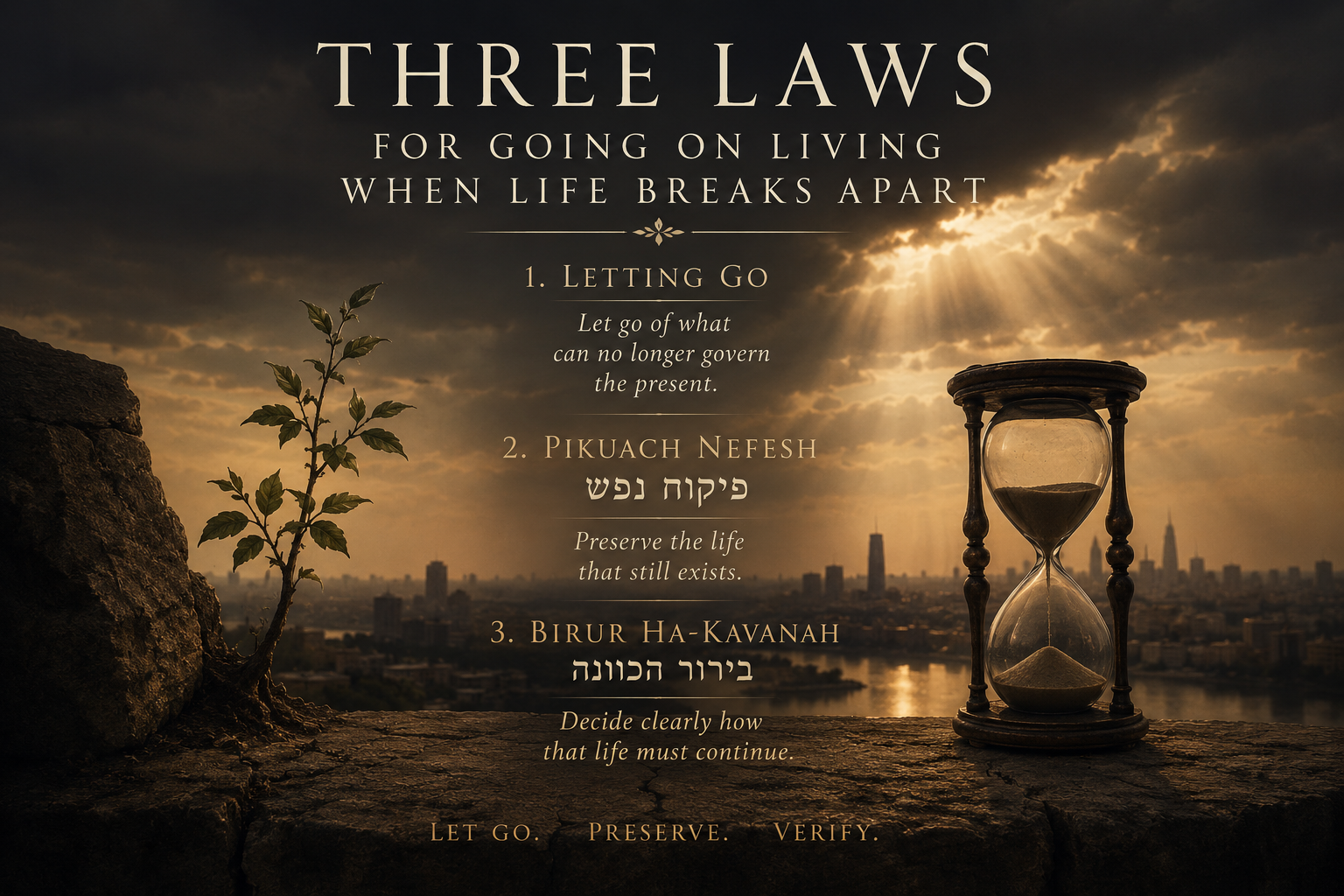
Three Laws for Going On Living When Life Breaks Apart
I was walking with Yohanita through the park near the Museum of Fine Arts in Antwerp.
There, once again, we saw a group of Ukrainians gathered together.
Whenever Yohanita sees them, something inside her grows sad. Not people talking in a park. She sees families torn from their land, lives cut short, homes that may no longer exist — people forced to build a new existence while part of them goes on living in the place they had to leave behind.
Then she asked me:
—What would you do in a situation like that?
Her question broke something open in me.
I did not need to construct a complicated answer. I answered her directly, trying to hold in a few words something that, for me, governs every life that is truly awake.
I told her I would try to live under three laws.
They are not laws only for Ukrainians.
They are laws for any human being whose life has been broken by war, loss, illness, separation or a transformation there is no coming back from.
First law: Letting go
There are moments when going on living demands that we accept the reality we knew before is simply gone.
Letting go does not mean forgetting.
It does not mean ceasing to love the land, the home, the language, the dead, the life one once had.
Nor does it mean declaring that what happened was just.
It means no longer demanding that the present become the past again.
While a person remains completely bound to what they lost, part of their strength will keep trying to rebuild a door that may no longer open onto anything. That part will not be available for anything else.
Letting go is not betrayal.
Letting go is to stop dying every day beside what has already died.
Memory can stay. Love can stay. Identity can stay. But life needs space — real space, not symbolic — to continue.
Sometimes the most faithful thing a person can do for everything they have lost is not to lose themselves as well.
The second: Pikuach Nefesh
פיקוח נפש — Pikuach Nefesh: the preservation of life.
In Jewish tradition, saving a life stands above almost every other commandment. Not as an emergency exception. As a structural principle.
This is not merely a religious rule. It is a radical claim about the value of human existence — and about what existence demands when everything else has come down.
When everything falls, the first obligation is not to protect pride, image, inner territory, the idea one once had of oneself.
The first obligation is to protect life.
To eat.
To sleep.
To seek safety.
To care for the children.
To accept help.
To learn a new language.
To build new relationships.
To return to work.
To let the body stop living permanently in a state of war.
There is no shame in surviving. No cowardice in moving away from the fire. No betrayal in choosing a place where children can sleep without hearing explosions.
Life does not have to justify itself for continuing.
To continue is already sacred.
And yet — this is the part that costs something to say — preserving life sometimes demands decisions that genuinely hurt. It may mean leaving behind something one loves, accepting that the return is not coming, seeing clearly that nostalgia cannot be a way of living. There is no way to say this without it landing hard. But while there is life, the possibility of rebuilding still exists. Of encounter. Of meaning. Without life, there is nothing left worth defending.
The third: Birur ha-kavanah
בירור הכוונה — Birur ha-kavanah: the verification of intention.
Before acting, I have to ask myself what I truly want to achieve. What I am trying to protect. Whether I am acting to preserve life or only to quiet the fear for a moment. Whether this decision comes from clarity or from the pressure of the moment.
Good intentions are not enough.
A person who is genuinely awake looks at the consequences, the dependencies, the risks, the possibility of going back if the decision turns out to be wrong. They think before they act. Not to become paralyzed — so that pain does not make their decisions for them.
Birur ha-kavanah requires Yishuv ha-da’at.
A settled mind. The capacity to stop inwardly when everything around you is pushing you to react. First the intention. Then the consequences. Then the choice.
And once the action is chosen: carry it out without altering on impulse what you decided to preserve. No adding. No improvising. No pulling apart a stable structure while trying to fix something local.
Then verify the result. It is not enough for something to look finished. The appearance of completeness is not completeness. Count. Compare. Look honestly at whether what you meant to do was actually done.
This sounds like engineering applied to life. In a way, it is. It is not coldness. It is respect. When a decision touches a life, a family, a future — moving without checking is a form of carelessness you cannot undo.
Letting go, protecting and verifying
As we walked through that park in Antwerp, something was settling into place inside me as I spoke. I do not know whether I had seen it clearly before Yohanita asked.
Those three laws form a sequence.
First, let go of what can no longer govern the present.
Then, protect the life that still exists.
Finally, decide clearly how that life must go on.
Letting go.
Pikuach Nefesh.
Birur ha-kavanah.
Let go.
Preserve.
Verify.
Perhaps that is what it means to live consciously. Not without pain. Not without memory. Not pretending nothing happened. But to look reality in the face, accept what cannot be undone, protect what remains and build what comes next without betraying the intention that set you in motion.
I thought of the Ukrainians gathered in that park.
Perhaps some of them are still waiting to return. Perhaps others already know they will not. Perhaps many live between two worlds — physically in Antwerp, emotionally in the city they left behind.
I do not know what decision each person should make.
But I do believe no life can remain indefinitely suspended between a past that has disappeared and a future that still does not dare to begin. A moment comes. Consciousness must open.
Not to abandon the dead.
Not to forget the injustice.
Not to deny the homeland.
But to say:
What I lost will remain part of me. But I will not let it destroy the life I still have.
And perhaps that is the deepest form of fidelity — not the most comfortable, not the most recognizable, not the kind you can defend to anyone who has not stood where you stood.
To go on living.