From Kibbutz to the global stage
“The Peace Restaurant in Kazakhstan (1990)” — A Prelude to the Abraham Accords
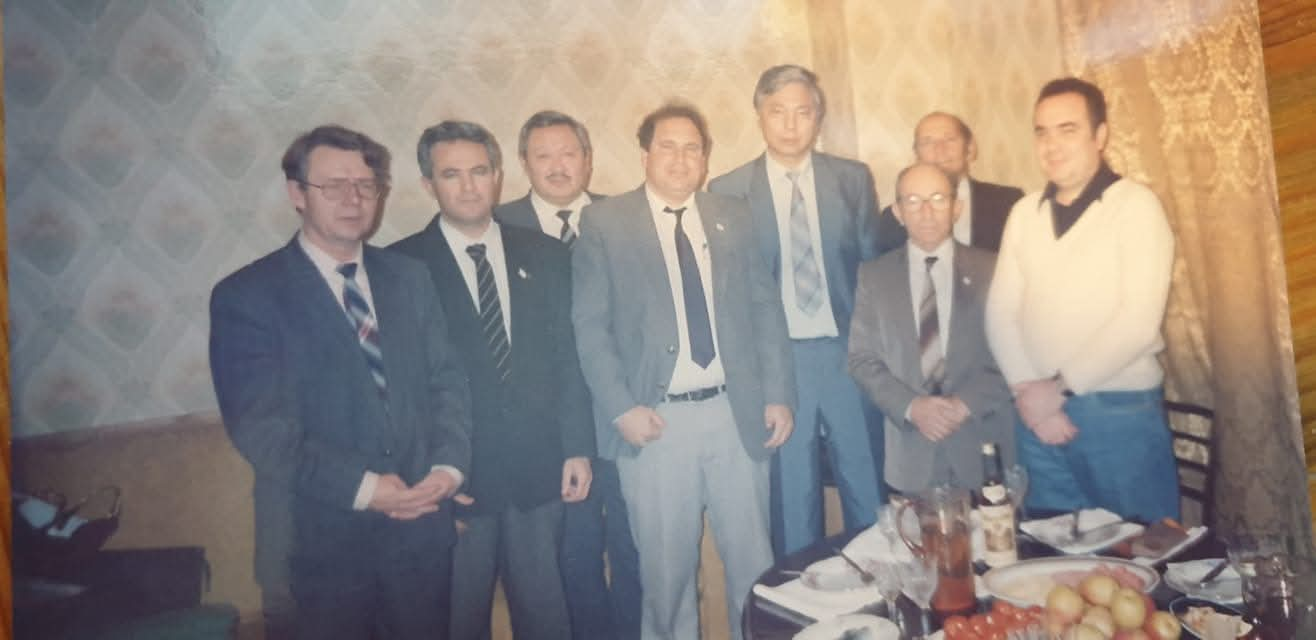
In the photo: I am pictured with senior officials of the Kazakh Ministry of Communications — Deputy Minister Tungusbayev (fourth from right), myself to his left, V. Stekov, Director General of the Kazakh Telecom Company, to my left; Flovoy, the Jewish economist who initiated the process (first from right); Moshe Paran (second from left) from ECI Telecom; Yosef Sher, consultant from Telrad (second from right); behind him Isidor Wittmann from Bezeq; and on the far left, Eliasov, another Deputy Minister of the Kazakh Ministry of Communications. Photo: Rafi Glick
Photo: Rafi Glick
“The Peace Restaurant in Kazakhstan (1990)” — A Prelude to the Abraham Accords.
In 1990, an Israeli-Jewish restaurant named “Shalom” opened inside the Ministry of Communications of Kazakhstan. It was the twilight of the Soviet Union — before the renewal of diplomatic relations with Moscow — and Kazakhstan was still one of its most strategic republics.
Our own “Abraham Accords” with Kazakhstan were, in a sense, signed back then — at the Shalom restaurant — alongside a groundbreaking telecommunications project that connected Kazakhstan to the world. Using a Russian Sputnik satellite linked directly to Israel’s international exchange, we provided 300 international phone lines, replacing the mere eight that had existed before, and for the first time gave Kazakhstan global connectivity independent of the Soviet central authority.
At that time, Nursultan Nazarbayev, then the Communist Party Secretary of Kazakhstan and later the country’s first President, already understood the importance of building relations with Israel. Soon after came Project “Apple” (“Alma” in Kazakh) — a plan to upgrade Kazakhstan’s copper-based telecommunications infrastructure, in cooperation with engineers from the Baikonur Space Center.
Today the world talks about the Iranian nuclear threat, but in 1990, the fear was that Kazakhstan — with its large Muslim population — might become independent while holding dozens or even hundreds of nuclear-armed missiles left over from the Soviet arsenal.
Our connection with Kazakhstan began at the Agritech Exhibition in September 1989, during the delicate thaw in relations with the USSR after more than two decades of hostility. To our surprise, a delegation of four visitors from Kazakhstan arrived — the first Soviet citizens we had met in such a setting.
The delegation was led by a Jewish economist who had developed a theory: that Kazakhstan’s vast natural resources, combined with Western knowledge and technology, could lead to rapid economic growth.
To translate theory into practice, I met in March 1990 with senior officials of the Moscow Polytechnic Institute, who helped Kazakhstan gain the support of the Soviet Politburo. During that meeting I proposed starting with the telecommunications sector, using Kazakhstan’s copper ore as a financial base for importing Israeli know-how and technology.
A joint project office was soon established with Bezeq, ECI Telecom, Tadiran Communications, and other Israeli cable and telecom firms. The initiative was named Project “Apple”, the Hebrew equivalent of “Almaty,” the Kazakh capital.
In October 1990, the first Israeli mission traveled to Kazakhstan to explore the possibilities. Participants included representatives from Bezeq, ECI, Tadiran, and the cable industry.
Our journey began at Moscow’s Domodedovo Airport, where we were ushered — on a freezing, snowy night — through the tarmac directly into Aeroflot’s VIP terminal. That unusual detour caused a small diplomatic mystery: one of our delegation members and our interpreter were mistakenly taken straight to a plane without passing through the terminal — a scene straight out of a classic Russian intrigue.
The confusion made us miss our night flight and delayed us until morning, while senior Kazakh officials waited anxiously at Almaty Airport, unsure why their Israeli guests had not arrived.
Upon landing, we boarded a small Russian aircraft that shook with every gust of icy Siberian wind, flying to two massive copper mining sites. At each location we were honored with the head of a lamb — a traditional Kazakh gesture of respect. According to our hosts, we were the first Western visitors ever to reach those sites.
Later meetings at the Kazakh Ministry of Communications in Almaty led to several major telecom projects in the following months and years. But more importantly, we came to understand that Kazakhstan’s Muslim citizens were genuine friends of Israel, and that an independent Kazakhstan would not be a nuclear threat to Israel or the world. History proved this true: with international cooperation, the wisdom of the Kazakh leadership, and President Nazarbayev’s vision, Kazakhstan became a trusted partner and peaceful power.
And one more small but meaningful note:
That project in Kazakhstan opened for me the world of international communications and Space , a field that has accompanied my professional journey ever since.
In the photo: I am pictured with senior officials of the Kazakh Ministry of Communications — Deputy Minister Tungusbayev (fourth from right), myself to his left, V. Stekov, Director General of the Kazakh Telecom Company, to my left; Flovoy, the Jewish economist who initiated the process (first from right); Moshe Paran (second from left) from ECI Telecom; Yosef Sher, consultant from Telrad (second from right); behind him Isidor Wittmann from Bezeq; and on the far left, Eliasov, another Deputy Minister of the Kazakh Ministry of Communications.
Photo: Rafi Glick (רפי גליק)
Photo: Rafi Glick
Related Topics
Related Posts