
Greek Jewish roots. New York voice. Unfiltered perspective.
The People We Love Keep Becoming
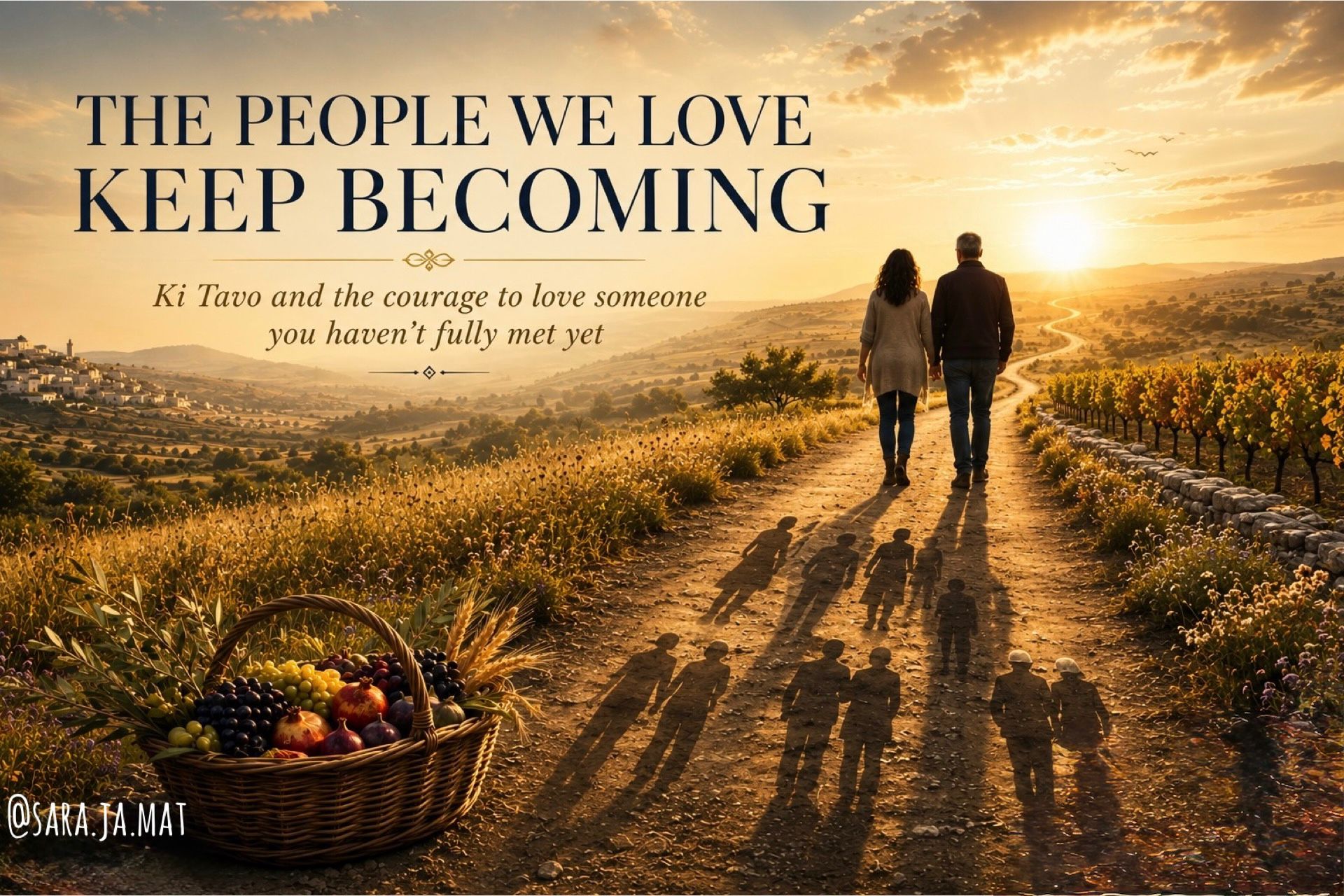
Ki Tavo and the courage to love someone you haven’t fully met yet
I think we set the bar for love far too low.
We talk about finding someone who will love us “just the way we are.”
But if you are lucky enough to love someone for decades, “the way they are” is going to keep changing.
The person you love at twenty will not be exactly the person standing in front of you at forty. Or sixty. Or eighty.
Their interests will change. Their world may get bigger. They will learn things, lose things, discover things, survive things. If they are really living, they will keep becoming.
So perhaps the real question isn’t:
Will you love me just the way I am?
It is:
Will you make room for who I have not yet become?
Can you look at someone becoming more of themselves and resist thinking:
Where do I fit now?
And instead say:
Look at you.
I kept thinking about that this week.
And, unexpectedly, I kept thinking about Dolly Parton.
Maybe that isn’t so unexpected.
Dolly Parton died this week at 80, just over a year after the death of her husband, Carl Dean. And like so many people around the world, I found myself looking back at the extraordinary life she built.
But as the world looked back at everything Dolly accomplished, I found myself thinking about something quieter:
Her love story.
Nearly six decades with the same man.
And I found myself wondering what it means to love someone across that much becoming.
Dolly Parton married Carl Dean in 1966, at twenty, at the very beginning of her career. She had dreams, talent, ambition, and no way of knowing how enormous her life would become.
And then she became Dolly.
The records. The tours. The movies. The businesses. The rhinestones. The wigs. The philanthropy. The voice and personality that became recognizable around the world.
She kept becoming more of herself.
By all public accounts, the man beside her never needed her to become less.
We only know what they chose to share publicly about their marriage, of course. But the principle their story illustrates is worth considering:
The right person does not merely tolerate your becoming. They make room for it.
And that brings me to Ki Tavo, this week’s Torah portion.
When You Arrive
Ki Tavo means, essentially, when you come in. When you arrive.
The Israelites are finally approaching the land after generations of slavery and decades of wandering.
And once they settle there and the land begins producing, they are commanded to take the first fruits of their harvest — the Bikkurim — and bring them to the Temple.
But they don’t simply drop off a basket of fruit and leave.
They have to speak.
They have to tell the story.
They remember vulnerability. Egypt. Oppression. Suffering. Crying out. Redemption.
And only then do they stand before what has grown.
That has always struck me as extraordinary.
At precisely the moment when a person can look around and say, I made it, the Torah says:
Remember.
Remember where you began.
Remember what came before the harvest.
Remember what it took to arrive here.
The Torah refuses to let success develop amnesia.
You have fruit in your hands?
Remember when you had no land.
You have abundance?
Remember when your ancestors were vulnerable.
You have arrived?
Tell the story of when you hadn’t.
And then — importantly — rejoice.
The Whole Story Belongs in the Basket
There is something else about the declaration of the first fruits that I love.
It does not require us to rewrite the journey in order to be grateful for where we arrived.
The difficult parts stay in the story.
The fear stays.
The suffering stays.
The wilderness stays.
The Torah does not ask us to be grateful instead of remembering what hurt. It asks us to be grateful while remembering it.
That distinction matters.
Judaism has never required gratitude to mean amnesia. We tell stories that contain both bitterness and redemption. We remember what hurt while giving thanks for what came afterward.
Perhaps that is because gratitude built on denial is fragile.
The deeper kind can look backward without flinching and still say:
And look what grew.
Maybe that is what Bikkurim asks us to do.
Look at what grew.
Remember the soil it grew from.
And then do something with the harvest.
Because gratitude in Ki Tavo is not passive.
You bring something.
You say something.
You give something.
And then you rejoice in it.
Dolly Brought the Basket
That may be another reason Dolly Parton kept coming to mind.
She came from very little. She was one of twelve children growing up in rural Tennessee, in circumstances she has spoken about openly throughout her life.
Then came extraordinary success.
But she didn’t simply accumulate it.
She gave.
Her Imagination Library has put books into the hands of children around the world. She has supported education, health care, disaster relief and communities in need.
She became enormously successful without pretending she had always lived at the top of the mountain.
She remembered the cabin.
She remembered the people.
She remembered where she came from.
And then she did something with the harvest.
That is Bikkurim.
Not the fruit itself, obviously.
The posture.
I know where I began.
I know what grew.
And I know that what grew is not mine merely to admire.
But What If the Harvest Isn’t Yours?
Perhaps Bikkurim contains another challenge we don’t talk about enough.
It is one thing to rejoice in my harvest.
What happens when the harvest belongs to someone I love?
Can I rejoice when your basket gets heavier?
When your world gets bigger?
When you discover something you are good at that neither of us saw coming?
When you find a new passion?
When you change your mind?
When you become more confident?
When the person I met becomes someone neither of us could have imagined at the beginning?
Can I celebrate your abundance without experiencing it as my diminishment?
That may be one of the hardest tests of love.
And not only romantic love.
Friendship.
Family.
Parents and children.
Siblings.
Any relationship that lasts long enough for the people inside it to change.
Because they will.
You Knew Me Then. Come Meet Me Now.
I love friendships that have known me for decades.
There is something extraordinary about having people in your life who knew you at twenty, then thirty, then forty — and who keep getting introduced to you all over again.
Every decade, they get to meet a new version of me.
Not because everything at my core has changed.
It hasn’t.
My core values have not wavered. My loyalty has always been fierce. My capacity to love people fully — to show up, to care deeply, to give everything I have to the people I love — was there decades ago and is still here now.
But my world has gotten bigger.
I have seen more.
Learned more.
Asked different questions.
Met people I never could have imagined knowing.
Walked into rooms I never imagined entering.
Discovered interests I didn’t have ten years ago and, perhaps most importantly, discovered things I am capable of doing that an earlier version of me didn’t yet know were possible.
I haven’t become someone else. I’ve become more of myself.
And when I love you — whether you are my partner, my friend or my family — I want to share that person with you.
I want to bring you into the things I am discovering.
I want to tell you what I have learned.
I want to share experiences with you that an earlier version of me didn’t even know were waiting.
There is something almost magical about being able to look at someone who has known you for decades and say:
You knew me then.
Come meet me now.
And then we get to make new memories together.
Maybe that is one of the greatest privileges of loving someone for a very long time.
You don’t just get to grow old together. You get to watch each other become.
Growth Doesn’t Mean Sameness
That doesn’t mean two people need to grow in the same direction.
They don’t.
They don’t need to grow at the same speed. They don’t need the same careers, interests, ambitions or definition of success.
One person may build a business while the other discovers they want a quieter life.
One may travel more.
One may become more religious while another begins asking different questions.
One may discover a new passion at fifty that would have bored them senseless at thirty.
Growth doesn’t require two people to become more alike.
It requires enough openness to allow each other to become different.
Every decade gives us new information.
We learn things.
We unlearn things.
Our tastes change.
Our interests expand.
Things that once seemed desperately important become strangely irrelevant, while things we barely noticed become essential.
And sometimes relationships struggle with that.
Sometimes a friend keeps speaking to the person you were ten years ago.
Sometimes a family member is deeply attached to the role you have always played.
Sometimes a partner experiences your growth not as something happening to you, but as something being done to them.
You changed.
Yes.
Isn’t that partly the point of being alive?
Growth does not mean endless ambition. It does not require fame, money, professional achievement or perpetual reinvention.
There is a difference between being content and being stuck.
Growth can simply mean curiosity.
The willingness to encounter a new idea.
The humility to admit that something you believed ten years ago may no longer fit what you know today.
And the generosity to allow the people you love that same freedom.
The friendships that last fifty years are not necessarily the ones in which two people keep changing in exactly the same direction.
Sometimes they are the ones in which two people simply keep making room for one another’s becoming.
You can remember who I was without requiring me to remain her.
And I can do the same for you.
Which brings me back to Dolly and Carl.
She got to be Dolly.
He got to be Carl.
And somehow there was room for both.
Carl did not have to become Dolly in order for Dolly to become more fully herself.
That is not the absence of growth.
That may be one of its most mature forms.
Fifty-Six Years of Meeting Each Other
Perhaps I am thinking about all of this a little more personally today.
Today, August 29, my parents celebrate their 56th wedding anniversary.
Fifty-six years.
Think about how many versions of two human beings can exist inside that amount of time.
The two people who stood beside one another on their wedding day could not possibly have known everything life would ask of them — or everything they would eventually become.
Careers change.
Families grow.
Children arrive and become adults.
Parents become grandparents.
The world changes around you.
You lose people you love.
You celebrate things you once couldn’t imagine.
You endure things you never would have chosen.
Your interests evolve. Your opinions deepen. Your bodies age. Your roles change.
And somehow the relationship has to keep meeting the people who emerge.
Maybe that is part of what it means to love someone for decades:
You keep meeting them.
Not two people frozen forever as the versions of themselves who first fell in love.
Two people continuing to grow — and neither requiring the other to shrink.
Because perhaps the great challenge of an enduring relationship isn’t merely staying.
It is remaining curious enough to notice who has stayed with you.
So What Is in Your Basket?
And this is where Ki Tavo stops being a story about ancient Israelites, Dolly Parton, my friendships or my parents.
It turns toward us.
What has grown in your life that you have become so accustomed to seeing that you have forgotten you once prayed for it?
The job we complain about may once have been the opportunity we prayed for.
The child driving us crazy may once have been the baby we couldn’t wait to hold.
The home with the endless list of things that need fixing may still be the place we once dreamed of calling ours.
The friendship we take for granted may once have been the person we prayed would stay.
The relationship that now feels ordinary may contain years of answered prayers we have simply become accustomed to living inside.
Ki Tavo says:
Stop.
Bring the basket.
Tell the whole story.
Don’t erase the wilderness.
But don’t erase the harvest either.
And then perhaps ask something harder.
Who has grown beside you — and have you noticed?
When was the last time you really looked at your spouse, your friend, your sibling, your parent or your child and considered who they have become?
Not who they were ten years ago.
Who they are now.
Have you allowed them to change?
Have you remained curious about them?
Or are you still interacting with a version of them that no longer entirely exists?
When someone you love begins discovering a larger version of their life, what happens inside you?
Do you become curious?
Do you move closer?
Can you say:
Tell me about this new thing you love. I want to understand why it matters to you.
Or does some part of you quietly ask:
Where do I fit now?
And perhaps the harder question:
Can I celebrate what is growing in you even when I did not plant it?
Can I rejoice in your harvest when it looks nothing like mine?
Can I allow your world to expand without interpreting that expansion as my diminishment?
And then:
Am I still growing?
Not achieving.
Not accumulating.
Not becoming more impressive.
Growing.
When was the last time you changed your mind because you learned something new?
When was the last time you discovered something about yourself you didn’t know?
When was the last time someone who has loved you for decades got to meet a new side of you?
And Where Is the Joy?
There is another startling idea later in Ki Tavo.
Among the warnings of the Tochacha comes a verse explaining calamity, in part, as a consequence of not serving God “with joy and gladness of heart.”
That is an extraordinary standard.
Not merely:
Did you do it?
But:
Was there joy in it?
And perhaps that question belongs in our relationships too.
There is a difference between remaining in someone’s life and rejoicing that they are in yours.
A difference between performing the obligations of love and still experiencing the person as a gift.
So perhaps we should ask:
When did familiarity become invisibility?
When did something I once treasured become something I simply expect?
Where has the joy gone out of something I still deeply value?
And what would it take to invite that joy back?
Not manufactured positivity.
Not pretending the difficult parts never happened.
Bikkurim does not ask us to do that.
It tells the whole story.
The gratitude is deeper precisely because the whole journey is allowed to remain in it.
Maybe We Keep Arriving
Perhaps arrival is not something that happens only once.
We arrive over and over throughout a life.
At new understandings.
New relationships.
New versions of old relationships.
New versions of ourselves.
And each time, Ki Tavo seems to offer the same instruction:
Remember where you began.
Tell the whole story.
Notice what grew.
Give from it.
And rejoice.
So maybe our own Vidui Bikkurim begins with a few questions:
Where did I begin?
What did it take to get here?
What have I survived that I rarely give myself credit for surviving?
What has grown that I no longer notice because I see it every day?
Who stood beside me while it grew?
Whose growth have I failed to notice?
Who in my life am I still seeing as they were instead of becoming curious about who they are now?
And perhaps the hardest one:
Am I making room for the people I love to become more fully themselves — or do I love them most comfortably when they remain familiar?
Because maybe gratitude isn’t merely looking at your own basket and saying:
Look at everything I have.
Maybe sometimes gratitude is looking across the field at someone you love and saying:
Look at you.
And meaning it.
Not:
Look how much you have changed.
Not:
Where do I fit now?
But:
Look who you became.
And perhaps that is the harvest Ki Tavo is asking us to notice too.
Not only what has grown in our own lives.
What has grown in the people we love.
So bring the basket.
Remember where you began.
Tell the whole story.
Don’t erase the wilderness.
Don’t overlook the harvest.
And when someone you love becomes more fully themselves, don’t merely make peace with it.
Rejoice in their becoming.
Because the right love doesn’t just love who you were when it found you.
It makes room for who you have not yet become.
Related Topics