Researching Antisemitism. Building Allyship. Refusing Silence.
“The People Who Refuse to Bow to Tyrants”
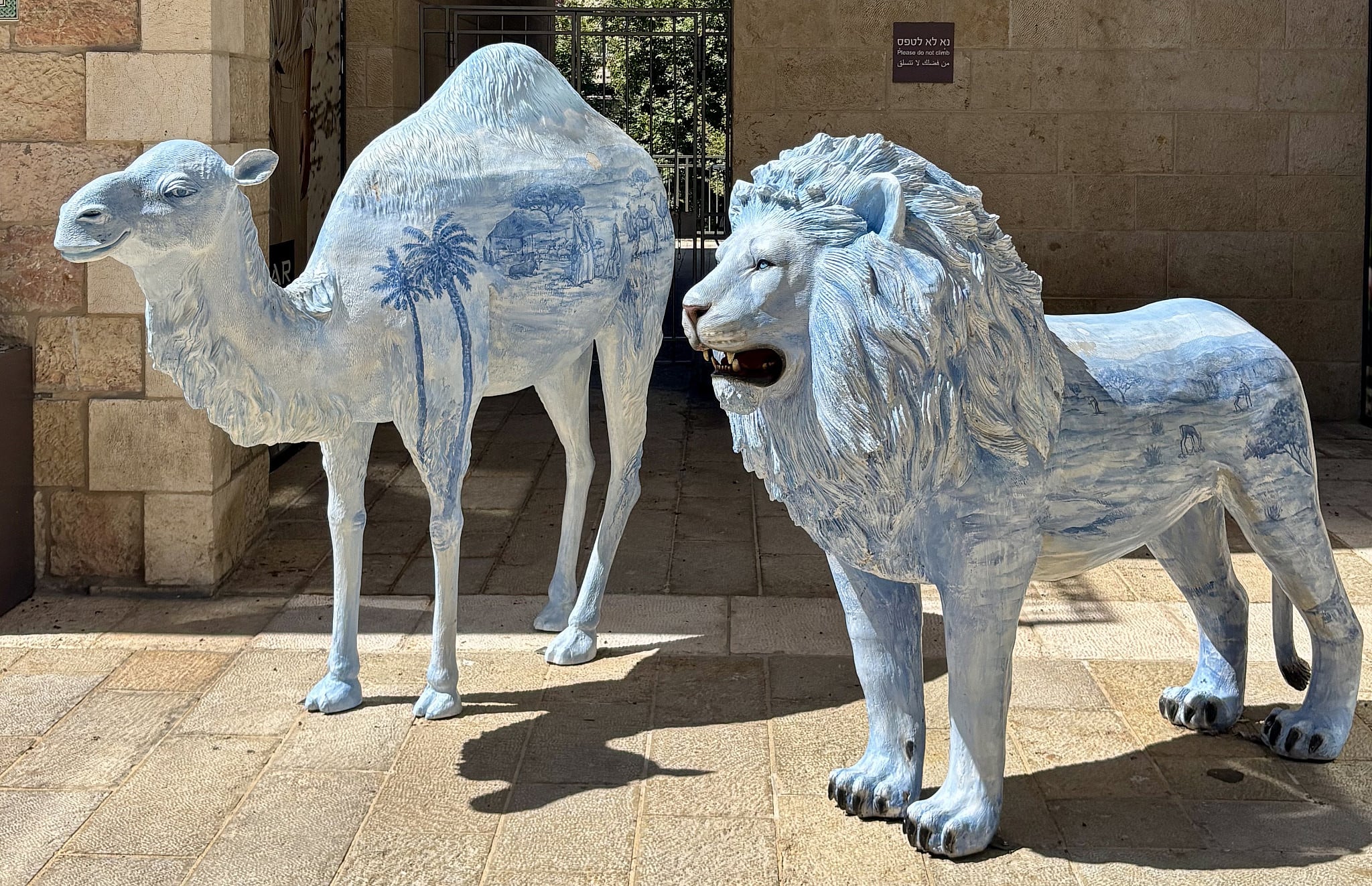
Camel and lion statues in Jerusalem's Mamilla Mall
Dara Horn’s new book named something I’ve watched two Jewish friends live out all year: a refusal to bow.
This past summer, two friends and I sat outside at HaBasta, a small restaurant tucked on a side street just off Tel Aviv’s Carmel Market, where the kitchen sources everything fresh from the market each morning and the menu changes daily to match.
Over small plates and wine from a list built around lesser-known, remarkable bottles, we talked long into the night about what Jews were facing back home, the hatred coming from antizionist students and faculty, and what the year ahead might hold. Both are Jewish faculty, each at different universities in the states.
A few days ago I finished reading Dara Horn’s new book, The Final Solution to the Jewish Question: A Love Story for the Living (Avid Reader Press/Simon & Schuster, 2026). Horn’s book isn’t just another accounting of what was lost during the Holocaust. It’s an invitation for readers to ask what it means to be a Jew in the 21st century, and to consider how their own lives might help dismantle the “big lie” of antisemitism, the lie that Jews are destroying what a society values most.
To me, the book is about courage, not just Horn’s to write it, but the courage it calls for in all of us, Jews and allies alike: standing against the big lie, and proclaiming instead the long history of a resilient, courageous people who shaped Western civilization in profound ways. Chief among them, a world-changing idea: “that every human being is made in the divine image.”
Horn is honest and detailed about how life changed for American Jews after 10/7, in ways many did not expect. Her stories of the lies and what those lies led to, in America, on college campuses, in the streets of Paris and beyond, are crystal clear about one thing: there is something rotten at the core.
That moral rot is entangled with the big lie of antisemitism, an evil that destroys societies and cultures and brings all of us down.
There’s a deeper, less-discussed sadness in Horn’s book: the loss of Jewish communities throughout the Middle East after 1948. One million Jews lived across twenty-two Arab states, many communities predating Islam. Today, those populations are gone. This erasure doesn’t get talked about enough, though since 2014, Israel has marked November 30th as a national day of commemoration for the roughly 850,000 Jews displaced from Arab lands and Iran.
If one erasure has gone undiscussed, another has been actively rewritten: the ideological one. Horn illuminates the work of Izabella Tabarovsky, showing how today’s “zombie antizionism” is recycled from Soviet state policy dating to 1918, when propaganda branded Israel racist and colonialist, called Jews “oppressors,” and endorsed resistance “by any means necessary.” For those who grew up in the USSR, the pattern is unmistakable, and it’s lifted straight from the old Soviet playbook. But it’s trendy.
Horn writes about being intimidated early on during speaking gigs, by students shouting that Zionism is racism, by the refrain of “Free Palestine” at school assemblies. But as her journey continued, that fear evolved into pity. These students, she realized, didn’t have the traditions, the rituals, the community, the kind of story her own children carried.
That same turn from fear to something steadier is exactly what I watched happen in my own circle this year, proof that this courage isn’t just a story confined to the page.
Horn juxtaposes this moment with the story of Queen Esther in ancient Persia. Jews today, she writes, are in an Esther moment: “They can choose not to say anything, choose to disappear. That would be the default choice. Or they can choose life and rise to the occasion.”
That afternoon after finishing the book, I took a walk and listened to my friends’ voice memos in our group chat. I realized: they are part of the group Horn describes, those rising to the occasion.
One of my friends spoke up for the first time in a meeting with other Jewish faculty, where a vocal contingent of antizionist Jews demanded a campus space where antizionists would not be harassed, while opposing any definition of antisemitism that included antizionism. He spoke up for the Zionist students and faculty on campus, naming the harm they’d experienced from antizionist words and behavior. His refusal to stay silent wasn’t just brave.
It was an act of defiance in the midst of a group that did not expect a different perspective.
My other friend has learned this the hard way. When some of her students recognized her as a Zionist, they targeted her with retaliatory complaints, hostile reviews, and pressure that many other faculty simply can’t understand. She filed a Title VI report, only to discover what many Jewish faculty nationwide have found: slow processes, weak remedies, and by the time anything happens, the harm has already spread.
Faculty at institutions like Columbia have described an atmosphere where Jewish, Zionist, and Israeli colleagues felt excluded, unwelcome, even physically threatened, and some are too afraid of retaliation to come forward.
My friend didn’t settle for silence.
She stayed the course, even when the system meant to protect her offered little more than paperwork and delay.
I’m watching, in real time, both friends demonstrate a strength that inspires courage in me too. What Horn illustrates in her book is that courage doesn’t get easier just because you’ve done it once.
It’s still scary.
But at the heart of the Jewish story is a refusal to bow to tyrants. My friends are living that story now on their campuses.
In the last chapter, Horn writes about the empowerment that comes once you step through the fear: “In that moment when you finally choose truth and freedom and courage, you don’t only discover your own strength. You also discover the thousands of grateful people who were waiting for you to say it.”
Related Topics
Related Posts