


The plowshare in the bomb shelter
So I wrote a few days ago about watching Sennacherib’s Prism — a 2,700-year-old record of the siege of Jerusalem — get carried into a bomb shelter during a missile alert. It was a pretty surreal thing…but it gets even better.
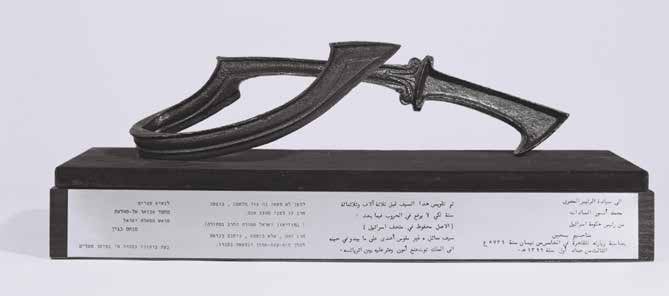
A few weeks ago, we opened an exhibition at the Bible Lands Museum Jerusalem titled “As Soon as the War Is Over,” which traces ancient warfare from the Battle of Kadesh to the Pax Romana. The exhibition ends with peace. Specifically, it ends with a bent sickle sword.
In the ancient Near East, weapons were sometimes deliberately bent before burial — retired from violence, permanently. The metal itself says: this is over. The prophets took the image further. Isaiah didn’t just imagine weapons destroyed. He imagined them transformed: swords into plowshares, spears into pruning hooks, war itself unlearned.
Our particular sword has a modern chapter. In 1979, when Israel and Egypt signed their peace treaty, Menachem Begin gave Anwar Sadat a replica of it. The inscription: “This sword was bent 3,300 years ago, so that it shall no longer be used for war.” Begin knew what he was reaching for — not a diplomatic gift but an argument that runs three thousand years deep.
The original is on loan to us from the Israel Museum. We placed it as the last thing visitors see before the exit. Walk through millennia of conflict, arrive at a bent sword. That was the basic idea.
The sword, of course, has gone into our safe.
Just across the road, at the Israel Museum, the Great Isaiah Scroll had been on full display for the first time since 1968 — seven meters of parchment containing the actual words that gave the sword its meaning: “They shall beat their swords into plowshares, and their spears into pruning hooks; nation shall not lift up sword against nation, neither shall they learn war anymore.” The scroll has also been removed.
So: on the same hilltop in Givat Ram, the prophet’s text and the object it describes are both in storage. The words about the end of war, and the sword that embodies them, pulled from view because of war.
The prism in a shelter was an absurdity — a tyrant’s war diary needing protection from war. The sword in a safe is different. You don’t need to protect a peace symbol in a peaceful world.
The peace with Egypt has held for over four decades, through everything. Begin’s gesture was not naive. But Isaiah imagined swords becoming plowshares. He did not imagine the plowshare needing a bomb shelter.
The sword will go back on display. The scroll will go back on display. Visitors will stand in front of them and feel the pull of that vision — that this eventually ends.
But right now the sword is in a safe and the scroll is in a vault and the war is not over.
As soon as the war is over.