
In the Shelter with Sennacherib
I’ve been in Israel long enough to know the drill but not long enough to be numb to it. When you come to this country as an adult, the sirens never become background noise. They stay foreign in your body.
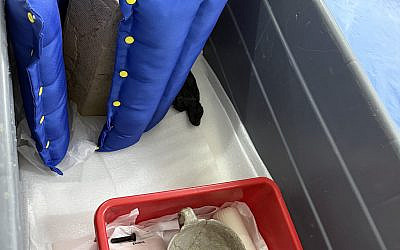
And so when the missile alerts came this week, I noticed things that maybe a native Israeli wouldn’t — or wouldn’t think to mention. Like the fact that our conservator moved a 2,700-year-old Assyrian artifact into a shelter during a warning alert with the same calm focus she’d bring to any other Wednesday.
The artifact was Sennacherib’s Prism. If you’re not an ancient Near East person: it’s a hexagonal clay cylinder covered in cuneiform text, in which the Assyrian king brags — in excruciating, obsessive detail — about his military campaigns, including his siege of Jerusalem in 701 BCE. He writes that he shut up King Hezekiah “like a caged bird” inside this city.
Same city. Different missiles. You can’t make this up.
The prism survived the fall of the Assyrian empire. It survived 2,700 years of burial, excavation, handling, and the occasional institutional turf war. And was loaned to us for a special exhibition just a few weeks ago. And now it needed to survive another round of someone trying to destroy Jerusalem. Different century, different technology, same general idea.
Cultural preservation in a conflict zone is an operational reality. Every escalation means a new round of decisions: what moves, where it goes, who stays, what happens if the power cuts out and climate control fails. You plan for things you hope will never happen, and then they happen, and you’re grateful for the planning.
Israeli museums carry a weight that most cultural institutions in the world will never have to understand. The Bible Lands Museum Jerusalem holds artifacts from ancient Egypt, Mesopotamia, Anatolia, Persia, Greece, and Rome — objects that belong not just to Israel, not just to the Jewish people, but to the entire shared story of where we all came from. When a missile is aimed at Jerusalem, it’s not only Israeli lives at risk. It’s the physical record of the ancient world.
When cultural heritage is destroyed in conflict — we saw it in Iraq, Syria, Ukraine — the world mourns. Rightly so. But mourning after the fact is the easy part. The hard part is what Israeli museum professionals do before: the protocols, the maintenance, the removal of objects for safekeeping and then trying to figure out when it’s safe enough bring them back. Every museum in Israel has people like this. They don’t make the news. They should.
Just weeks ago, we opened an exhibition called “As Soon as the War Is Over,” examining ancient warfare from the Battle of Kadesh to the Pax Romana. The title comes from Hašek’s *The Good Soldier Švejk* — “as soon as the war is over,” the thing everyone always says, half hope, half dark joke. We built the show to make people think about the long arc of conflict. We didn’t expect to become part of it, or was it inevitable?
Sennacherib’s scribes carved his victories into clay because they wanted his glory to last forever. And it did — but not the way they planned. Nobody remembers Sennacherib as glorious. We remember him because the object survived. The record survived. The thing itself made it through, passed from hand to hand across millennia, until it ended up in a bomb shelter in Jerusalem, wrapped in blue padding, waiting out another war.
Sennacherib is long gone. Jerusalem is still here. So is the prism. We intend to keep it that way.