"These fragments I have shored against my ruins"
The Plural of “Never Again”
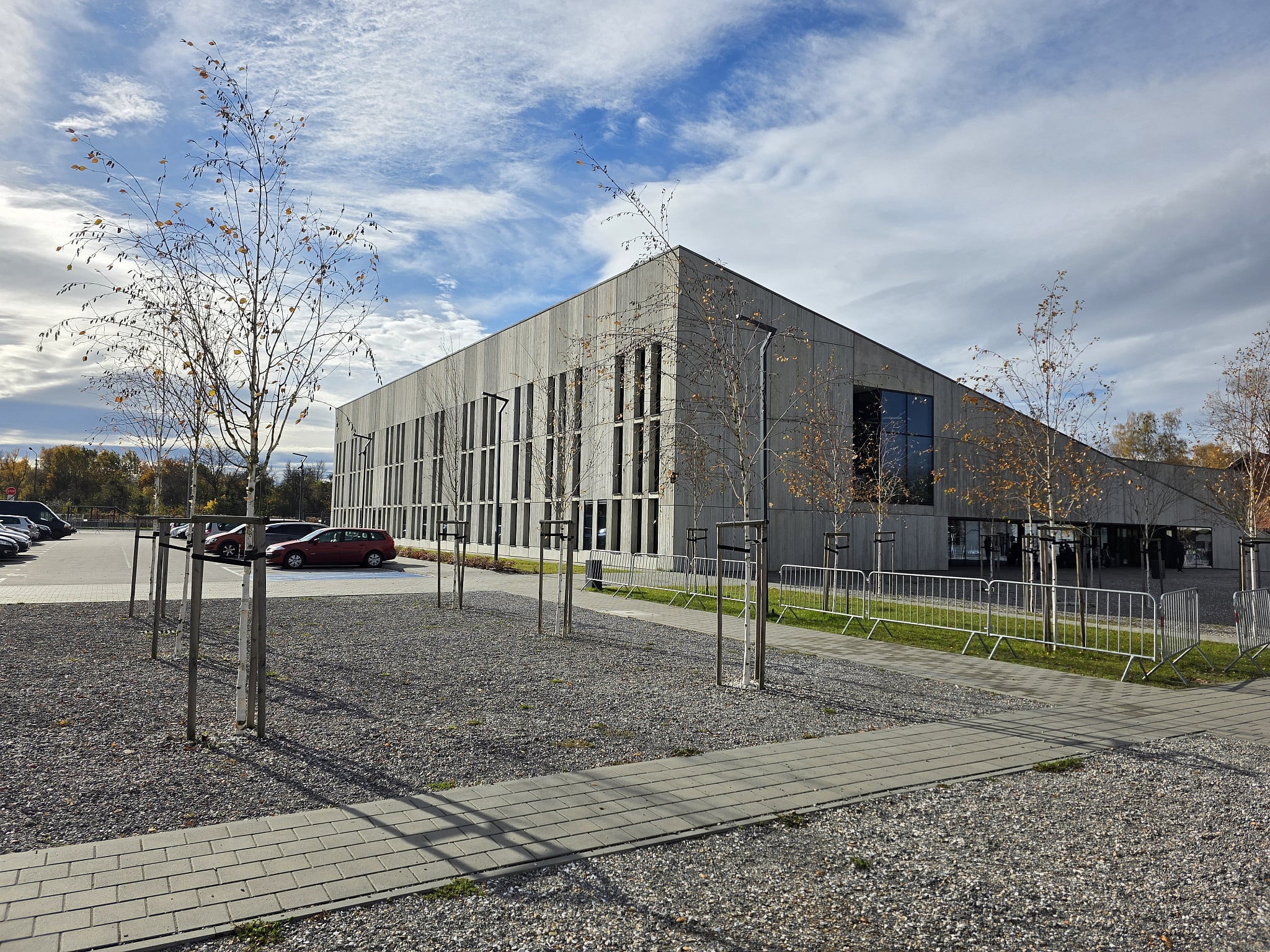
The guesthouse of the Auschwitz Memorial
The first night after dinner, I didn’t notice at once that the conversation slipped into German. We were strangers sitting in the dark lobby of the guesthouse of the Auschwitz Memorial. I had stayed behind after the meal to talk a bit longer with some of the people, and the talk flowed easily. People laughed, shared fragments of biography, a kind of polite camaraderie among the participants of the media seminar for journalists from different countries that follows food and the desire to fill awkward silences.
Some people felt tired and returned to their rooms, some stayed. Then, quietly, the sound changed. The words were the same, but the voice was not. German had crept in the way fog creeps: unobserved, until it is all around you. Since I could understand everything, it took a few minutes for my mind to catch up. And when it did, my laughter died. Not dramatically; the laughter simply stopped, as if someone had closed a window on it.
It wasn’t that they were doing anything wrong. The ones who stayed were German; they slipped into their own language. If anything, the moment was natural and ordinary. What shocked me was not the language itself but the context into which it had fallen: this is a place whose very name carries a verdict against that language. The shock was not moral but physical; the moment I realised I was sitting in Auschwitz, listening to German as the language of friendly conversation. “The mandatory language of the camp”, I thought, feeling trapped in a code I had not chosen.
I had gone to Auschwitz prepared to feel many things: shame, fatigue, sorrow, a careful moral anger, but not this small, sharp physical surprise: the air of the room shifting as if the walls themselves remembered the sound.
The surprise opened questions that are now hard to close. Who, in Europe today, still takes “never again” literally? Who keeps it as a vow rather than a slogan? The postwar phrase that once seemed universal has splintered, and the shards reflect different things depending on who holds them. For many, “never again” has become a hollow inscription, a line carved into stone while everyday politics proceeds unbothered. For others it has been recontextualised into competing moral frames after October 7: an appeal, an accusation, a weapon. And for some, it became “never again is now”. The unity I thought the phrase guaranteed has frayed.
Perhaps the sharpest fracture is this: the moral responsibility that once sat uneasily with Europe has, in recent years, become pluralised. In some quarters, Holocaust memory has been relativised; in others, it is invoked as a defence or as an indictment. The result is a continent where the moral grammar of atrocity no longer speaks one language. It speaks many, and often they contradict one another.
Which is precisely why my brief encounter with German that night felt so complicated. It didn’t make me wonder in the abstract whether there are still Germans who mean it; the real question was far more specific, almost uncomfortably intimate: what if these Germans sitting with me are the ones who still mean it; not as a ritual of memory, not as national branding, but as something that survives as an ethical reflex?
The idea sounds unlikely to those who remember the old stories of guilt and denial, and yet, Europe has been rearranged in ways that made this possibility less impossible. I was not naïve in my surprise; I knew that history and politics move on different tracks.
The signs were there long before the moral fractures of the 2015 refugee crisis. Even in the 1990s, when post-Soviet Jews began arriving in Germany in large numbers, the country responded in a way no one expected: by trying, even if awkwardly and imperfectly, to make space for Jewish life rather than merely Jewish memory. It was one of the earliest hints that the moral map of Europe had begun to shift, and that “never again” in Germany was evolving into something lived rather than recited.
And yet, to find myself in a room at Auschwitz where the conversation had slipped so easily into German (and to realise it only after I had already been laughing along) felt like witnessing an old grammar reassert itself in a place where grammar itself had once been annihilated.
That night, I went to my room and couldn’t stop thinking about how normality reasserts itself, or perhaps, how long it takes, and whether it ever truly does, and how a place of absolute negation can, decades later, accommodate light chatter in the same tongue.
The next morning, I kept my distance. It wasn’t deliberate; it was simply easier to join some others and let the previous night settle somewhere I didn’t have to touch yet. I walked under the cold iron letters of Arbeit macht frei without saying a word, certainly not in German. Auschwitz I was shrouded in haze, as grey and wet as memory ordered it to be: rain, mud, the flat iron light that seems to make everything feel inhuman.
The next day was Birkenau. I had been there before too, not only once, but that morning was different. The sky was piercing blue, the kind of blue that seems to erase memory. The birches were aflame with autumn colour, impossibly beautiful, as if the landscape had conspired to disguise itself. For a moment, it really did feel like a meadow, not Birkenau, just a birch meadow in October.
Here, between the barracks and the evening conversation, the question of language lodged itself in me. The German speakers were not performative penitents, and they were not my accusers. They were people with stories and accents and the same small fatigue I’d seen on many faces that week. Yet, the movement from ordinary conversation to a language that once functioned in this geography as an instrument of power made me feel momentarily unmoored.
It is easy and tempting to turn that moment into accusation. It is easier still to rehearse old binaries: perpetrators and victims, Germans and Jews, guilt and innocence. I did not want to do that. I did not want to lay a moral template over every human detail. What I felt, instead, was a more fragile truth: that ceremony and memory can be performed without necessarily being felt; that language can carry institutional responsibility in some societies and mere habit in others; and that moral seriousness is not distributed evenly across Europe.
“Never again” was once a backward-facing vow; a moral injunction drawn from the ruins of Europe. In Germany it took decades to articulate: first in guilt, then in silence, then in rituals that looked heavy but felt often hollow. By 2015, something shifted. During the refugee crisis, Germany began speaking of “never again” not only as a warning from the past but as an ethical instruction for the present: never again dehumanisation, never again exclusion, never again a state that looks away.
After October 7, that phrase mutated again. “Never again is now”, sharpened by Nancy Faeser on the 85th anniversary of Kristallnacht, became a counterreaction to the speed with which antisemitism reappeared in Europe, a refusal to let the slogan become a gravestone inscription.
Beneath the bluest sky, our guide pointed toward a stretch of empty field beyond the wire and said: This is where they planned to expand Birkenau. To hold and kill more Jews, I added to myself. Most of the group turned towards him, listening. I turned towards the German man standing beside me. I watched his face for a long time, long enough that it etched itself into memory. His eyes stayed on the horizon; his expression unreadable. I still don’t know what I saw. Maybe just the quiet incomprehension of someone trying to carry a weight that isn’t his but won’t go away.
I wasn’t only reacting to his discomfort; I was confronting my own. I hated that part of me still stiffened at the sound of a German accent in Auschwitz. He probably hated that part of him expected it. We both stood in the ruins of a world neither of us built, and yet somehow both of us inherited.
On the very last day, after breakfast, we said our polite goodbyes in front of the building. He came to me, said his farewell, and stepped away. A few paces later he stopped, turned around, crossed the distance between us. As he turned to walk back towards me, he lifted his arms before he’d even reached me; a clear, unmistakable announcement of what was coming.
I had several long seconds to stand there with all the things I carry: the reflexive tightening, the old suspicion that still flickers alive in places like this, and the guilt that follows immediately after. And he carried his own burden: arriving in Auschwitz as a German, knowing exactly how he must look through the eyes of someone like me. Neither of us is innocent. We inherit different guilts, but they coexist in the same atmosphere.
And yet, when he reached me, I didn’t flinch or step back. Not only I let him hold me, but I also embraced him in return. I could feel the restraint and the sorrow in that hold, the kind of human pressure that says what words cannot. It wasn’t tenderness and it wasn’t reconciliation. It was something stranger and more precise: a moment where two people briefly refused to perform the roles history assigned to them. A gesture that didn’t belong to either of us personally, but to the narrow space between us.
When he finally stepped back, neither of us spoke. There was nothing to explain. The gesture itself was both apology and acknowledgment, and maybe also resistance; against forgetting, against indifference, against the exhaustion of remembrance.
I came away from the seminar with no neat moral metaphors. I did not discover a single European locus of purity where memory remains untouched. Instead, I found contradiction and a stubborn refusal to be reduced to slogans. I found people who stumble towards moral seriousness in different ways: some through law, some through education, some through private ritual, some through small actions that resist public indifference. And I found, most oddly, that the language I had once expected to hear only in the mouths of perpetrators in Auschwitz could also be the vehicle for a simple human reach.
Perhaps that is the bitter lesson: Europe’s moral geography has changed in ways that surprise and discomfort us. The old maps no longer fit. The dangers have shifted, and the lines we thought clear are fuzzy at the edges. But memory remains necessary precisely because the world will not always remember for us. Nature goes on; the sky turns blue; new politics eclipse ancient vows. The task of remembrance is to persist in the face of that indifference.
We live in a Europe I could never imagine when I was younger; a Europe where the Germans are no longer the bad guys, and where “never again” has fractured into meanings that depend on who says it and about whom. The phrase has become plural, contested, worn thin. Standing in that meadow, watching a German look into the distance, and later feeling him hold me as if to steady something in both of us, I realised that whatever “never again” means now, its gravity no longer lives in nations but in individuals; in the ones who choose to carry it.
Some people still mean “never again”. You can hear it in their silences. And sometimes, you can feel it in an unexpected gesture of someone with whom you’ll never see each other again, that carries the weight of everything neither side can say.
Related Topics
Related Posts