Seeking honest leadership, and new narratives.
The Politics of “Nakba:” Why Mamdani’s Rhetoric Matters
Credit: Shutterstock
Zohran Mamdani’s recent invocation of the term “Nakba” (https://www.timesofisrael.com/liveblog_entry/mamdani-doubles-down-on-nakba-day-video-as-criticism-mounts/) is not just another progressive soundbite in the endless social media war over Israel. It is part of a rhetorical pattern in American politics, particularly on the activist left, where language once confined to radical anti-Zionist circles is becoming normalized in mainstream discourse. And when this rhetoric comes from a mayor governing the city with the largest Jewish population outside of Israel, it deserves scrutiny, not silence.
For many Jews, the issue is not criticism of Israeli policy. We Israelis criticize our government every day. No government in the world is immune of criticsm by its citizenry. The issue is the adoption of a political vocabulary that increasingly frames the very existence of Israel as a catastrophe.
The word “Nakba” (النكبة) literally translates from Arabic as “catastrophe” or “disaster.” It was popularized by Syrian intellectual Constantin Zureiq following Israel’s creation in 1948 and the Arab defeat in the war launched against the newly declared Jewish state. Zureiq’s 1948 book, “Ma’na al-Nakba” (“The Meaning of the Catastrophe”), described the broader collapse of Arab military and political efforts to prevent the establishment of a Jewish state.
This historical detail matters.
The original context of the term was tied directly to the failure of the Arab world to destroy Israel at birth. Over time, however, the term evolved. Beginning in the 1960s Palestinian nationalism and international activist movements reframed the “Nakba” as the foundational moral indictment of Zionism itself. In modern activist language, “Nakba” no longer refers merely to the suffering of refugees during a war. It functions as shorthand for the claim that Israel’s very creation was illegitimate.
That distinction is critical when American politicians, even the current mayor of the City of New York, who happily describes himself as characterized as anti-Israel and anti-Zionist, invoke the term casually.
When Mamdani uses the language of “Nakba,” he is not merely expressing sympathy for Palestinians. He is consciously or unconsciously aligning himself with a narrative framework that many Jews experience as denying Jewish indigeneity, Jewish self-determination, and ultimately Jewish legitimacy in their ancestral homeland. This is why we Jews hear the term differently than progressive activists do.
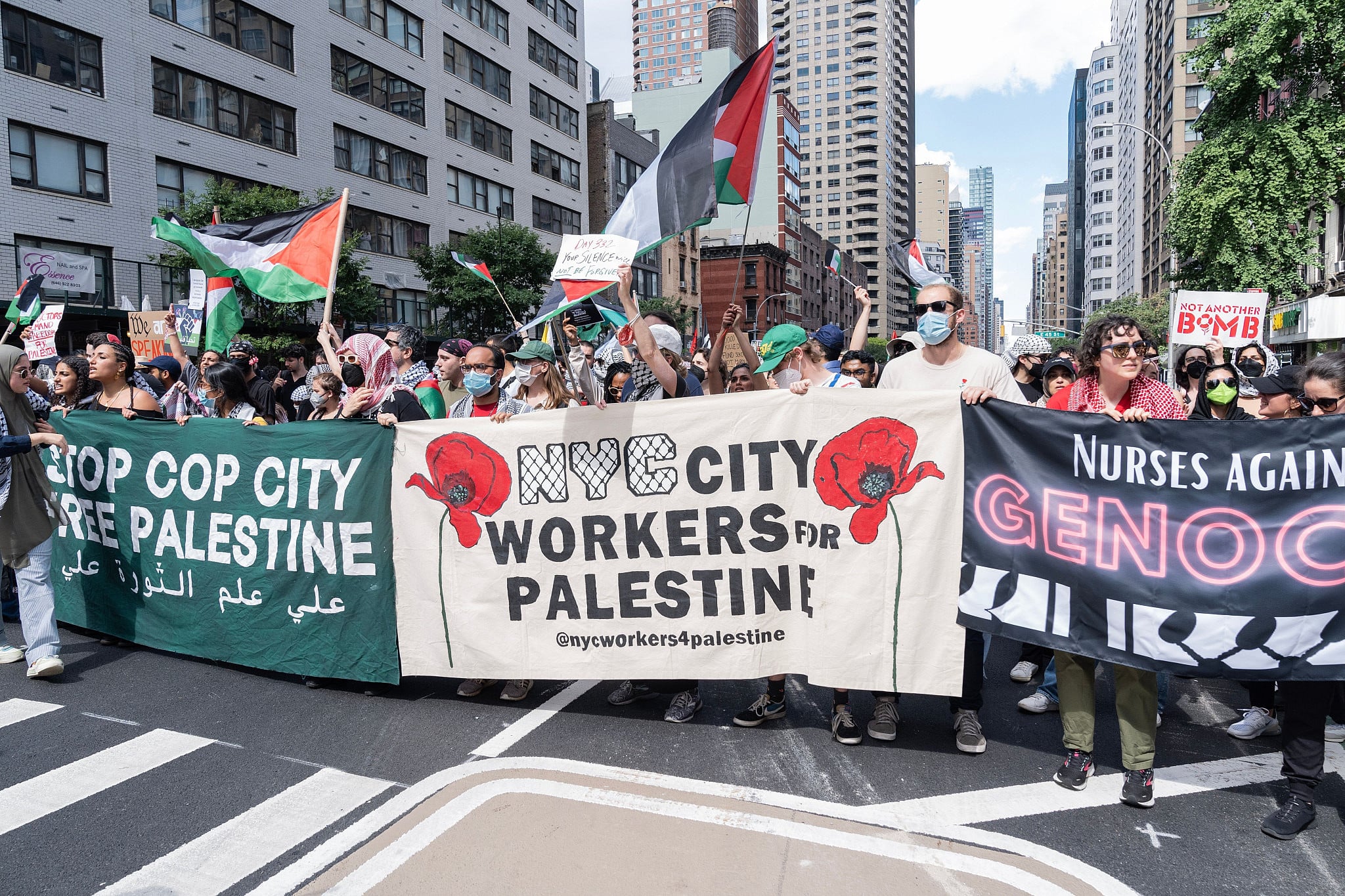
To Jews, especially after October 7, it has become associated with a political movement that seeks not coexistence but reversal: the undoing of Israel itself. In anti-Israel demonstrations across Western cities, chants referencing the “Nakba” are frequently paired with slogans like “From the River to the Sea,” a phrase many Jews interpret not as a call for peace, but for the elimination of the world’s only Jewish state.
And this is where the issue becomes politically and morally serious for New York City.
The City of New York is home to nearly one million Jews. It is a city shaped profoundly by Jewish immigration, Jewish culture, Jewish philanthropy, Jewish labor activism, Jewish intellectual life, and Jewish political engagement. The relationship between New York and the Jewish community is not peripheral. It is foundational.
That does not mean New York’s mayor must support every Israeli policy. Mamdani is no Ed Koch. Far from it. But it does mean that Jewish residents have a right to expect that those seeking to lead the city understand the historical trauma embedded in certain rhetoric.
Especially now.
In the wake of October 7, Jews across America have witnessed an explosion of rhetoric that often blurs the line between criticism of Israel and hostility toward Jewish identity itself. Synagogues have increased security. Jewish students reported intimidation on campuses. Demonstrations celebrated “resistance” within hours of the largest massacre of Jews since the Holocaust. And in that atmosphere, words matter. Two and a half years later, we don’t see the light at the end of the tunnel.
They matter because language shapes legitimacy.
When politicians normalize terminology rooted in the idea that Israel’s creation was a “catastrophe,” they contribute to a political culture where Jewish nationhood is uniquely treated as suspect among the nations of the world. No other modern state born through war, displacement, partition, or decolonization is subjected to this same perpetual moral revocation.
Here are just a few examples: India was born in bloodshed and partition. Pakistan was born through mass displacement. Millions were expelled during the population exchanges following World War II. Nearly a million Jews were themselves expelled or fled from Arab lands after 1948.
Yet only the Jewish state, Israel, remains uniquely branded in activist discourse as an original sin requiring historical reversal. That is why this conversation matters far beyond one video clip.
The growing adoption of “Nakba” reflects a broader shift in progressive political culture: the transformation of Israel from a complicated democracy into a symbolic villain within the ideology of global oppression politics. In this framework, Jews are increasingly recast not as a historically vulnerable minority, but as avatars of colonial power. The result is a political environment where hostility toward Zionism increasingly bleeds into hostility toward Jewish communal identity itself.
Many American Jews once dismissed these concerns as exaggerated. After October 7, far fewer do.
The real tragedy here is that this rhetoric pushes peace further away, not closer. In my opinion, that is exactly why Mamdani uses this and other terms. Peace will never emerge from narratives that deny either Palestinian suffering or Jewish legitimacy. Both peoples carry trauma. Both peoples possess historical ties to the land. Any sustainable future requires acknowledging both truths simultaneously.
But the modern activist use of the word “Nakba” too often serves not as an invitation to reconciliation, but as a moral indictment of Jewish sovereignty itself. And when a politician who is leading America’s largest city embraces that language, Jews are justified in asking a simple question:
If Israel’s very existence is framed as a catastrophe, where exactly does that leave the Jews who believe in its right to exist?
Related Topics
Related Posts