
The Post-Election Shuq: How the Calculus of Minority Leverage Governs Israel
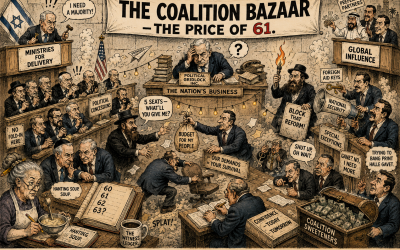
If the mechanics of Israel’s voting booth are engineered for broad inclusion, the day after an election is when the real cost of that design comes due. Once the ballots are counted and the 120 seats of the Knesset are divided, the campaign rhetoric instantly gives way to the real theater of Israeli democracy: the coalition bazaar. In a system where no single party has ever won a 61-seat majority on its own, election night does not crown a winner. It merely determines the arithmetic from which a government must somehow be assembled.
To understand how Israeli governments are built—and why they so frequently collapse—one must understand the brutal arithmetic of the magic number 61. Following an election, the president consults representatives of the parties elected to the Knesset and then assigns one member of the Knesset the task of forming a government. That person is usually the leader judged most capable of assembling a viable coalition, which is not necessarily the leader of the largest party. Because no party has ever captured an outright Knesset majority, forming a government normally requires constructing a patchwork alliance of parliamentary factions capable of commanding the confidence of the Knesset. In practical political terms, 61 remains the number around which the entire exercise revolves.
This necessity transforms coalition building into a high-stakes auction where the laws of political supply and demand can become wildly distorted. In many democratic systems, the largest parties dominate the legislative agenda. In Israel’s coalition bazaar, however, leverage can shift dramatically toward whichever smaller factions possess the seats necessary to turn a prospective coalition into a governing majority. A niche party holding just four or five seats can suddenly find itself in a position to make or break a prospective government. Its political influence is determined not merely by how many voters supported it, but by whether its seats are indispensable to the coalition arithmetic.
This dynamic can grant pivotal minority factions extraordinary leverage over national policy. To secure the support of essential junior partners, the prospective prime minister and participating factions negotiate written coalition agreements before the government takes office. These are not merely vague statements of shared values; they can contain detailed commitments concerning budgetary priorities, ministerial appointments, legislation, and policy concessions tailored to the interests of individual coalition partners. The agreements are formally submitted and made public, creating a written political blueprint for the government the parties have agreed to support.
Through this mechanism, single-issue parties, religious factions, or ideological hardliners can punch far above their demographic weight when their seats are essential to forming or maintaining a majority. They can demand control over important government ministries, secure substantial funding for institutions or constituencies they represent, or insist upon policy commitments that a much larger party might never have adopted on its own. The prime minister is forced to act less like an executive commander and more like a permanent mediator, constantly balancing the competing and often contradictory demands of coalition partners who understand precisely how much their continued support is worth.
Nor does the departure of a small coalition partner automatically bring down the government or send the country back to the polls. A government that loses its parliamentary majority may continue as a minority government, attempt to recruit another partner, or struggle to pass legislation and budgets. Israel also operates under a constructive vote of no confidence, meaning that the Knesset cannot simply vote a government out of office without simultaneously assembling the parliamentary support necessary for an alternative government. Nevertheless, when a coalition is built upon a narrow majority, the withdrawal or rebellion of only a handful of members can cripple its ability to govern and begin the political process that eventually ends the government.
The mathematical maneuvering begins even before the first coalition meeting, embedded in the laws that govern how the final seats are allocated. Under Israel’s surplus-vote system—generally known as the Bader-Ofer method—two parties may sign a surplus-vote agreement before Election Day. After the initial allocation of Knesset seats, the paired lists are treated together for purposes of competing for remaining seats, after which a further calculation determines which of the two parties receives any additional seat won by the pair. The formula can provide an advantage to larger lists and gives parties another reason to seek tactical cooperation with politically compatible partners even before the polls open.
At the same time, parties face the existential terror of the electoral threshold, currently set at 3.25 percent of the valid national vote. Any party that fails to cross this hurdle receives no representation in the Knesset, and its votes are excluded from the calculation used to distribute the 120 seats among the qualifying parties. This creates a high-stakes game of political chicken before every election. Ideologically adjacent micro-factions are frequently pressured into shotgun marriages to survive, while major party leaders spend weeks agonizing over whether a small political ally will clear the threshold or fall just short, leaving a potentially significant bloc of sympathetic voters without parliamentary representation and altering the arithmetic of the entire Knesset.
The structural consequence of this setup is that Israeli politics is governed by permanent compromise, but not necessarily by coherent policy. Coalition agreements can force parties with substantially different priorities into the same government, producing internal tensions over budgets, legislation, religion and state, security policy, judicial reform, and countless other issues. Long-term strategic planning can become subordinate to the immediate political requirement of maintaining enough parliamentary support to keep the coalition functioning.
Foreign observers often view these frantic bargaining sessions as a sign of institutional corruption or personal opportunism. But that misunderstands the incentive structure of the system itself. Politicians in the Knesset are often acting rationally within an architecture that rewards leverage as much as mandate. When every government is assembled from several parties, a pivotal junior partner has little reason to surrender the very demands that made its participation valuable in the first place. Its strength lies not simply in the votes it received on Election Day, but in the possibility that the larger parties cannot govern without it.
Ultimately, the coalition bazaar is the natural outcome of a country that chose proportional representation and broad political inclusion over the likelihood of single-party government. By placing the parliamentary majority at the center of political life, Israel built a system in which a relatively small faction can sometimes possess influence far beyond its numerical size. The government that emerges from this process may bear only a complicated resemblance to what individual voters envisioned on Election Day, but it is the government the parliamentary arithmetic can produce.
And now, you know why everyone is still confused.
If you’re saying, “I didn’t know that,” then now you know the whole story.
Steven Teplitsky, for The Witness Ledger. Good day.
Cartoon courtesy of The Witness Ledger
This is the second in a four-part series examining the architecture of Israel’s electoral system. Read Part One: The Design of Distrust: How Israel’s Voting System Engineered Its Own Chaos.
https://steventeplitsky.substack.com/p/the-witness-ledger-the-design-of