The Price of Serving
American patriotism is often defined by iconic scenes from legendary films. The image of soldiers raising the flag at Iwo Jima, fiery speeches echoing words like “freedom” and “courage,” and parades where the uniform is worn like sacred armor. These moments shape a nation’s identity, a story of heroes willing to sacrifice everything for their country’s ideals. Patriotism is a powerful myth, celebrated on screens and in monuments, cheered in stadiums, and woven into the very fabric of the American dream.
We grow up believing that those who wear the uniform are heroes. That service buys respect. That battlefields earn forgiveness. That no matter what path a soldier walks after war, the nation they fought for will remember, will understand, will care. But sometimes, America remembers only what it wants to. And when the story gets inconvenient, when the scars of war turn into prison sentences and death row numbers, patriotism becomes just another word. Just another lie we tell ourselves to sleep at night. Because in Florida, another U.S. veteran is scheduled to die.
Zakrzewski’s story is not just about one man it’s about a country that lets its own fall through the cracks, trading gratitude for judgment, and loyalty for a death warrant. Too often, veterans like him find themselves abandoned after their service ends, forgotten by a nation that once called them heroes. The scars they carry visible and invisible are met not with care or support, but with suspicion and punishment. For Edward Zakrzewski, the battlefield didn’t end when he left the Air Force; instead, it led him down a darker path, one marked by systemic failures, missed opportunities for rehabilitation, and a justice system quick to condemn rather than understand.
In a state where the death penalty still looms large, Zakrzewski’s impending execution is a stark reminder of how the very ideals of sacrifice and honor are betrayed. It raises uncomfortable questions about how America treats those who have borne the heaviest burdens for its freedom. When a veteran’s service is met with a death sentence instead of dignity, it exposes a profound fracture in the social contract a betrayal not only of one man but of the values the nation claims to uphold. Zakrzewski’s fate challenges us all to reconsider what true patriotism means, and whether a society that kills its veterans can truly call itself just.
Edward Zakrzewski is not the first. He is the third U.S. military veteran Florida has chosen to execute this year. Three men who once stood ready to die for their country now quietly erased by it. They survived war zones, only to be buried by bureaucracy. Their uniforms meant something once. Now, they hang in closets like relics of promises broken. What does it say about a nation when those it once hailed as heroes are disposed of without mercy, without reflection? When the very people trained to protect us come home only to be met with silence, stigma, and, ultimately, a needle in the arm?
These are not isolated tragedies. They are a pattern. A reflection of a country that praises service until it no longer serves a narrative of perfection. Until the soldier breaks. And then the same flag they once saluted waves above their execution chamber proud, polished, and blind.
And the ones making it happen the prosecutors who argue for death, the judges who uphold it, the governors who sign the warrants, the wardens and technicians who carry out the killing these are the people America holds up as models of discipline, honor, and civic virtue. They dress the part. Clean-shaven, God-fearing, flag-waving Americans. The ones who hang veteran flags on their porches in November and cry during the national anthem. The ones who talk about duty, tradition, moral values. But strip away the performance, and what are they really? They are administrators of death. Functionaries in a machine that crushes the very people it claims to revere.
They are the same people who tell schoolchildren to thank a soldier for their service then turn around and kill that same soldier in a fluorescent-lit execution chamber with a state seal on the wall. They will talk endlessly about sacrifice, but only the kind that fits their narrative. The clean, photogenic kind. Not the raw, ugly aftermath of war. Not the PTSD, the moral injury, the addiction, the dislocation. They want uniforms and medals, not trauma and therapy. They want the myth, not the man. And when the myth breaks, they punish the man for it.
Let’s be clear: Edward Zakrzewski, and veterans like him, are not executed in spite of their service they are executed because their humanity, their fallibility, their brokenness after war disrupts the national script. The system cannot tolerate the contradiction. It cannot reconcile the image of the heroic airman with the reality of a man unraveling under the weight of unhealed wounds. And so, it kills him. Quietly. Efficiently. As if silencing the person can erase the failure that made him.
And yet, the irony is almost unbearable: these state actors claim to defend law, order, and patriotism while engaging in premeditated, bureaucratized killing. They speak of justice, but what they practice is retribution stripped of reflection. They speak of honor, but cannot see the dishonor in destroying those who once stood ready to protect them. They speak of America, but they are its most chilling contradiction.
“Justice,” they’ll say like it’s sacred. Like it’s above question. But in Edward Zakrzewski’s case, what they call justice is a sentence built on division, not consensus. His fate wasn’t decided by a unanimous jury. Far from it. Not once, but twice, juries voted 7 to 5 for death. Seven for execution, five for life. That’s not certainty that’s a courtroom tearing itself in half. In any system that values doubt in matters of life and death, those five votes would have stopped the machinery. They should have. But they didn’t.
Because back then, Florida allowed a judge to override the jury’s recommendation. And that’s exactly what happened. One man in a robe decided that seven votes were enough. He erased the five dissenting voices, dismissed the weight of human hesitation, and handed down a death sentence. A single hand signing off on irreversible punishment even when nearly half the jury said don’t.
Even in Florida 7-5 couldn’t hold for a death sentence to be imposed. But Zakrzewski was sentenced before that change. So now, the state clings to a ruling it no longer defends, using the past as a weapon to justify what the present refuses to repeat. This isn’t justice. It’s historical residue, ossified cruelty. It’s killing a man not because the law still demands it but because no one has the courage to say we were wrong.
So this is patriotism? Condemning a U.S. Air Force veteran to death based on two split juries 7 to 5 and a judge who decided his voice mattered more than nearly half the people sworn to deliberate? Is that what loyalty looks like in America now? We salute the troops in public, then execute them in private under rules so unjust they’ve since been thrown out. What happened to Edward Zakrzewski would be unconstitutional today. Not just immoral illegal. Even Florida, the same state rushing to kill him, no longer allows a judge to override a jury’s recommendation for life. And yet here we are, using a dead law to end a living man.
So again this is patriotism? Celebrating service with parades while ignoring the trauma that follows? Honoring sacrifice only when it fits the story, and burying the rest under courtroom paperwork and death warrants? They called him a hero when he served. Now they call him disposable. The same hands that pinned on medals are signing off on poison. If this is what loving your country looks like, then patriotism has rotted from the inside out. It’s not pride it’s betrayal dressed in red, white, and blue.
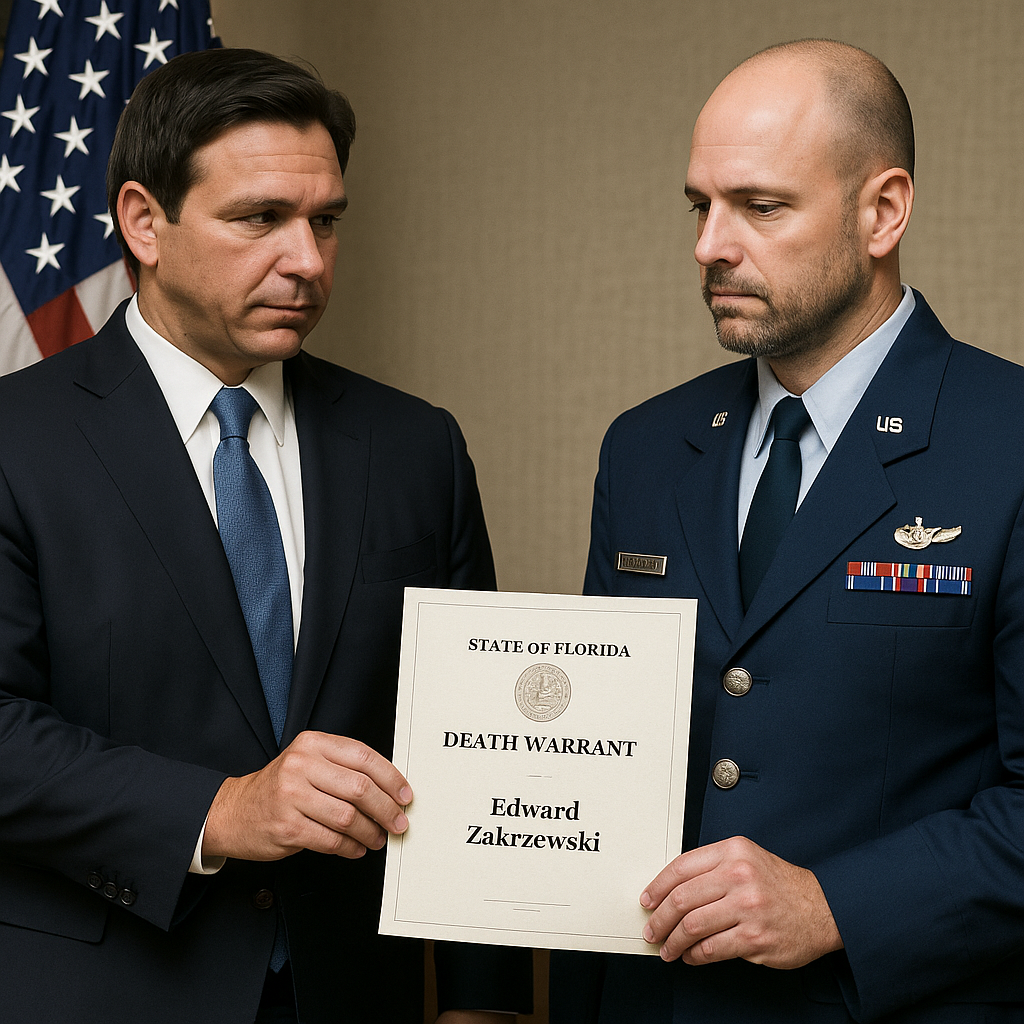
Edward Zakrzewski’s execution is scheduled for July 31st. In just a matter of days, a man who once stood ready to defend this nation will be silenced forever by the very system he served. But it is not too late. It is never too late not until the final second slips away, not until the last breath escapes to rise up and demand justice. Because this, this is what true patriotism means: loving your country not only in its triumphs but in its darkest moments. Loving your fellow citizens not when it’s convenient, but when they are broken, forgotten, and condemned.
The Star-Spangled Banner asks if we can still see the “broad stripes and bright stars” through the perilous fight. But what does it mean to see those stars if we turn away from the men and women who wore the uniform and came home wounded, broken, and abandoned? To be a patriot is to hold that flag high not just on the football field or in a parade but in the hard work of standing up for justice, mercy, and humanity. It means demanding that the nation lives up to its promises, even when it is uncomfortable, even when it challenges the narratives we want to believe.
Edward Zakrzewski’s battle didn’t end overseas. It continues here, now, in courtrooms and execution chambers. His life is on the line, but so is the soul of this country. Don’t surrender before the final round is fired. Don’t let silence be the last thing he hears. Be strong. Be relentless. Be the voice for those who cannot speak.
This is our chance to show what patriotism truly is: not blind allegiance, but fierce, compassionate love for a nation and its people that demands we fight for justice until the very end.
“ And so, my fellow Americans: Ask not what your country can do for you, ask what you can do for your country.”
John F. Kennedy, inaugural address, January 20, 1961