
Eyes everywhere
The pro-Palestinians clash with police in Rome while waging Hezbollah flags
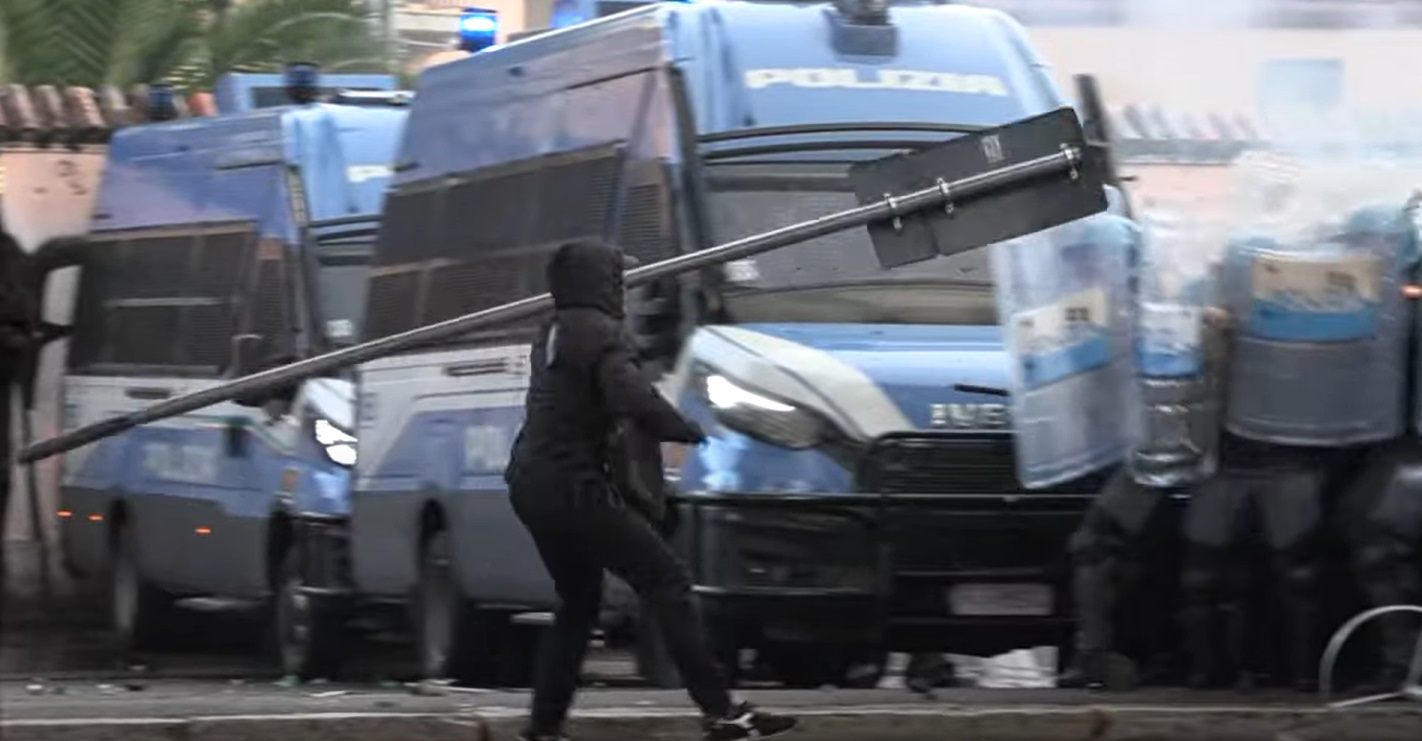
A pro-Palestinian demonstrator attacking the Italian police in Rome (YouTube screenshot; used in accordance with Clause 27a of the Copyright Law).
At least 30 police officers were injured on Saturday, October 5th, during a non-authorized pro-Palestinian demonstration that took place in Rome’s Piazza Ostiense. The scenes of masked agitators using street posts as rams against the police, throwing stones, bricks, metal objects, glass bottles, and any other object available that could cause injuries, have been seen worldwide. It is useless to say that cars and businesses were damaged as residents helplessly witnessed everything from their windows, but it is still a duty to recall it.
After weeks of deliberation by the Minister of the Interior, Matteo Piantedosi, it was decided not to authorize the demonstration due to the high risk it posed to public order, and because it was a celebration of the October 7th massacre.
However, despite the prohibition, the demonstration took place anyway, as the agitators challenged the government’s decision. Public order was disrupted as clashes broke out towards the end of the event. The officers present were insufficient in number and had to wait for reinforcement before being able to counterattack.
The “non-authorization” was already ambiguous as the Ministry prevented many demonstrators from reaching the site of the event by blocking them outside Rome, while at the same time allowing those who made it to Piazza Ostiense to gather there, closing them within the perimeter by blocking all exists to the square. Around 1 PM local time, rumors of a static demonstration being allowed by the authorities went viral among the demonstrators.
Real-time camera footages showed demonstrators reaching the event location without difficulties while anti-riot police were already on the site.
Palestinian, Iranian, Yemeni and yellow Hezbollah flags were displayed by the crowd while various far-left and Palestinian activists from groups such as CARC, Arab-Palestinian Democratic Union (UDAP), OSA, Communist Network, Cobas, Potere al Popolo, and the Palestinian Youth held speeches attacking Israel, the United States, the Italian government, all in the name of “anti-imperialism” and “anti-Zionism”.
On Sunday, one of the far-left groups present at the demonstration, CARC, celebrated the mess and incited more public order disruption. The objective? Generate a political problem for the government, overthrow it, and install a “popular block government” (whatever that means).
Tactically speaking, closing the demonstration within a perimeter could have made sense only if followed by a precise operation to defuse the initiative, but this was not the case. The impression is that, once again, the idea was to keep one foot in two camps, officially banning the demonstration, but tolerating a “sit-in” in the hope that the situation would not get out of hand for the authorities. Unfortunately, it did.
If a demonstration is not authorized, then it must be prevented from taking place. Plain and simple. Most of the groups and agitators active on Saturday were very likely known to the Italian security apparatus. As a matter of fact, Italy often praises its longstanding experience in contrasting domestic far-left and far-right extremism.
Since October 7th, Italy has seen a concerning increase in violent rhetoric, both from far-left groups, Palestinian, and Islamist areas. Extremism, if allowed to spread, inevitably leads to violent actions and that is exactly what happened in Rome on Saturday, October 5th.
The line pursued by the Italian Ministry of Interior, based on the concept of “letting people vent”, “letting people “express their opinions”, has proven to be a failure. The narrative of hatred, violence, has spread like wildfire. This is not “freedom of expression”, it is pure hate, ideological extremism, which inevitably leads to violence.
In recent months, we have gone from the glorification from mosque pulpits of Hamas, of terrorists, and antisemitic statements, to blacklists and incitements to “action” against “Zionist enemies”, including “house marking” (just like during the Nazi era). Websites and social pages inciting hatred should have been closed by now but, instead, they are still online and active.
If the Italian government had acted in due time with the necessary firmness, perhaps we would not have reached this point. The resignation of Minister Piantedosi could be a first step towards a firmer and more effective government line on security, since Italy will most likely see a very “hot” fall season, from a public order perspective. Leaving things as they are, will possibly lead to a disaster.
Related Topics