
Where history exposes power and moral failure
The Problem of Collective Responsibility
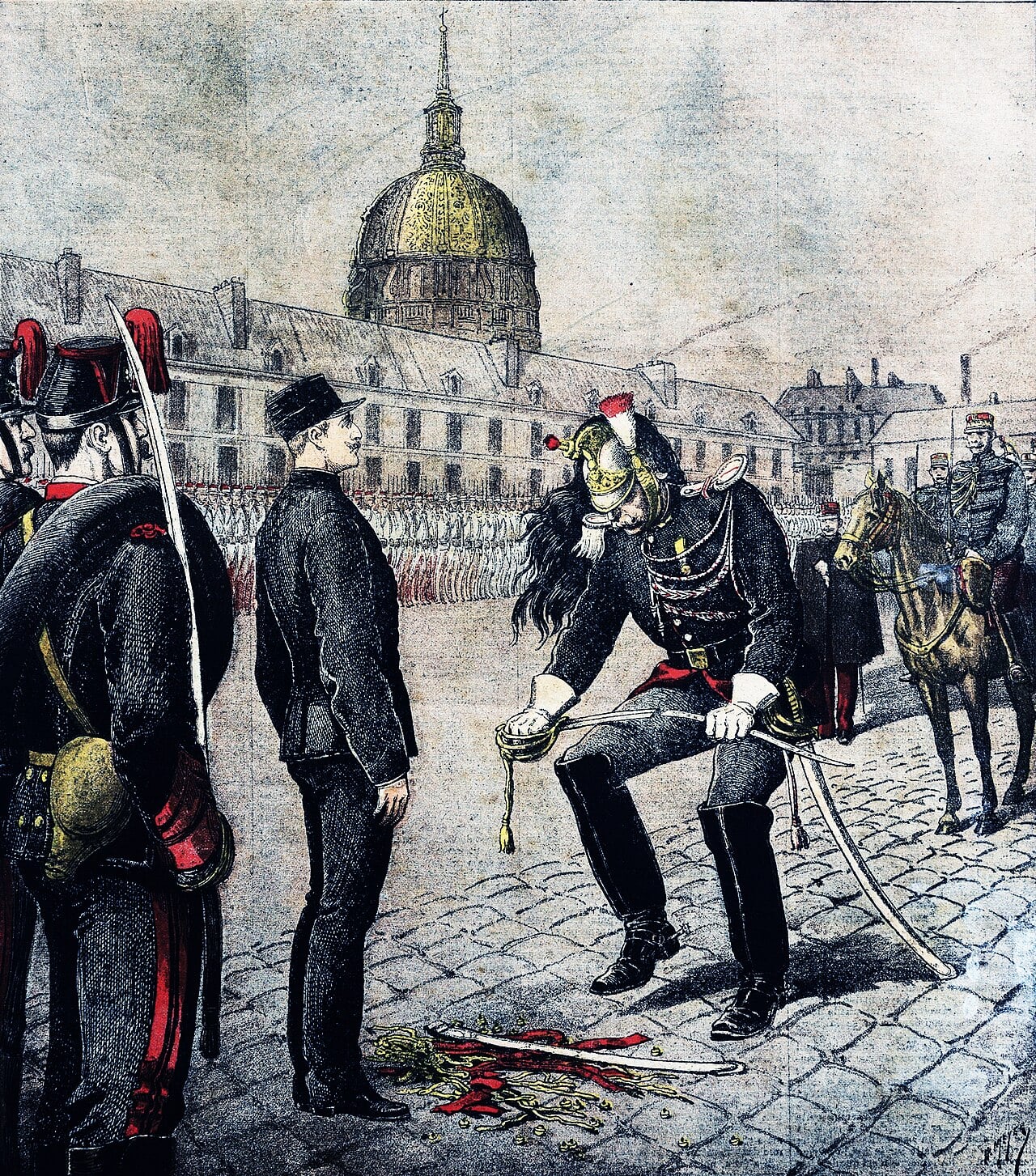
The public degradation of Captain Alfred Dreyfus at the École Militaire, Paris, January 5, 1895. Illustration by Henri Meyer for Le Petit Journal (1895). Public domain.
Mandy Patinkin said something imprecise, frightening, and partly true in The New York Times. Speaking of Benjamin Netanyahu’s government, he argued that it was endangering the State of Israel and Jews around the world. The response came quickly. Unpacked accused him of victim-blaming, of giving antisemites a free pass, of engaging in Holocaust inversion. The reply had its own force. Antisemites are responsible for antisemitism. A man who attacks a synagogue does not acquire innocence because a foreign government behaved badly. Hatred does not become clean because it has found a newspaper headline to hide behind.
Patinkin was not wrong to notice danger traveling outward from state action. Unpacked was not wrong to insist that pretext is not cause. The historian’s irritation begins where both arguments start using old categories too quickly. Consequence is not guilt. Explanation is not absolution. Criticism of a government is not automatically an indictment of a people. Protection of a people is not automatically a defense of every act committed by a government that claims to protect them.
Medieval France supplies one older version of the trap. Jews were not persecuted because a particular Jewish resident of Blois, Troyes, Paris, or Rouen had personally caused Christian suffering. They were made answerable as a category. Jewish communities had existed in southern France since antiquity and spread widely through medieval France by the eleventh to fourteenth centuries, with open neighborhoods organized around synagogues, schools, ritual baths, and butcher shops. After the First Crusade massacres of 1096, their situation deteriorated into exclusion from professions, exorbitant taxation, defamatory badges, ritual-crime accusations such as Blois in 1171, the burning of Hebrew manuscripts under Louis IX, Black Death well-poisoning accusations, expulsions, confiscations, and the conversion of synagogues into churches. The category did the work. Jewishness itself became usable suspicion. That history does not mean government action is irrelevant to public danger. It means the person hurling a stone at a synagogue owns the stone, the arm, and the hatred, even when a government somewhere else has behaved with brutality, arrogance, or strategic stupidity.
The Dreyfus Affair gave the mechanism a modern uniform. Captain Alfred Dreyfus was one French artillery officer, not the governing committee of world Jewry, though the antisemitic press of the 1890s had little use for that distinction. His trial for treason, his degradation in the courtyard of the École Militaire, the forged documents, the secret dossier, the army’s need to protect itself, the furious newspaper culture surrounding the case: all of it turned one man into proof of an accusation that had been waiting for him. Émile Zola’s “J’Accuse…!” defended Dreyfus, but it also exposed the appetite for a Jewish traitor. France had discovered a man. Antisemitism had discovered a specimen.
By the early twentieth century, the accusation had become remarkably portable. The Protocols of the Elders of Zion, forged in the Russian Empire and distributed across Europe, offered readers the comforting illusion of documentation. Minutes. Meetings. Plans. Signatures. The forgery succeeded because it provided what conspiracy theories always crave: paperwork. Once accepted, it transformed every development into evidence of the same conclusion. Financial instability became proof. Revolution became proof. Liberalism became proof. Nationalism became proof. Contradiction ceased to be a problem. A population blamed for mutually exclusive crimes can be blamed for anything.
The Bolshevik Revolution added another layer. The myth of Judeo-Bolshevism spread across Europe despite the obvious reality that Jews occupied every conceivable position in relation to communism. Some were revolutionaries. Some were liberals. Some were conservatives. Some fled the Bolsheviks. Some were murdered by them. The category absorbed these distinctions without difficulty. A Jewish shopkeeper in Warsaw and a Communist official in Moscow could be assigned the same political identity because the accusation did not require accuracy. It required collectivity.
The Soviet Union inherited the habit while changing the vocabulary. Stalin’s campaigns against “rootless cosmopolitans” and later anti-Zionist campaigns rarely relied on the language of medieval theology. They did not need to. The old structure survived beneath newer ideological clothing. Entire populations became suspect through association. Loyalty became a matter not of conduct but of presumed affiliation. The accusation could move from religion to race to ideology without losing its essential shape.
A peculiar feature of this history is that the accusation often works in opposite directions simultaneously. Jews have been condemned for insufficient attachment to a nation and excessive attachment to a nation. They have been accused of dangerous cosmopolitanism and dangerous nationalism. They have been portrayed as disloyal outsiders and as hyper-coordinated insiders. The content shifts according to circumstance. The demand remains remarkably stable: explain yourself. Declare your loyalties. Account for others.
That demand has not disappeared. It has merely become more sophisticated. A contemporary Jewish dissenter who criticizes Israeli military action may find himself accused of providing cover for antisemites. A contemporary Jewish supporter of Israeli military action may find herself treated as personally answerable for decisions made by a government in which she holds no office and casts no vote. The disagreement concerns a war. The accusation concerns identity. Political arguments become arguments about authenticity.
This is where the Patinkin exchange becomes more interesting than the particulars of Netanyahu’s government. Patinkin was not speaking as a cabinet minister. He was speaking as an American Jewish actor. The response he received was not solely a disagreement about military policy. It was a disagreement about the consequences of saying certain things as a Jew in public. Beneath the exchange sits an older question: when does criticism become betrayal, and who gets to decide?
Jewish political disagreement is not a recent development requiring explanation, nor is it a private matter only insiders can notice. Historians routinely study the political arguments of communities to which they do not personally belong; otherwise most of modern European history would be impossible to write. Religious anti-Zionists, Labor Zionists, Revisionist Zionists, Bundists, liberal Zionists, socialists, conservatives, assimilationists, territorialists, sociologists, psychologists, historians, and countless others argued in newspapers, congresses, synagogues, party meetings, universities, kitchens, universities, and streets for more than a century.
The existence of disagreement is ordinary. The insistence that disagreement threatens collective legitimacy belongs to a far more dangerous archive.
Selected Sources
Arendt, Hannah. The Origins of Totalitarianism. New York: Harcourt, 1951.
Beller, Steven. Antisemitism: A Very Short Introduction. Oxford: Oxford University Press, 2007.
Cohn, Norman. Warrant for Genocide: The Myth of the Jewish World-Conspiracy and the Protocols of the Elders of Zion. London: Eyre & Spottiswoode, 1967.
Hanebrink, Paul. A Specter Haunting Europe: The Myth of Judeo-Bolshevism. Cambridge, MA: Harvard University Press, 2018.
Harris, Ruth. Dreyfus: Politics, Emotion, and the Scandal of the Century. New York: Metropolitan Books, 2010.
Hertzberg, Arthur, ed. The Zionist Idea: A Historical Analysis and Reader. Philadelphia: Jewish Publication Society, 1959.
Jewish Museum of Art and History. “Jews in France in the Middle Ages.” mahJ Permanent Collection. Accessed June 24, 2026.
Kieval, Hillel J. Blood Inscriptions: Science, Modernity, and Ritual Murder at Europe’s Fin de Siècle. Philadelphia: University of Pennsylvania Press, 2022.
Klier, John D. Russians, Jews, and the Pogroms of 1881–1882. Cambridge: Cambridge University Press, 2011.
Laqueur, Walter. A History of Zionism. New York: Schocken Books, 2003.
Lipstadt, Deborah E. Antisemitism: Here and Now. New York: Schocken Books, 2019.
Mendes-Flohr, Paul, and Jehuda Reinharz, eds. The Jew in the Modern World: A Documentary History. 3rd ed. Oxford: Oxford University Press, 2010.
Mosse, George L. Toward the Final Solution: A History of European Racism. Madison: University of Wisconsin Press, 1985.
Poliakov, Léon. The History of Anti-Semitism. 4 vols. Philadelphia: University of Pennsylvania Press, 2003.
Samuels, Maurice. Alfred Dreyfus: The Man at the Center of the Affair. New Haven: Yale University Press, 2024.
United States Holocaust Memorial Museum. “Protocols of the Elders of Zion.” Holocaust Encyclopedia. Accessed June 24, 2026.
Zola, Émile. “J’Accuse…!” L’Aurore, January 13, 1898.
Related Topics