The Protocols of Contradiction
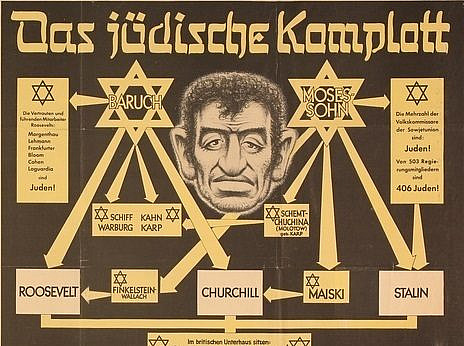
Antisemitism endures not because its claims are coherent, but because its contradictions remain endlessly adaptable to the needs of each moment in which they surface.
I recently encountered a description of antisemitism that was unsettling, not because it was hateful, but because it was explicit and precise. It described a process:
First, Jews are turned into abstractions. Individual lives, beliefs, histories, and differences are erased until a people is flattened into abstract form.
Second, contradiction is layered onto that abstraction. Jews are portrayed as simultaneously powerful and weak, global and insular, dominant and illegitimate. These inconsistencies are never resolved because they are not meant to be. They are meant to persist.
Third, internal differences are deliberately exploited. Jewish communities have always contained disagreement across religious, cultural, and political lines. What changes is how those differences are highlighted, judged, and weaponized. Disagreement is emphasized, reframed as measures of validity, and used to question legitimacy, hardening divisions.
As cohesion weakens, blame becomes easier to assign. Responsibility shifts away from specific actions and settles on an entire people. Painting groups with broad brush strokes is a common human impulse. Antisemitism goes much further. With contradiction doing the work, any outcome can be read as confirmation, and no evidence can disprove the claim. Contradiction is not accidental. It is the mechanism.
This structure did not emerge spontaneously.
The Protocols of the Elders of Zion was a short pamphlet circulated in early twentieth-century Russia as a purported exposé of Jewish power. Courts, journalists, and historians later demonstrated that it was a fabrication produced by figures connected to tsarist authorities. Regardless, it spread quickly and widely.
Its significance lies less in its content than in its design. The Protocols offered a blueprint for conspiracy thinking. Jews were recast as a single hidden force, contradiction was embedded into the narrative, and blame was detached from evidence. The pamphlet offered convenient explanations for the anxieties of its time. Once it took hold, it no longer needed to physically circulate. The blueprint persisted.
Beyond falsely accusing Jews of ritual violence, the pamphlet attributed political instability, economic crises, social change, and moral decline to a single sinister hand. Jews were accused of manipulating governments and revolutions, controlling finance and debt, corrupting the press, undermining religion and family, and exploiting both elites and minorities. Liberalism and authoritarianism were blamed, in parallel, on Jewish influence. Whatever went wrong, Jews were responsible.
Seen through a modern lens, the method is familiar. Fiction abounds and is accepted as fact because repetition substitutes for verification. Absent context, authority is implied rather than earned. Fragments are stripped of their surrounding facts and presented as proof. Misinformation, “fake news,” inverted headlines, AI-driven memes, and social media posts amplify the spread faster than correction can keep up. The blueprint has changed form, not function, and survives.
A more recent evolution builds on the same structure by denying Jewish peoplehood altogether. Jews are recast as “White Europeans,” “colonizers,” “Khazars,” or “land thieves,” while still being held collectively responsible as Jews. Hatred remains constant even as identity is denied. Jews are blamed as a people and then told they are not a people at all, asserted to have no connection to their history, their ancestral land, or to B’nai Yisrael, the Children of Jacob, and the Twelve Tribes of Israel, despite millennia of continuous presence and record.
This denial relies on selective memory. Entire Jewish populations from the Middle East and North Africa were expelled or fled under violence in the twentieth century, with most finding refuge in Israel. Their histories complicate the colonizer narrative and are therefore sidelined. The inconvenient truth of Jewish continuity is rendered irrelevant.
Numbers expose the contradiction further. Jews make up roughly 0.2% of the world’s population, yet are routinely described as wielding outsized influence over governments, finance, media, and culture. They are framed as uniquely powerful, uniquely suspect, and uniquely responsible. Jews are too global and too tribal. Too capitalist and too socialist. Too assimilated to be trusted and too separate to be accepted. They are marginal and illegitimate, yet powerful enough to orchestrate global outcomes. Each charge negates the last without canceling it. The beliefs persist not because they are plausible, but because plausibility is not required.
The same structure governs how Israel is treated in global discourse. Civilian casualties are consistently emphasized, while the circumstances in which they occur receive far less attention. Other conflicts with much higher death tolls are downplayed or omitted from discussion, and when invoked are frequently dismissed as “whataboutism.” In Israel’s case, casualties are more readily interpreted as evidence of intent.
When Israeli governments respond to provocation, their actions are treated as if they appeared out of nowhere. They are not framed as political or security decisions, but as proof of malice, unlike the responses of other actors on the world stage. This framing travels outward, attaching itself to Jews everywhere. Regardless of citizenship, belief, or proximity, Jews are blamed and targeted.
Serious critiques of the Israeli government deserve engagement. The problem begins when critique hardens into a single story that attempts to explain everything. Power itself becomes proof of guilt. Historical, genetic, and archaeological facts are twisted, dismissed, or ignored to make that guilt stick. Palestinian actions are treated only as reactions, while Israeli actions are treated as proof of culpability. A vicious cycle follows: blame fuels outrage, outrage fuels distortion, and distortion reinforces blame.
The same inversion applies to civic engagement itself: advocacy and lobbying, ordinarily understood as democratic participation, are reframed as manipulation or corrupt influence when Jews engage in them.
In this environment, antisemitism is often recast as something else. “Anti-Zionism” frequently functions as a linguistic shield, allowing animus toward Jews to circulate under the cover of political critique. The language of morality is used without moral responsibility. Social reward and inclusivity increasingly flow to those who repeat accusations built on partial or false information.
This dynamic is visible in how certain Jewish organizations are elevated as moral gatekeepers. Despite their peaceful-sounding names, groups such as “Jewish Voice for Peace,” “If Not Now,” and “Peace Now” advance positions that are Anti-Zionist in substance. Jewish identity itself merely exists as a purported credential. Those who publicly distance themselves from Zionism are treated as acceptable representatives, while others are cast as suspect. The contradiction surfaces again, with names connoting peace and reconciliation while advancing frameworks that reject Jewish national existence and collective self-determination.
The language used reduces serious debate to accusatory tropes. Terms such as “ethnic cleansing,” “genocide,” “apartheid,” “open-air prison,” “dual loyalty,” and “baby killers” circulate widely. Detached from context, their inflammatory nature overrides reason and turns them into automatic, default responses. Once widely repeated, any attempt at correction is dismissed as self-interested or manipulative. Silence and response are equally condemned.
Jewish communities have never been monolithic. Orthodox, Conservative, Reform, Reconstructionist, Hasidic, secular, and progressive; Ashkenazi, Sephardi, Mizrahi. Disagreement itself is not new. What is new is how that disagreement is deliberately exploited.
Jewish texts are scrutinized, mined, and selectively quoted with an intensity rarely applied to any other religion. The natural contradictions that arise in a tradition spanning thousands of years are amplified, keeping trope creation and adoption continuous.
Virality on the Internet accelerates the process. Platforms reward outrage over nuance, allowing contradiction to persist without challenge. Groupthink and radicalization take hold.
This is precisely why definitions and clarity matter. The IHRA working definition of antisemitism identifies recurring patterns by which Jews are targeted through abstraction, contradiction, and collective blame. When language blurs responsibility, the absence of clear definitions does not produce neutrality. It produces permission.
Persistent contradictions give rise to demonization, delegitimization, and double standards. When societies permit these contradictions to perpetuate, they are not neutral observers but participants in the conditions that make antisemitism acceptable. History shows that when this logic is accepted and applied to one of the smallest minorities on earth, it does not stop with Jews.
This cannot be explained away. It cannot be outpaced. It cannot be neutralized by hiding identity, muting culture, or softening language. A system that has been normalized cannot be reasoned with after the fact.
So, now what?